初詣
hatsumodeThe first shrine or temple visit of the New Year, one of Japan's most beloved and widely-observed annual traditions.
Meaning
初詣 (はつもうで, hatsumode) refers to the first visit to a 神社 (shrine) or 寺 (temple) after the beginning of the 新年 (New Year). The word combines 初 (hatsu, "first" or "beginning") and 詣 (mōde, "shrine visit" or "pilgrimage"). Together the characters convey the sense of making one's inaugural act of 参拝 (worship or visit) in the new year.
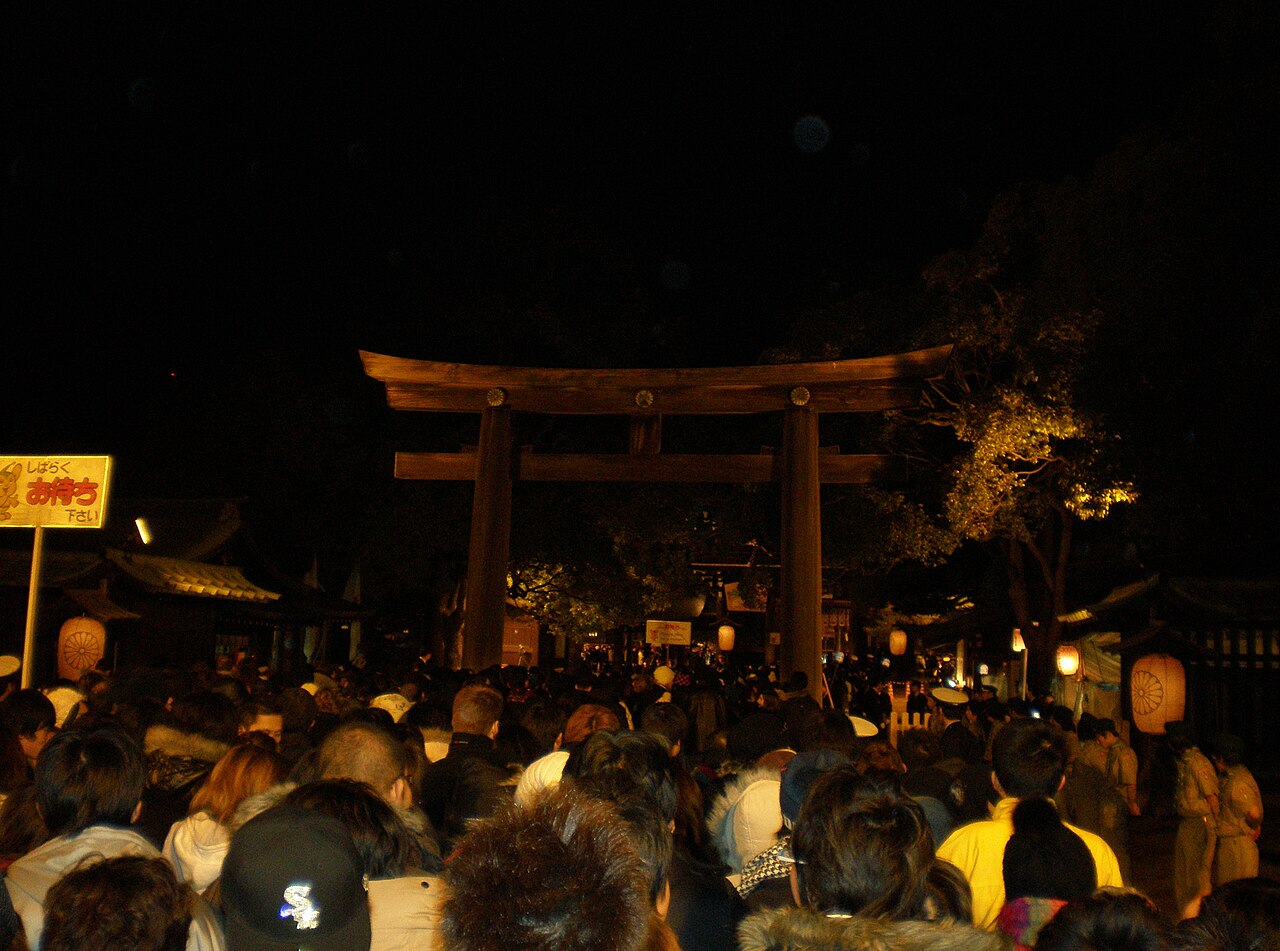
Worshippers walking the sando (approach path) beneath the great 鳥居 at Meiji Shrine during New Year hatsumode. Photo: おむこさん志望, CC BY 3.0, via Wikimedia Commons.
Hatsumode is not a solemn religious obligation but rather a warmly anticipated cultural event. People of all ages participate — from grandparents to young children — and the mood at popular shrines blends reverence with the festive atmosphere of お正月 (New Year celebrations). Both 神道 (Shinto) shrines and 仏教 (Buddhist) temples welcome hatsumode visitors, reflecting the longstanding coexistence of these two traditions in Japanese life.
When It Happens
The traditional hatsumode period runs from January 1 through January 3 — the first three days of the new year, known collectively as san-ga-nichi (三が日). January 1 (元日, ganjitsu) is considered the most auspicious day, and it is common for devout visitors to arrive at midnight as the new year begins. Major shrines count visitors through the entire three-day period.
While purists observe the three-day window, many people extend their hatsumode visit through the first week or even the first two weeks of January. Broadly, any visit made before Koshōgatsu (小正月, January 15) can still be considered hatsumode.
What People Do
A hatsumode visit follows a familiar sequence of activities, though not all are obligatory:
Approaching the Shrine
Visitors walk the sando (参道), the tree-lined path leading to the main hall. At the entrance stands a 鳥居 (torii gate), marking the transition into sacred ground. Before approaching the hall, visitors purify their hands and mouth at the temizuya (手水舎), a stone basin of running water — a ritual act of cleansing called temizu or chōzu.
Offerings and Prayer
At the main hall (honden or hondō), visitors toss a coin into the saisen-bako (賽銭箱, offertory box), ring a bell if one is present, bow twice, clap their hands twice, offer a silent 祈願 (prayer or wish), and bow once more. This two-bow, two-clap sequence is standard Shinto etiquette at most shrines.
The nature of the prayers varies widely: health for the family, success in studies or work, safety in travel, a good marriage, or simply gratitude for the year just ended.
Omamori — Lucky Charms
One of the most popular activities is purchasing a new お守り (omamori), a small brocade amulet said to carry a deity's protection. Common types include:
| Type | Purpose |
|---|---|
| 健康守り (kenkō mamori) | Health and wellness |
| 学業守り (gakugyō mamori) | Academic success |
| 交通安全守り (kōtsū anzen mamori) | Traffic safety |
| 縁結び守り (enmusubi mamori) | Love and relationships |
| 商売繁盛守り (shōbai hanjō mamori) | Business prosperity |
Crucially, old omamori from the previous year are returned to the shrine, not discarded at home. Shrines collect and ceremonially burn them in a ritual called otakiage (お焚き上げ), releasing the deity's spirit. Keeping an old charm is considered bad luck.
Omikuji — Fortune Strips
Omikuji (御神籤) are paper fortune strips drawn at random from a box or cylinder. Each slip reveals one's fortune for the coming year on a scale ranging from 大吉 (daikichi, "great blessing") down through several middle grades to 大凶 (daikyō, "great curse"). The full traditional scale in descending order is:
大吉 → 吉 → 中吉 → 小吉 → 末吉 → 凶 → 大凶
If the fortune is good, visitors keep the slip. If it is unfavorable, the custom is to tie it to a wire rack or pine branch provided by the shrine, leaving the bad luck behind. The word play omikuji o kiku (御神籤を引く, "to draw a fortune") is itself a new year staple in everyday conversation.
Ema — Votive Plaques
絵馬 (ema) are small wooden plaques on which visitors write a specific wish and hang it at the shrine. The word literally means "picture horse," referring to the historical practice of donating a real horse to a shrine — later replaced by a painted image, and eventually by the small wooden votive plaques used today. During hatsumode, the racks where ema are hung fill up quickly with thousands of wishes.
Famous Hatsumode Destinations
The scale of hatsumode in Japan is staggering. Across the country, an estimated 100 million people visit a shrine or temple during the first three days of January — roughly 80% of the Japanese population. The most visited destinations over that three-day period include:
| Shrine / Temple | Location | 3-Day Visitors (approx.) |
|---|---|---|
| 明治神宮 (Meiji Jingū) | Tokyo | ~3.2 million |
| 成田山新勝寺 (Naritasan Shinshōji) | Chiba | ~3 million |
| 川崎大師 (Kawasaki Daishi) | Kawasaki | ~3 million |
| 伏見稲荷大社 (Fushimi Inari Taisha) | Kyoto | ~2.7 million |
| 住吉大社 (Sumiyoshi Taisha) | Osaka | ~2.6 million |
| 鶴岡八幡宮 (Tsurugaoka Hachimangū) | Kamakura | ~2 million |
Queues at major shrines can stretch for hours. It is common to wait two to three hours simply to reach the offertory box at Meiji Jingū on January 1.
Cultural Context
The custom of visiting a shrine at the start of the new year has ancient roots in Japan. In the Heian period (794–1185), aristocrats observed a practice called toshigomori (年籠り), spending the night of New Year's Eve inside their local tutelary shrine in prayer. The head of a household would visit the shrines in each of the four cardinal directions — a practice called etchū-mairi (恵方詣り) — to gather blessings.
The modern form of hatsumode, involving travel to major shrines regardless of direction, spread during the Meiji era (1868–1912), partly driven by the expansion of railway networks. Train companies began offering New Year discount passes, and newspapers published rankings of popular shrines. This commercialization helped transform a local neighborhood custom into a national event.
Hatsumode cuts across religious denomination in a way that can seem surprising to those from monotheistic traditions. Many Japanese people who do not identify as particularly Shinto or Buddhist nonetheless visit shrines or temples for hatsumode. The practice is often described as nenchū gyōji (年中行事) — an annual seasonal custom — as much as a religious act. It is understood as a way of marking the passage of time, expressing gratitude, and setting intentions for the year ahead.
Hatsumode is also deeply social. Families attend together, groups of friends coordinate visits, and couples often include hatsumode as part of their New Year plans. The festive food stalls (yatai) that line the approach to major shrines — selling amazake (sweet rice wine), yakitori, taiyaki, and oden — add to the carnival atmosphere.
Seeing the First Sunrise
Some visitors combine hatsumode with watching 初日の出 (hatsu hinode), the first sunrise of the new year. Popular spots include mountaintops, coastal promontories, and the upper floors of tall buildings. Watching the sun rise on January 1 is considered deeply auspicious, and the combination of sunrise-watching followed by a shrine visit makes for an immersive way to welcome the new year.
Related Customs
- Nengajō (年賀状): New Year greeting cards sent to arrive on January 1, the postal equivalent of well-wishing done through hatsumode.
- Otoshidama (お年玉): Money given in envelopes to children during the New Year period.
- Kadomatsu (門松): Pine and bamboo decorations placed outside homes to welcome the 神 (deity or spirit) of the new year.
- Osechi (おせち): Traditional New Year foods eaten over the first three days, each dish carrying a symbolic meaning for the coming year.
Related Dictionary Words
first shrine visit of the New Year
Shinto shrine
temple (Buddhist)
charm; amulet; talisman
votive tablet; wooden tablet usu. filled out with a prayer and one's name and hung up at a shrine or temple; orig. picturing a horse, as a stand-in for a donation of a live horse
going and worshipping (at a shrine or temple); visit (to a shrine or temple to worship)
prayer (for something); supplication
New Year
New Year (esp. first three days)
torii (Shinto shrine archway)
Shinto; Shintoism
Buddhism