歌川広重
Utagawa HiroshigeThe Edo-period ukiyo-e master of atmospheric landscapes and "Hiroshige blue," best known for The Fifty-three Stations of the Tōkaidō and prints that captivated Van Gogh and Monet.
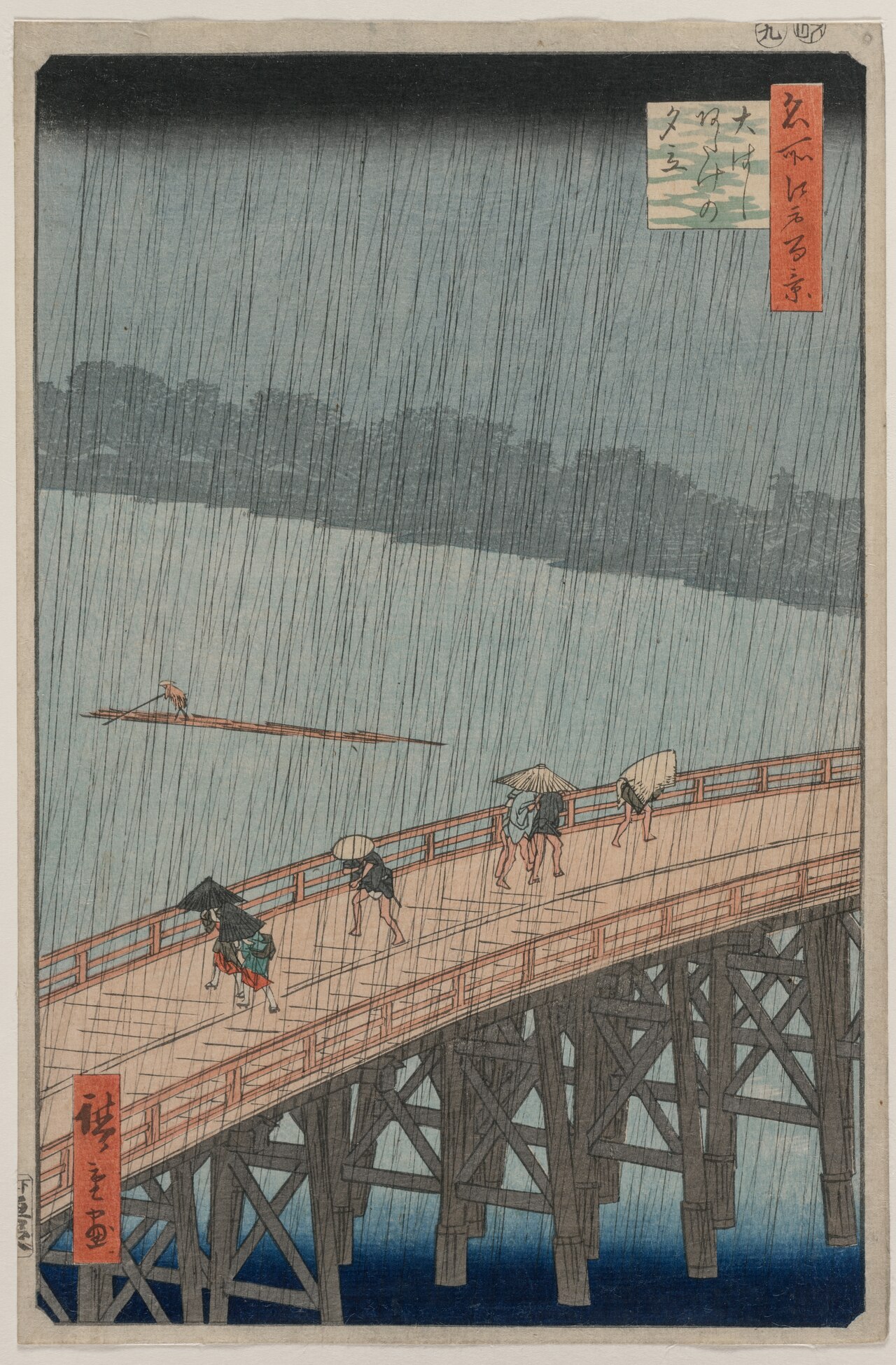
"Sudden Shower over Shin-Ōhashi Bridge and Atake" (大はしあたけの夕立), from Hiroshige's series One Hundred Famous Views of Edo, 1857. This is the print Vincent van Gogh copied in oil paint. CC0, Cleveland Museum of Art, via Wikimedia Commons.
Utagawa Hiroshige (歌川広重, 1797–1858) was a master of 浮世絵 (ukiyo-e, "pictures of the floating world") who spent his career doing something almost no other 絵師 of his era attempted: making the 風景 itself — rain, mist, snow, moonlight, the hush of a riverbank at dusk — the true subject of the picture, with people reduced to small, human-scaled figures moving through it. Alongside 葛飾北斎, he is remembered as one of the last great masters of the ukiyo-e tradition, and one of the two Japanese artists whose prints did the most to reshape Western painting in the 19th century.
Meaning
Hiroshige was born in 1797 in 江戸 (modern Tokyo), the son of a low-ranking fire warden attached to the Edo Castle fire brigade. He inherited his father's post as a young man and held it for years while training as a painter on the side, eventually giving it up around 1823 to pursue 芸術 full time. He studied under Utagawa Toyohiro of the Utagawa school — the same print workshop tradition, though a different branch, from the one Hokusai had trained in decades earlier — and took the 雅号 (art-name) Hiroshige, by which he is known today.
His breakthrough came in 1832, when he reportedly traveled the 東海道 (Tōkaidō), the great coastal highway linking Edo to Kyoto, as part of an official shogunate delegation. The trip resulted in 東海道五十三次 (Tōkaidō Gojūsan-tsugi, "The Fifty-three Stations of the Tōkaidō"), a series of 55 full-color 錦絵 prints depicting each of the highway's post towns plus its two endpoints. Unlike earlier travel prints that mainly catalogued famous sights, Hiroshige's stations are full of weather, season, and mood — travelers hunched against wind and rain, ferries crossing swollen rivers, inns glowing at dusk. The series was an immediate commercial hit and made his career.
He followed it with dozens more series over the next quarter-century, most famously 名所江戸百景 (Meisho Edo Hyakkei, "One Hundred Famous Views of Edo," 1856–1858), 118 prints of his home city completed in the final years of his life, capturing Edo's bridges, shrines, fireworks, and back-alley shops with the same atmospheric intimacy he had brought to the open road. Some of these late prints even experiment with Western-style 遠近法 (linear perspective) and unusually cropped, close-up viewpoints, absorbed indirectly through Dutch prints that trickled into Japan despite its era of national seclusion. He died in the great cholera epidemic of 1858, reportedly leaving behind a poem noting he was leaving his brush in the "Eastern Capital" to go sightsee in the Western Paradise.
Hiroshige Blue
Hiroshige's landscapes are instantly recognizable for their 色 — specifically a deep, saturated blue used for skies, water, and rain that came to be nicknamed "Hiroshige blue" in the West. The pigment behind it was bero-ai (ベロ藍, literally "Berlin indigo"), the Japanese name for Prussian blue, a synthetic dye first developed in Europe in the early 1700s and imported to Japan via Dutch traders through the port of Nagasaki starting in the late 1820s.
Before Prussian blue became available, ukiyo-e artists relied on 藍 (natural indigo), a pigment that faded and shifted toward green over time. Prussian blue was colorfast, could be diluted into a wide range of tones from near-black to pale sky blue, and printed with a clarity Japanese pigments couldn't match. Hokusai was among the first ukiyo-e artists to adopt it widely (it defines the sky and sea in The Great Wave), but it was Hiroshige who built an entire visual signature around it — graduated blue skies (a technique called bokashi, gradation printing, where the carver and printer blend pigment density across a single block) that suggest time of day, weather, and distance all at once. That gradation technique, combined with his use of rain as a compositional device — diagonal lines of falling rain rendered as thin, precisely carved slivers cut across an entire print — became his most imitated innovation.
Hiroshige vs. Hokusai
Hiroshige and Hokusai are so often paired as "the last two great ukiyo-e masters" that it's worth being precise about how their work differs:
| Hokusai | Hiroshige | |
|---|---|---|
| Generation | Older (1760–1849) | Younger (1797–1858) |
| Signature series | 富嶽三十六景 (Thirty-six Views of 富士山) | 東海道五十三次, Meisho Edo Hyakkei |
| Compositional style | Bold, dynamic, exaggerated — towering waves, dramatic 構図 (composition) | Serene, atmospheric — 静寂 (stillness), weather, quiet moments |
| Recurring subject | Mount Fuji viewed from many angles | Travel roads and Edo cityscapes across the seasons |
| Signature technique | Bold outline, flattened perspective, near-abstract shapes | Bokashi color gradation, rain and snow effects, "Hiroshige blue" |
| Best-known single print | Under the Wave off Kanagawa (The Great Wave) | Sudden Shower over Shin-Ōhashi Bridge and Atake |
Where Hokusai's Great Wave grabs the eye with raw force, Hiroshige's prints reward lingering — a kind of visual 郷愁 (wistful nostalgia) that later Western critics often described using the vocabulary of mood and atmosphere rather than drama. Van Gogh, tellingly, copied Hiroshige rather than Hokusai when he wanted to study Japanese art most closely — he made oil-paint copies of both the Sudden Shower print above and Hiroshige's Plum Park in Kameido, tracing the compositions almost line for line while adding a border of invented kanji-like characters around the edges.
Usage
Hiroshige's name and works are cited constantly in art history and travel contexts:
歌川広重の「東海道五十三次」は、江戸時代の旅を描いた代表的な浮世絵シリーズです。 Hiroshige no "Tōkaidō Gojūsan-tsugi" wa, Edo jidai no tabi o egaita daihyōteki na ukiyo-e shirīzu desu. "Hiroshige's 'Fifty-three Stations of the Tōkaidō' is a representative ukiyo-e series depicting travel in the Edo period."
広重の青は「広重ブルー」と呼ばれ、西洋の画家たちにも大きな影響を与えた。 Hiroshige no ao wa "Hiroshige Burū" to yobare, seiyō no gakatachi ni mo ōkina eikyō o ataeta. "Hiroshige's blue is called 'Hiroshige Blue,' and it had a major influence on Western painters too."
Museum wall text and print catalogues often use 名所絵 (meisho-e, "famous-place pictures") as the broader genre term for Hiroshige's landscape and travel prints, distinguishing them from bijin-ga (portraits of beautiful women) or yakusha-e (actor portraits) within the wider ukiyo-e tradition.
Cultural Context
Hiroshige worked at the tail end of the 江戸時代's ukiyo-e golden age, during a period when domestic travel within Japan was becoming newly fashionable. Under Tokugawa 幕府 (shogunate) rule, the Tōkaidō was tightly regulated and travel required permits, but pilgrimage, and eventually leisure travel, along its 53 stations had grown into a popular pastime for merchants and samurai alike by the early 1800s. Hiroshige's Tōkaidō prints functioned partly as travel advertising — something between a guidebook and a souvenir — for a public increasingly curious about a country most of them, under 鎖国-era restrictions on foreign travel, would never see beyond its own borders.
When Japan reopened to foreign trade in the 1850s and Japanese prints began circulating in Europe, Hiroshige's landscapes proved especially influential on the emerging Japonisme movement. Claude Monet, who owned Hiroshige prints among his large ukiyo-e collection, cited them as an influence on his own studies of weather and light — the same haystack or water-lily subject painted repeatedly under different atmospheric conditions echoes Hiroshige's practice of depicting one location across rain, snow, mist, and moonlight. Vincent van Gogh went furthest, directly copying two Hiroshige compositions in oil in 1887, and writing to his brother Theo that Japanese artists' close observation of nature showed a way of seeing he wanted to bring into his own work. Hiroshige's snow scenes and rain effects are also frequently cited as a bridge between ukiyo-e's flat decorative color and the loose, weather-sensitive brushwork the French 印象派 (Impressionists) developed independently a generation later.
Legacy Today
Hiroshige's prints remain among the most reproduced Japanese artworks in the world, second largely to Hokusai's Great Wave in sheer visibility. Sudden Shower over Shin-Ōhashi Bridge and Atake is regularly cited in art history courses as a textbook case of direct cross-cultural influence, precisely because Van Gogh's copy survives alongside the original and the two can be compared side by side. His "Hiroshige blue" gradation skies remain a recognizable visual shorthand for classical Japanese landscape art, referenced in everything from anime background art to contemporary graphic design. Museums including the Brooklyn Museum, the Museum of Fine Arts Boston, and the Tokyo Fuji Art Museum hold major Hiroshige collections, and complete sets of both the Tōkaidō and Edo Hyakkei series are considered among the most collectible ukiyo-e prints on the market today.
Related Terms
| Term | Reading | Meaning |
|---|---|---|
| 浮世絵 | ukiyo-e | The woodblock print tradition Hiroshige worked in |
| 東海道五十三次 | Tōkaidō Gojūsan-tsugi | "The Fifty-three Stations of the Tōkaidō," his breakthrough series |
| 名所江戸百景 | Meisho Edo Hyakkei | "One Hundred Famous Views of Edo," his final series |
| ベロ藍 | bero-ai | The Japanese name for Prussian blue, "Hiroshige blue" |
| ジャポニスム | Japonisme | The 19th-century European enthusiasm for Japanese art Hiroshige helped fuel |
Related Dictionary Words
ukiyo-e; ukiyoe; Edo-period woodblock print
painter; artist
scenery; scene; landscape; view; sight
Edo (shogunate capital; former name of Tokyo); Yedo
Edo period (1603-1868)
art; the arts
alias; pseudonym; pen name; nom de plume
Tōkaidō (Edo-period Edo-Kyoto highway)
fifty-three stations on the Tōkaidō (Edo-Kyoto highway in Edo-period Japan)
nishiki-e; multi-colour woodblock print
perspective
colour; color; hue; tint; tinge; shade
dyer's knotweed (Persicaria tinctoria, used to produce indigo dye)
Thirty-six Views of Mount Fuji (woodblock prints by Katsushika Hokusai)
Mount Fuji; Mt. Fuji; Fujiyama; Fuji-san
composition (of painting); structural outline; compositional arrangement
silence; stillness; quietness
nostalgia; homesickness
shogunate; bakufu
national isolation; closing the country (to foreigners)
Impressionists