居酒屋
izakayaA Japanese pub-style eatery where people gather to drink, share small plates of food, and socialize, forming a cornerstone of Japan's after-work culture.
Meaning
居酒屋 (izakaya) is best described as a Japanese gastropub — a hybrid between a bar and a casual restaurant where eating and drinking are equally important. The word breaks down into two parts: 居 (i, meaning "to stay" or "to sit") and 酒屋 (sakaya, meaning "liquor store" or "sake shop"). Together, the name evokes the idea of "a liquor shop where you linger" — which is precisely how the izakaya was born.
Unlike a formal restaurant, an izakaya is built for lingering. Customers order food and drinks throughout the evening, dishes arrive as they're ready rather than in courses, and the relaxed atmosphere encourages conversation and conviviality above all else.
History
The izakaya traces its roots to the Edo period (1603–1868), when sake shops began allowing customers to drink on the premises rather than taking their purchase home. These early sit-in sake shops — called izakaeri shops — were initially simple affairs: a mat on the floor, a cup of sake, perhaps a few pickled vegetables.
Around the mid-18th century, a pivotal evolution occurred when these drinking spots merged with shops selling simmered foods (niriuri), creating what we would recognize as the first true izakayas. By the early 19th century, Edo (present-day Tokyo) had over 1,800 registered izakayas — the single most common type of eating establishment in the city.
The Meiji era (1868–1912) and Japan's subsequent industrialization brought waves of workers to urban centers, and izakayas expanded to serve them. After World War II, as Japan rebuilt its economy and the salaryman class rose to prominence, the izakaya became deeply embedded in corporate and social life. The post-war boom through the 1960s and 70s cemented the izakaya's role as the default venue for after-work socializing.
The Experience
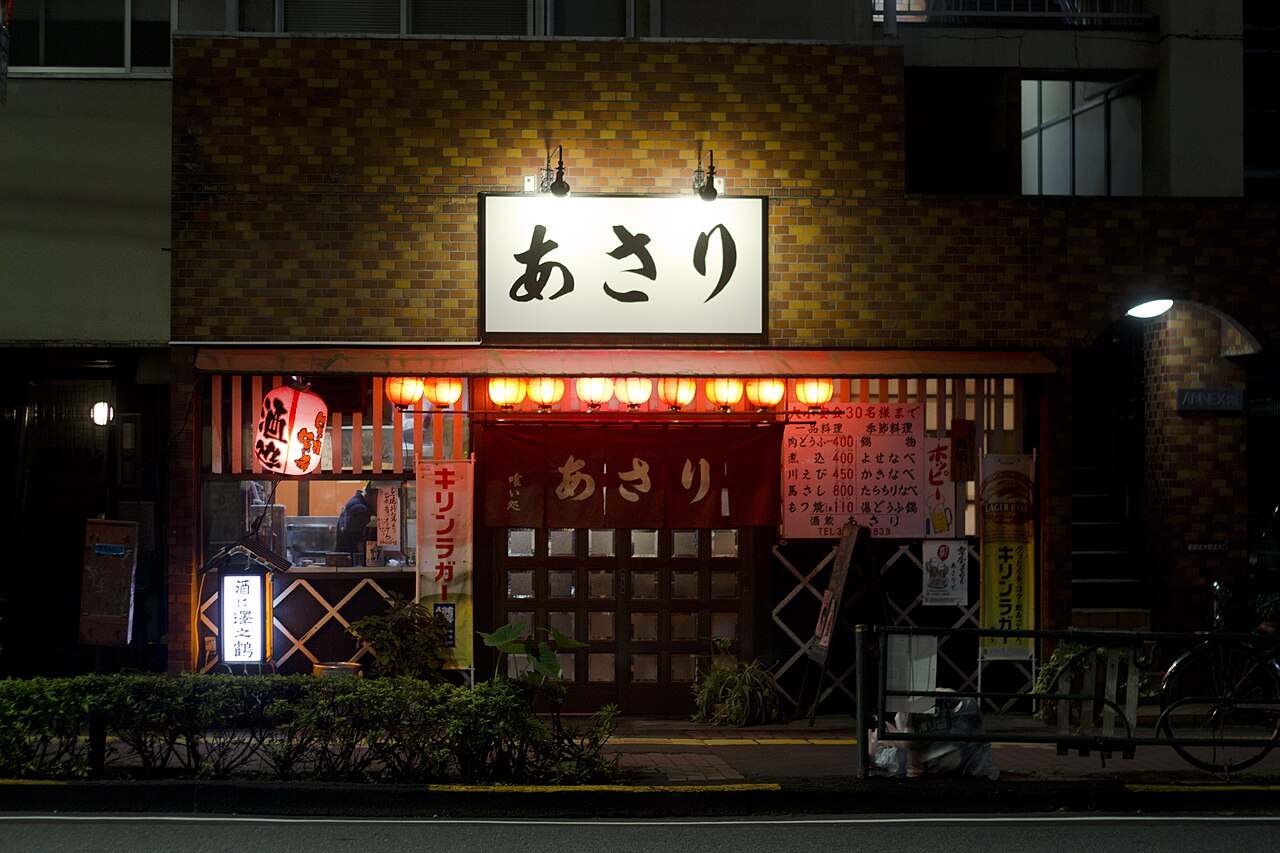
An izakaya exterior in the Gotanda district of Tokyo. Photo: Japanexperterna.se, CC BY-SA 3.0, via Wikimedia Commons.
Walking into an izakaya, you're greeted with a chorus of irasshaimase! (いらっしゃいませ!, "welcome!") from the staff. The décor ranges from rustic wooden interiors hung with red paper lanterns (aka chōchin, 赤提灯) to slick modern establishments with private booths. Seating is typically at low tables with cushions on tatami mats, at counter seats (カウンター) facing the kitchen, or at raised wooden tables with chairs.
The evening typically unfolds as follows:
- Oshibori — A warm (or cold, in summer) wet towel is brought to clean your hands.
- Otōshi / Tsukidashi — A small complimentary appetizer automatically appears with your first drink. This is not free: it functions as a cover charge, typically costing ¥200–500 per person. In Tokyo it's called otōshi (お通し); in Osaka and Kobe, tsukidashi (突き出し).
- First drinks — Everyone orders their first drink simultaneously, then raises glasses together for 乾杯 (kanpai, "cheers!") before drinking.
- Ordering in rounds — Food and drinks are ordered throughout the evening. Dishes are shared by the whole table.
Many izakayas offer 飲み放題 (nomihodai, all-you-can-drink) plans — pay a flat fee (typically ¥1,000–2,000) for unlimited drinks within a set window, usually 90 minutes to two hours. This is especially popular for group bookings and 宴会 (banquets).
Food and Drink
The izakaya menu is designed for sharing — small plates (ko-zara) rather than individual meals. Classic staples include:
Food
| Japanese | Reading | Dish |
|---|---|---|
| 焼き鳥 | やきとり | Grilled chicken skewers (salt or tare sauce) |
| 唐揚げ | からあげ | Crispy Japanese fried chicken |
| 枝豆 | えだまめ | Salted boiled soybeans in the pod |
| 刺身 | さしみ | Sliced raw fish and seafood |
| たこ焼き | たこやき | Octopus balls in savory batter |
| 揚げ物 | あげもの | Assorted deep-fried items |
| 豆腐 | とうふ | Tofu dishes (agedashi, hiyayakko) |
| 焼肉 | やきにく | Grilled meat |
| ポテトサラダ | ぽてとさらだ | Japanese-style potato salad |
| 唐揚げ定食 | からあげていしょく | Fried chicken set meal |
Ordering is typically done via paper slips, a tablet at the table, or calling out to a staff member with sumimasen! (すみません!, "excuse me!").
Drinks
日本酒 (nihonshu, sake) is a natural choice, available warm (atsukan), room temperature (jouon), or cold (reishu). 焼酎 (shōchū) — a distilled spirit made from sweet potato, barley, or rice — is another izakaya staple, often served with water and ice (mizuwari) or with hot water (oyuwari).
Draft beer (nama biru) in a chilled mug is the most popular first drink for many Japanese. In recent decades, the highball (ハイボール) — whisky and soda — has become ubiquitous, as have chūhai (チューハイ), which are shochu-based highballs in flavors like lemon, grapefruit, and plum.
Non-alcoholic options (soft drinks, sofuto dorinku) are always available for designated drivers or those who prefer not to drink.
Social Culture
The izakaya is inseparable from 飲み会 (nomikai) culture — organized group drinking parties that play a significant role in Japanese professional and social life. サラリーマン (office workers) routinely gather at izakayas after work, a tradition called nomi-nication (飲みニケーション) — a portmanteau of nomu (to drink) and "communication." The informal setting and flow of alcohol was long seen as essential for building workplace trust outside the rigid hierarchy of the office.
Seasonal nomikai have their own names: the bōnenkai (忘年会, "year-forgetting party") in December, and the shinnenkai (新年会, "new year party") in January, are the two biggest occasions in the izakaya calendar. New employees are welcomed with a kangeikai (歓迎会), and colleagues are sent off with a sōbetsukai (送別会). Virtually every workplace milestone calls for a gathering at an izakaya.
Etiquette
A few customs make for a smooth and respectful izakaya visit:
- Kanpai — Always wait until everyone has their drink before the first toast. Raise your glass and say 乾杯! Junior staff and younger guests traditionally hold their glass slightly lower than seniors as a sign of respect.
- Sharing dishes — Food is communal. Use the unused end of your chopsticks (urahashi) to take from shared plates, or ask for a serving spoon.
- Otōshi — Accept the mandatory appetizer gracefully; refusing is not customary.
- Keeping glasses full — It's polite to keep an eye on others' glasses and pour for them before your own. Pouring your own drink can seem slightly immodest.
- Paying the bill — The bill is traditionally settled as a group using 割り勘 (warikan, splitting evenly). At many izakayas, individual checks are not issued; the total is divided equally regardless of what each person ordered. The most senior person sometimes pays for the whole group as a gesture of generosity (ogori).
- Last orders — Staff will call last order (ラストオーダー) before closing. It's polite to begin wrapping up shortly after.
Types of Izakaya
Neighborhood izakayas (ji-izakaya, 地居酒屋) are the soul of the genre — family-run spots, often small and smoky, with handwritten menus on wooden plaques (tanzaku) and a master (taisho, 大将) who's cooked the same recipes for decades. These places cultivate regulars (jōren) who may have their own designated seat or even a reserved bottle of shochu.
Chain izakayas dominate the urban landscape and offer consistency, affordability, and easy group reservations. Major chains include:
- Watami (ワタミ) — One of Japan's largest izakaya chains, known for all-you-can-eat-and-drink plans
- Torikizoku (鳥貴族) — Famous for its flat ¥350-per-item yakitori menu
- Shirokiya (白木屋) — A popular mid-range chain with extensive menus
- Tengu (天狗) — Known for its large portions and beer towers
Themed izakayas (concept izakaya) have surged in popularity: ninja-themed establishments, izakayas decorated like old-school train cars, and places where servers dress in traditional garb create shareable experiences alongside the food and drink.
Izakaya Outside Japan
The izakaya concept has spread globally alongside the global appetite for Japanese food culture. Cities from New York and London to Sydney and São Paulo now have izakaya-style restaurants, often adapting the format to local tastes while preserving the core ethos: good drinks, shared small plates, and unhurried conversation. The term izakaya itself has entered English culinary vocabulary without needing translation — a testament to how distinctly the concept has traveled.