切り絵
kirieKirie is the traditional Japanese art of cutting intricate pictures from a single sheet of paper, ranging from delicate silhouettes to elaborate multi-layered scenes.
Meaning
切り絵 literally means "cut picture" — from 切る ("to cut") and 絵 ("picture"). It refers to the craft of using a small, sharp knife to cut an image out of a single sheet of paper, leaving behind a lace-like design where the removed sections become negative space. The finished piece is usually mounted on a contrasting background (often black paper on white, or vice versa) so the silhouette reads clearly.
Unlike scissor-cut folk crafts found in many cultures, Japanese kirie is prized for extraordinary fineness of line — a single sheet can contain hundreds of connected cuts, sometimes finer than a hair, held together only by a thin lattice of remaining paper.
History and Origins
Paper cutting is not unique to Japan. The oldest known tradition is Chinese jianzhi (剪紙), practiced since at least the 6th century, where cut-paper designs were used as religious offerings, window decorations, and ancestor ornaments. When washi — Japanese handmade paper — arrived from 中国 via Korea in the early 7th century, the craft of cutting decorative paper came with it. In Japan it was first used almost exclusively for Shinto and Buddhist ritual objects, such as the zigzag paper streamers (shide) still seen at shrines today.
A closely related tradition, katagami (型紙, literally "pattern paper"), developed alongside kirie. Katagami were stencils cut from layers of mulberry paper stiffened with persimmon tannin, used since the 江戸 period to dye repeating patterns onto kimono fabric. Because katagami artisans needed to cut extremely fine, structurally stable lines into paper stencils that would be reused hundreds of times, their techniques — bridging cut sections with tiny connecting threads of paper, layering sheets for precision — fed directly into the aesthetic and technical vocabulary of decorative kirie as a standalone picture-making art. Ise Katagami, the stencil-cutting tradition of Ise (modern Mie Prefecture), is recognized today as an Intangible Cultural Property.
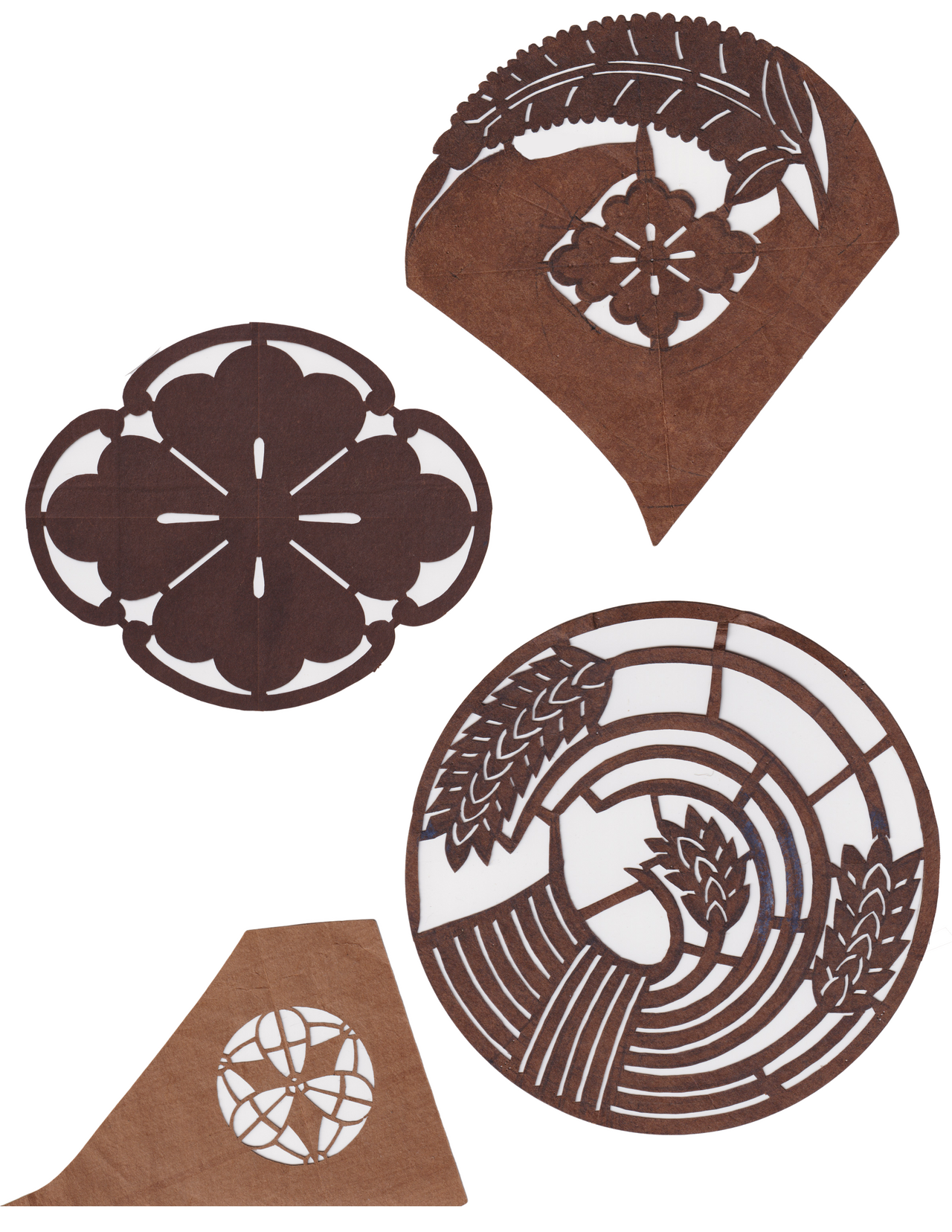
Ise katagami dyeing stencils — a related cut-paper tradition whose fine-line cutting techniques influenced decorative kirie. Public domain, via Wikimedia Commons.
By the Edo period, paper had become abundant and affordable enough for kirie to move beyond ritual use into popular entertainment: street performers cut silhouette portraits and scenes live for audiences, a tradition that continued into the 20th century as a kind of folk performance art. The modern sense of kirie as fine-art picture-cutting — as opposed to religious craft or portraiture — solidified over the 20th century as individual artists began publishing collections and holding exhibitions.
Techniques and Tools
Kirie is made with a short list of simple tools, but they demand exacting control:
| Tool | Purpose |
|---|---|
| Kiri-e knife (deba knife / craft knife) | A small, very sharp blade — often a snap-off utility blade — used to cut curved and straight lines with a single stroke rather than a sawing motion |
| Cutting mat | A self-healing mat placed under the paper to protect the blade and work surface |
| Washi or kent paper | Thin but strong paper; washi is traditional, though modern artists also use black kent board for high-contrast silhouette work |
| Pencil / tracing paper | Used to sketch or transfer the design onto the paper before cutting |
| Awl or needle | For piercing tiny starting holes so the blade can be threaded through interior cuts |
Most kirie is worked from a single, uncut sheet — the entire design must remain physically connected, so the artist plans every cut to leave a supporting lattice of paper (a discipline sometimes compared to line-drawing, since every enclosed shape needs at least one "bridge" holding it to the rest of the sheet). More elaborate works use layered kirie, stacking several cut sheets of different colors behind one another to create depth, shading, or a multi-tone image — similar in spirit to a woodblock 版画 print built from multiple registered layers. Because a mis-cut line cannot be undone, kirie artists typically work from a fully finished pencil design, then cut slowly from the smallest interior details outward to the larger outer silhouette, so the paper stays as stable as possible for as long as possible.
Typical Subject Matter
Kirie draws on the same visual vocabulary as much of Japanese decorative art:
- Nature and botanical motifs — cherry blossoms, maple leaves, bamboo, cranes, and koi are perennial favorites, often tied to 季節 (seasonal) themes matched to the time of year they're displayed.
- Silhouettes — because the cut paper is essentially a シルエット against its backing, figurative kirie of people, animals, and cityscapes reads as bold black-and-white デザイン.
- Yokai and folklore — supernatural creatures from Japanese folklore, or 妖怪, are a popular subject for artists who want dramatic, high-contrast 影 (shadow) imagery; a well-cut yokai kirie leans into the same eerie play of silhouette and negative space that made cut-paper ghost lanterns and shadow puppetry popular in earlier centuries.
- Landscapes and townscapes — elaborate multi-layer kirie can render entire scenes, from Mount Fuji to festival crowds, with each paper layer adding a plane of depth.
Relationship to Other Japanese Paper Crafts
Japan has several distinct traditions built around washi, and kirie is often confused with its better-known cousin 折り紙 (origami). The two are opposites in method: origami transforms a sheet purely by folding, without cutting or gluing, while kirie transforms a sheet purely by cutting, without folding. (A hybrid called kirigami combines both folding and cutting, and is common in pop-up cards and paper snowflakes.) Where origami's discipline is about geometry and structural folds, kirie's discipline is about maintaining a connected, uncut silhouette — the challenge is closer to line art or printmaking than to sculpture.
Both crafts depend on the same underlying material: 和紙, handmade Japanese paper valued for being simultaneously thin, strong, and fibrous enough to hold fine detail without tearing. Regional washi varieties — Mino washi, Echizen washi, Tosa washi — are prized by kirie artists for their combination of durability and translucency, the same properties that make them useful for origami, shoji screens, and calligraphy.
Modern Popularity
Kirie has enjoyed a strong revival in the smartphone-and-social-media era, largely because the finished work photographs beautifully: a backlit or shadow-cast kirie piece translates directly into a striking image for platforms like インスタグラム. Contemporary artists have pushed the craft in new directions — Ryo Takagi (高木亮), working under the name "kirieya," is known for intricate cat-themed kirie shared online and collected into books; Nahoko Kojima has taken kirie into large-scale, suspended paper sculpture exhibited internationally; and countless amateur artists post process videos and time-lapses of a single sheet being cut into a finished scene, a format that suits short-form video well.
Kirie is also taught as a beginner-friendly craft — many introductory kits use pre-printed line patterns so newcomers can practice blade control before attempting freehand design — which has helped it spread as a hobby alongside other paper 芸術 (art) forms both inside and outside Japan.
Related Terms
| Term | Reading | Meaning |
|---|---|---|
| 折り紙 | おりがみ | Origami — paper folding, kirie's fold-only counterpart |
| 型紙 | かたがみ | Katagami — cut-paper dyeing stencils, a technical ancestor of decorative kirie |
| 剪紙 | jiǎnzhǐ | Jianzhi — the Chinese paper-cutting tradition that inspired kirie |
| 切り紙 | きりがみ | Kirigami — cutting combined with folding |
| 影絵 | かげえ | Kage-e — shadow pictures / shadow puppetry, a related silhouette art |
Related Dictionary Words
cutout; cutout picture; papercut art
paper
washi; Japanese paper
origami; art of paper folding
ghost; apparition; phantom; spectre; specter; demon; monster; goblin; yōkai
shadow; silhouette; figure; shape
pattern paper (for dressmaking)
Edo (shogunate capital; former name of Tokyo); Yedo
China
to cut; to cut through; to perform (surgery)
picture; drawing; painting; sketch
craftsman; artisan; tradesman; worker; workman
tradition; convention
season; time of year
nature
design
silhouette
woodcut; woodblock print; art print
type; style; model; pattern
art; the arts