新海誠
Shinkai MakotoThe self-taught anime director behind Your Name, Weathering with You, and Suzume, whose photorealistic skies and stories of distant connection made him the most commercially successful anime filmmaker outside Studio Ghibli.
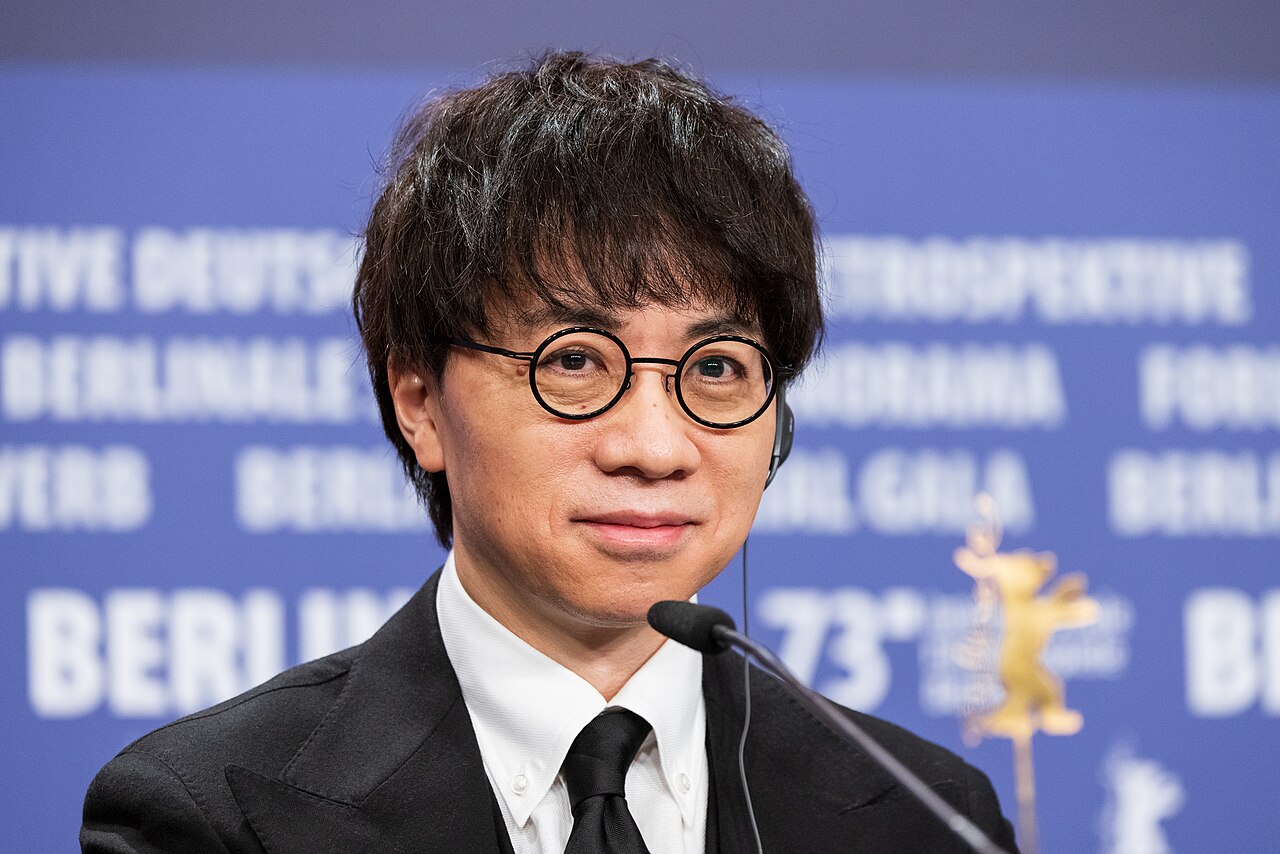
Makoto Shinkai promoting Suzume at the 2023 Berlin International Film Festival. Photo: Martin Kraft, CC BY-SA 4.0, via Wikimedia Commons.
新海誠 (Shinkai Makoto, born February 9, 1973) is a Japanese 監督 (kantoku, "director") widely regarded as the most commercially successful アニメ filmmaker of his generation outside Studio Ghibli. Beginning as a virtual one-man studio producing digital-animated short films on his home computer, he rose to direct Your Name (君の名は. / Kimi no Na wa., 2016), which became the highest-grossing anime film in history at the time of its release, followed by Weathering with You (天気の子, 2019) and Suzume (すずめの戸締まり, 2023). Shinkai's films are known for photorealistic backgrounds, glowing light and sky, teenage protagonists separated by distance or disaster, and a recurring fascination with the exact moment two people's lives intersect and then risk drifting apart.
Meaning
Unlike most major anime directors, Shinkai did not come up through a traditional animation studio apprenticeship. He studied Japanese literature at Chuo University and worked as a graphic designer at the video game company Nihon Falcom, producing title-screen animations and promotional videos, before teaching himself 3D software and animation on his own time. In 2002 he wrote, directed, animated, and largely voiced Voices of a Distant Star (ほしのこえ, Hoshi no Koe) almost entirely alone on a Power Mac G4, a 25-minute science-fiction short about two teenagers exchanging text messages across ever-widening interstellar distance. Its visual polish, achieved on a hobbyist's budget, stunned the anime industry and earned him comparisons to Hayao Miyazaki even before he had directed a feature.
That solitary, DIY origin still shapes how Shinkai's films are discussed in Japan: he is often framed as proof that a single obsessive creator with a personal computer could rival アニメ スタジオ output, a narrative that made him a folk hero among aspiring digital animators during the 2000s, even as his later features grew into large-scale studio productions (through his own company CoMix Wave Films) employing hundreds of artists.
Major Works
| Film | Japanese Title | Year | Notes |
|---|---|---|---|
| Voices of a Distant Star | ほしのこえ | 2002 | 25-minute short, made almost single-handedly |
| The Place Promised in Our Early Days | 雲のむこう、約束の場所 | 2004 | First feature; alternate-history science fiction |
| 5 Centimeters per Second | 秒速5センチメートル | 2007 | Three-part story of a fading first love |
| Children Who Chase Lost Voices | 星を追う子ども | 2011 | Fantasy adventure, an homage to Ghibli |
| The Garden of Words | 言の葉の庭 | 2013 | 46-minute film about a shoe-maker student and an older woman |
| Your Name | 君の名は。 | 2016 | Body-swap 恋愛 story; broke box-office records worldwide |
| Weathering with You | 天気の子 | 2019 | A runaway boy and a girl who can control the weather |
| Suzume | すずめの戸締まり | 2023 | A door-closing journey across disaster-scarred Japan |
Recurring Themes
Shinkai's 作品 return again and again to a tight cluster of preoccupations, which is part of why critics can describe a film as "very Shinkai" on sight.
Distance and connection. From the light-years separating the lovers of Voices of a Distant Star to the years and kilometers separating the childhood friends of 5 Centimeters per Second, and the centuries-old thread linking the body-swapped teens of Your Name, nearly every Shinkai plot is built around two people kept apart by 距離 (kyori, "distance") — geographic, temporal, or emotional — and the question of whether they can close it.
Hyper-detailed, glowing skies. Shinkai's backgrounds are famous for photorealistic clouds, rain, and sunlight rendered with an almost obsessive attention to how 光 (hikari, "light") falls through 空 (sora, "sky"); animation fans and critics alike frequently single out his cloud and lens-flare work as a signature so distinctive it is sometimes parodied as "Shinkai sky."
Weather and disaster. Weathering with You is built entirely around anomalous rain and a girl who can manipulate 天気 (tenki, "weather"), while Suzume follows a girl sealing doors that unleash earthquakes across Japan — a theme widely read as processing the trauma of the 2011 Tōhoku earthquake and tsunami, an event Shinkai has said profoundly affected his work after Your Name, whose own plot involves a catastrophic meteor strike.
Sekai-kei sensibility. Shinkai's early work, especially Voices of a Distant Star, is frequently cited as a defining example of セカイ系 (sekai-kei), a 2000s subgenre in which an intensely personal, often romantic relationship between two 青春 (seishun, "youth"/adolescent) protagonists is directly tied to the fate of the entire world, with little narrative interest in the social or political middle ground in between.
Usage
In everyday Japanese, Shinkai's name and his films' titles function as widely recognized shorthand for a particular visual and emotional register:
新海誠監督の映画は空の描写が本当に綺麗だよね。 Shinkai Makoto kantoku no eiga wa sora no byōsha ga hontō ni kirei da yo ne. "Director Shinkai Makoto's films really have beautiful depictions of the sky, don't they."
「君の名は。」を見てから新海誠作品にハマった。 "Kimi no Na wa." o mite kara Shinkai Makoto sakuhin ni hamatta. "I got hooked on Shinkai Makoto's work after watching Your Name."
Your Name and Global Breakthrough
Released in August 2016, 君の名は。 (Kimi no Na wa., Your Name) follows a boy in Tokyo and a girl in a rural mountain town who begin mysteriously swapping bodies, and became a genuine cultural phenomenon in Japan and well beyond it. It earned over ¥25 billion (roughly $250 million) worldwide, surpassing Miyazaki's Spirited Away to become the highest-grossing anime film of all time at the point of its release (a record later passed by Demon Slayer: Mugen Train), and was the first non-Ghibli anime film to break into the top ten highest-grossing films in Japanese box-office history. It won the Japan Academy Prize for Animation of the Year and was nominated for a Golden Globe, and its theme song by the rock band RADWIMPS became a chart-topping cultural touchstone in its own right. The film's success prompted immediate — and inevitable — comparisons to Miyazaki, with international press dubbing Shinkai "the next Miyazaki," a label he has publicly resisted, noting that his stories and Miyazaki's come from very different creative instincts.
Suzume and Continued Success
すずめの戸締まり (Suzume no Tojimari, Suzume, 2023) followed Weathering with You and continued Shinkai's run of box-office success, becoming the second-highest-grossing Japanese film ever released outside Japan at the time and winning the Japan Academy Prize for Animation of the Year. The film sends its teenage protagonist across Japan closing magical doors that would otherwise unleash 地震 (jishin, "earthquakes"), a premise Shinkai has described as his most direct attempt yet to reckon with the 2011 disaster and the losses it left behind, closing out what he has called his informal "disaster trilogy" alongside Your Name and Weathering with You.
Comparisons to Miyazaki and Studio Ghibli
Shinkai is the anime director most consistently discussed in the same breath as 宮崎駿 and スタジオジブリ, but the comparison highlights real differences as much as similarities.
| Shinkai | Miyazaki / Ghibli | |
|---|---|---|
| Visual approach | Photorealistic digital backgrounds, light and lens flare | Hand-painted watercolor backgrounds |
| Protagonists | Teenagers navigating romance, loss, and distance | Often girls or young women confronting nature, war, or growing up |
| Typical scale | Contemporary Japan, personal relationships tied to cosmic/disaster stakes | Fantasy or historical worlds, environmental and political themes |
| Studio model | Founder-driven; produced through his own company, CoMix Wave Films | Ensemble studio built around two veteran directors |
| Career start | Self-taught, one-man digital productions | Trained animator who rose through Toei Animation |
Where Miyazaki's films tend toward fantasy worlds and ecological or anti-war themes built up over painstaking hand-drawn animation, Shinkai's are grounded in recognizable, present-day Japan and driven by intimate relationships that happen to intersect with catastrophe. Both, however, share an obsessive attention to natural detail and a body of work capable of moving audiences who do not otherwise watch anime — a rare distinction in the medium.
Legacy
Shinkai's rise from a solo digital animator with a home computer to the director of some of the highest-grossing films ever released in Japan reshaped what the anime industry believed a single auteur-driven filmmaker could achieve commercially without a legacy studio behind him. His success helped prove that anime feature films could reliably compete at the very top of the domestic and international box office beyond Ghibli, paving the way for other post-Your Name anime blockbusters and cementing his place as the defining anime director of the 2010s and 2020s.
Related Terms
| Term | Reading | Meaning |
|---|---|---|
| 監督 | kantoku | Director (of a film) |
| 世界観 | sekaikan | Worldview; visual universe of a work |
| セカイ系 | sekai-kei | Genre where personal relationships determine the world's fate |
| 距離 | kyori | Distance |
| 天気 | tenki | Weather |
Related Dictionary Words
supervision; control; superintendence; direction
animation; animated film; animated cartoon; anime
movie; film; motion picture
work (e.g. book, film, painting, composition); piece; production; opus
worldview; outlook on the world; Weltanschauung
sekai-kei (genre of manga, anime, etc.)
distance; range; interval
weather
earthquake
light
emptiness; being empty