水引
mizuhikiA traditional Japanese decorative cord made from twisted, starch-stiffened washi paper, tied into symbolic knots to adorn gift envelopes for weddings, funerals, births, and other ceremonial occasions.
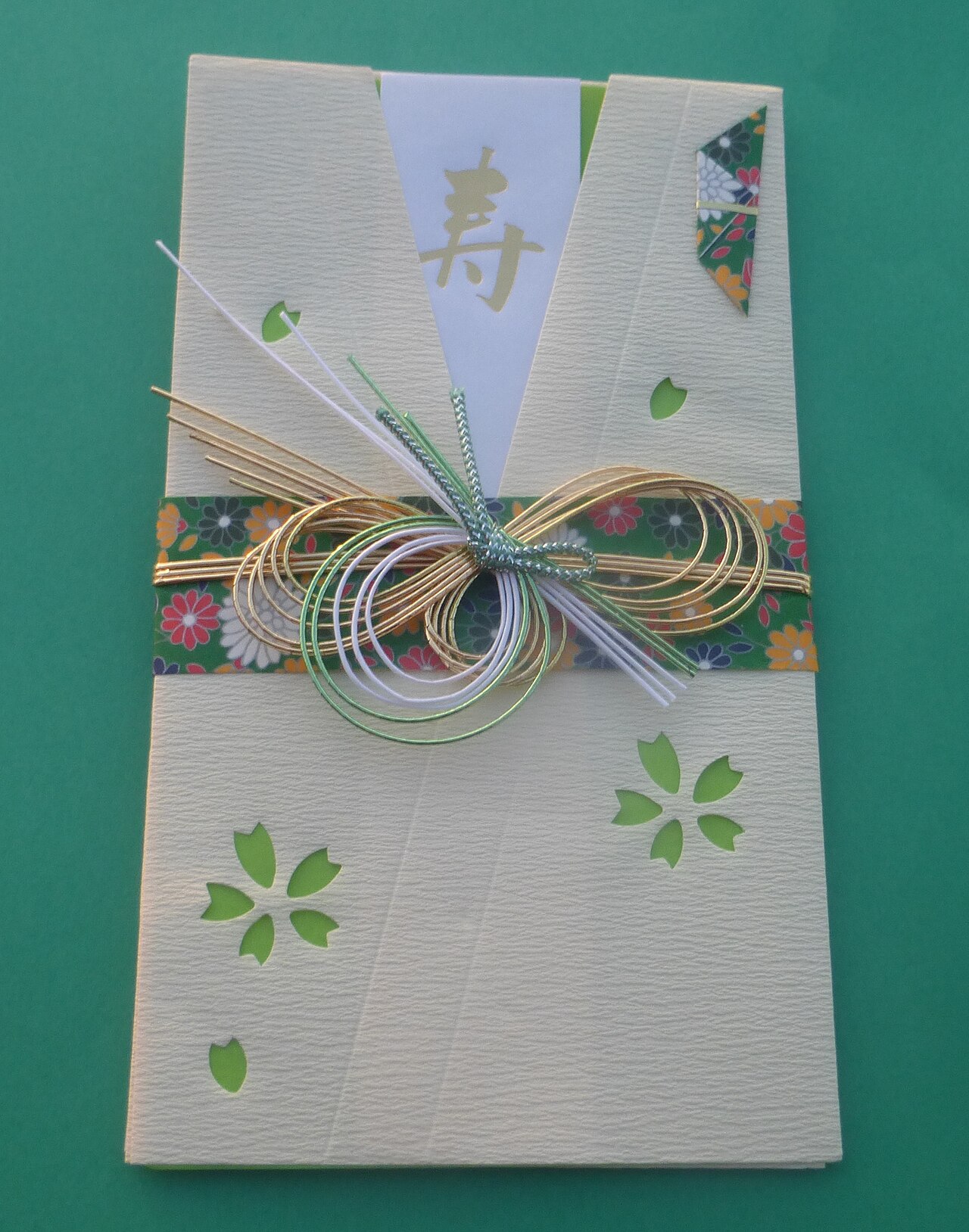
A 祝儀袋 (shūgi-bukuro) wedding gift envelope tied with an ornate mizuhiki knot. Photo: Nesnad, CC BY 4.0, via Wikimedia Commons.
Meaning
水引 (mizuhiki) is a traditional Japanese cord made from thin strands of 和紙 (washi, Japanese paper) that are twisted tight and stiffened with starch paste until they hold their shape like fine wire. Once dry, the cords can be bent, looped, and knotted into intricate decorative shapes without unraveling — a quality that separates mizuhiki from ordinary 紐 (string) or ribbon.
The name is generally believed to come from the manufacturing process itself: paper strips are twisted (hiku, "to pull/draw") and coated with starch glue known as mizu-nori ("water paste"), which is then combed and dried to harden the strand — mizu + hiku becoming mizuhiki. Individual cords are sold as plain strands but are far better known in their finished form: bundled, colored, and shaped into a musubi (結び, "knot") that adorns a gift.
Mizuhiki is inseparable from Japanese gift-giving etiquette. It is tied around のし袋 and shūgi-bukuro envelopes for cash gifts, wrapped around formal presents, and folded into standalone ornaments for 新年 decorations, hair accessories, and — in recent years — jewelry.
Knot Types and Their Meanings
The specific way a mizuhiki cord is 結ぶ (tied) is not decorative flourish; it is a message in itself, chosen to match the nature of the occasion.
| Knot type | Japanese | Meaning | Typical occasions |
|---|---|---|---|
| Musubikiri (also awabi-musubi variant) | 結び切り | A tight knot that cannot be pulled apart or re-tied — "this should happen only once" | 婚礼 (weddings), 葬式 (funerals), get-well and apology gifts |
| Chōmusubi (bow knot) | 蝶結び | A bow that can be untied and re-tied repeatedly — "may this happen again and again" | 出産 (births), 卒業 (graduations), promotions, seasonal greetings |
| Awaji-musubi | 淡路結び | An interlocking loop knot related to musubikiri; the more it is pulled, the tighter it holds — symbolizing an unbreakable bond | Weddings, engagements, thank-you gifts |
| Ume-musubi | 梅結び | A rounded knot shaped like a plum blossom, a flower that blooms in the cold and symbolizes perseverance and good fortune | Weddings, celebratory gifts, New Year decorations |
The core logic is simple: musubikiri-family knots (including awaji-musubi) are used for events one hopes will not repeat — marriage should last a lifetime, illness and mourning should not recur — while the easily-retied chōmusubi is reserved for happy events that are welcome to happen again and again. Giving a wedding gift tied with a chōmusubi bow, or a birth congratulations gift tied with musubikiri, is considered a real etiquette mistake in Japan.
Color Symbolism
Color carries as much meaning as knot shape. A typical mizuhiki bundle uses five, seven, or ten cords, always paired in a "bright" and "dark" combination:
- 紅白 (red and white) — the standard pairing for celebratory occasions: weddings, births, graduations, New Year.
- 金銀 (gold and silver) — reserved for especially formal or high-status celebrations, most famously weddings.
- Black and white (kuro-shiro) — used exclusively for 弔事 (funerals and condolence gifts) such as 香典 money.
- Yellow and white — sometimes substituted for black-and-white in the Kansai region for condolence gifts.
- Gold and red — an especially auspicious, festive combination for major 慶事 (happy occasions).
Combining the wrong color pair with an occasion is as much a faux pas as using the wrong knot — an all-black-and-white mizuhiki on a wedding envelope, for instance, would be deeply inappropriate.
Usage
Mizuhiki appears constantly in Japanese ceremonial life, almost always in service of a gift:
結婚祝いののし袋に、豪華な水引が結ばれていた。 Kekkon-iwai no noshi-bukuro ni, gōka na mizuhiki ga musubarete ita. "A lavish mizuhiki knot was tied onto the wedding congratulation envelope."
香典袋には黒白の水引を使います。 Kōden-bukuro ni wa kuro-shiro no mizuhiki o tsukaimasu. "A black-and-white mizuhiki is used on condolence-money envelopes."
Beyond envelopes, mizuhiki is folded into free-standing ornaments — cranes, pine branches, and plum blossoms — that decorate 贈り物 (gifts), wedding tables, and New Year kadomatsu-adjacent displays. A single elaborate knot, sometimes incorporating a small paper crane or turtle (symbols of longevity), can take a skilled artisan considerable time to complete by hand.
Cultural Context
Origins: from diplomatic gift cords to a Japanese craft
The most widely told origin story traces mizuhiki to 607 CE, when the envoy Ono no Imoko returned from an embassy to Sui-dynasty China bearing gifts bound with red-and-white hemp cords — a Chinese custom for marking formal gifts. Japan adopted the practice for its own imperial and diplomatic gift-giving, and over the following centuries the material shifted from hemp to paper.
By the Muromachi period (1336–1573), the modern technique — twisting slender strips of washi and stiffening them with starch paste — had been established, and the samurai class popularized wrapping formal gifts in plain paper bound with dyed red-and-white cords. Mizuhiki remained largely an aristocratic and samurai practice until the Edo period (1603–1868), when improved paper production and a merchant culture eager for ceremony and etiquette brought it into wider use among commoners for weddings, seasonal gifts, and everyday courtesies.
Iyo-mizuhiki and the craft centers of Japan
Today, two regions dominate Japanese mizuhiki production: Iida City in Nagano Prefecture, which produces roughly 70% of the nation's mizuhiki cord, and Shikokuchūchi/the Iyo region of Ehime Prefecture on Shikoku, home to Iyo-mizuhiki (伊予水引), designated one of Ehime's traditional local specialties. Local histories trace Iyo's mizuhiki-making back to the Heian period, and the industry grew through the Edo and Meiji eras thanks to abundant local washi paper and specialized dyeing and finishing techniques. In the early 20th century, the Taishō-era craftsman Sōkichi Tsuda is often credited with elevating mizuhiki from simple binding cord into a sculptural art form, popularizing elaborate three-dimensional motifs such as cranes, turtles, and pine-bamboo-plum designs that remain standard today.
Modern Revival
Although shūgi-bukuro and kōden envelopes remain mizuhiki's everyday context, the craft has found new life well beyond the gift-wrapping counter. Workshops and craft kits — in Japan and increasingly abroad — teach beginners the handful of core knots (chōmusubi, awaji-musubi, ume-musubi) as a mindful, low-cost hobby akin to macramé or quilling. Contemporary makers use mizuhiki cord, now available in a rainbow of dyed and metallic finishes far beyond traditional red-white-gold-silver, to create earrings, brooches, hair ornaments, bookmarks, and keychains, and some artists build large sculptural installations from the same twisted-paper technique once reserved for gift envelopes. This revival mirrors that of other traditional Japanese crafts like furoshiki wrapping cloth and origami paper folding — humble, paper-based practices finding renewed relevance as sustainable, handmade alternatives to mass-produced decoration.
Related Terms
Related Dictionary Words
decorative Japanese cord made from twisted paper
paper bag for putting a present in
special envelope for monetary gifts
knot
to tie; to bind; to link
washi; Japanese paper
string; cord
present; gift
marriage ceremony; wedding
funeral
childbirth; (giving) birth; delivery; parturition
graduation; completion (of a course)
New Year
rosette
bow; bowknot
red and white; colours for festive or auspicious occasions (colors)
gold and silver
unhappy event (e.g. death); funeral
happy event; auspicious event; matter for congratulation
gift brought to a funeral (usu. money); funeral offering; condolence gift; incense money
traditional craft; traditional handicrafts