年賀状
nengajouJapanese New Year's postcards, sent so Japan Post delivers them all on January 1st, traditionally decorated with the coming year's zodiac animal and printed with a lottery number.
Meaning
年賀状 (nengajō) are postcards sent to friends, relatives, coworkers, and business contacts to mark the New Year. The custom is built around one striking piece of postal engineering: if a nengajō is mailed within a set window in December, 郵便 (Japan Post) holds every one of them back and delivers the entire pile on the morning of January 1st, so recipients open their mailbox to a stack of greetings timed to arrive on exactly the same day. A typical card carries a short set-phrase greeting such as 賀正 ("celebrating the new year") or the fuller 謹賀新年 ("a respectful happy new year"), a picture related to that year's zodiac sign, and a handwritten line or two of personal news.
Nengajō sit at the intersection of etiquette, art, and logistics — part greeting card, part social-ledger update, part annual lottery ticket, since standard cards double as raffle tickets for prizes drawn after New Year's (see below).
Usage
Cards are written and mailed in the final weeks of December, addressed with the recipient's name, postal 宛先 (address), and often accompanied by a preprinted greeting plus a short handwritten note. A common message reads:
謹賀新年 本年もよろしくお願いいたします。 (Kinga shinnen. Honnen mo yoroshiku onegai itashimasu.) "A respectful happy new year. I look forward to your continued support this year as well."
Someone who didn't manage to send cards in time might instead send a simpler year-opening note any time before early-to-mid January, or skip that year's round of cards. If a household is in mourning (a close family member died that year), the custom is to send a 喪中 (mochū) notice in November or early December — a plain, undecorated postcard informing correspondents that the family is observing mourning and asking them not to send a nengajō that year, and not to receive an incoming one either.
Nengajō are also used to quietly maintain a social ledger: many people send them to coworkers, former teachers, distant relatives, and old classmates precisely because it's the one guaranteed yearly touchpoint, and the card doubles as a way to update everyone on a new address, job, marriage, or baby.
Cultural Context
From New Year calls to a postal system
Greeting one's superiors and neighbors in person at the start of the year is an old custom in Japan, but as cities grew in the Edo period (1603–1868) and personal visits to every contact became impractical, people began sending written new-year greetings instead. Japan's modern postal service, founded in 1871, formalized this into the nengajō system familiar today: postcards mailed with the correct markings during a designated late-December period are sorted and deliberately withheld, then delivered in bulk on January 1st. This "hold and release on the same day" logistics feat — millions of cards processed by temporary seasonal postal workers — remains one of the most visible annual operations Japan Post runs.
Zodiac art (干支)
Most nengajō designs feature that year's animal from the twelve-year East Asian zodiac cycle, or 干支 (eto). The cycle rotates through twelve creatures — 子 rat, 丑 ox, 寅 tiger, 卯 rabbit, 辰 dragon, 巳 snake, 午 horse, 未 goat, 申 monkey, 酉 rooster, 戌 dog, and 亥 boar — and printers, illustrators, and stationery brands compete every autumn to release fresh, often humorous or stylized takes on whichever animal is "up" that year. Because the zodiac imagery is so central, nengajō collecting and card design have become minor annual art traditions in their own right, and government offices, companies, and even the Imperial Household release their own zodiac-themed New Year stamps and cards.
| Animal | Kanji | Cycle position |
|---|---|---|
| Rat | 子 | 1 |
| Ox | 丑 | 2 |
| Tiger | 寅 | 3 |
| Rabbit | 卯 | 4 |
| Dragon | 辰 | 5 |
| Snake | 巳 | 6 |
| Horse | 午 | 7 |
| Goat | 未 | 8 |
| Monkey | 申 | 9 |
| Rooster | 酉 | 10 |
| Dog | 戌 | 11 |
| Boar | 亥 | 12 |
The lottery number: otoshidama-tsuki nengajō
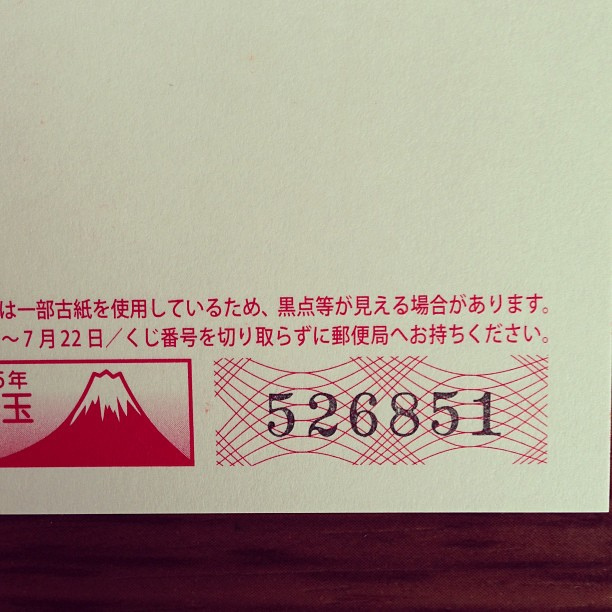
Detail of an official お年玉付郵便はがき (otoshidama-tsuki yūbin hagaki), the standard nengajō postcard sold by Japan Post — the printed serial number along the bottom edge doubles as a lottery ticket. Photo: Satoshi KAYA, public domain, via Wikimedia Commons.
Since 1949, the official nengajō postcards sold by Japan Post have been called お年玉付郵便はがき (otoshidama-tsuki yūbin hagaki, "New Year's-gift-attached postal postcards") — plain cards preprinted with a unique serial number along the bottom edge, functioning as a built-in national lottery ticket. お年玉 normally refers to the cash gifts adults give children at New Year, and the name plays on that: everyone who sends or receives one of these cards is automatically entered in a drawing. Winning numbers are announced in mid-January, with prizes ranging from small items (stationery sets, stamps) up through electronics, travel vouchers, or cash for cards matching more digits. Checking a stack of received cards against the winning numbers is itself a small January ritual in many households.
A custom in decline
Nengajō volume has fallen sharply since its early-2000s peak, when Japan Post issued roughly 4.4 billion cards in a single year. The rise of email, and especially of free messaging apps like LINE, gave people an instant, no-cost way to send New Year's greetings (賀詞, gashi) with a tap, undercutting the case for buying stamps, hand-addressing envelopes, and mailing physical cards weeks in advance. Younger generations in particular now often send digital greetings exclusively, and the volume of physical cards printed and sold has dropped year over year for over a decade, prompting Japan Post to shrink print runs and adjust pricing. Even so, nengajō have not disappeared: many businesses, older relatives, and formal relationships still expect a physical card, and it remains one of the few widely recognized ways to signal that a relationship is being actively maintained rather than left dormant — something a group chat message doesn't quite convey in the same way.
Related Customs
Nengajō are one piece of a wider New Year's (お正月) tradition that also includes 初詣 (the first shrine or temple visit of the year) and おせち料理 (the special foods eaten over the New Year holiday).
Related Dictionary Words
New Year's card
mail service; postal service; mail; post
sexagenary cycle; 60-term cycle of 12 zodiac animals combined with 5 elements in the traditional Chinese calendar; currently used in Japan for years, historically also for days
12 signs of the Chinese zodiac
New Year's gift (usu. money given to a child by relatives and visitors)
A Happy New Year!
Happy New Year
letter; note
printing
lottery; raffle; drawing (of lots); balloting
stamp (postage)
address; destination
address (of a home, business, etc.); residence; domicile
in mourning