おせち料理
osechi ryouriThe traditional Japanese New Year feast of symbolic foods packed into stacked lacquer boxes (jūbako), prepared in advance so no cooking is needed during the first days of January.
Meaning
Osechi ryori (おせち料理, osechi ryōri) is the traditional set of Japanese New Year foods, prepared in advance and packed into stacked lacquer boxes called 重箱 (jūbako) so that families can eat well through the first days of January without cooking. The name comes from o-sechi (お節), an honorific form of sechi, referring to the seasonal turning points (sekku) of the old lunar calendar. Over time the word narrowed to mean specifically the 正月 (New Year) feast, the most important of all the seasonal celebrations.
Osechi is not a single dish but a curated collection of small, individually symbolic foods — sweet, sour, dried, and vinegared items chosen so they keep for several days without refrigeration. Each item carries a wish for the coming year: health, fertility, a bountiful harvest, prosperity, or long life. Together the boxes function almost like an edible good-luck charm for the household.
The Jūbako: Stacked Boxes of Fortune
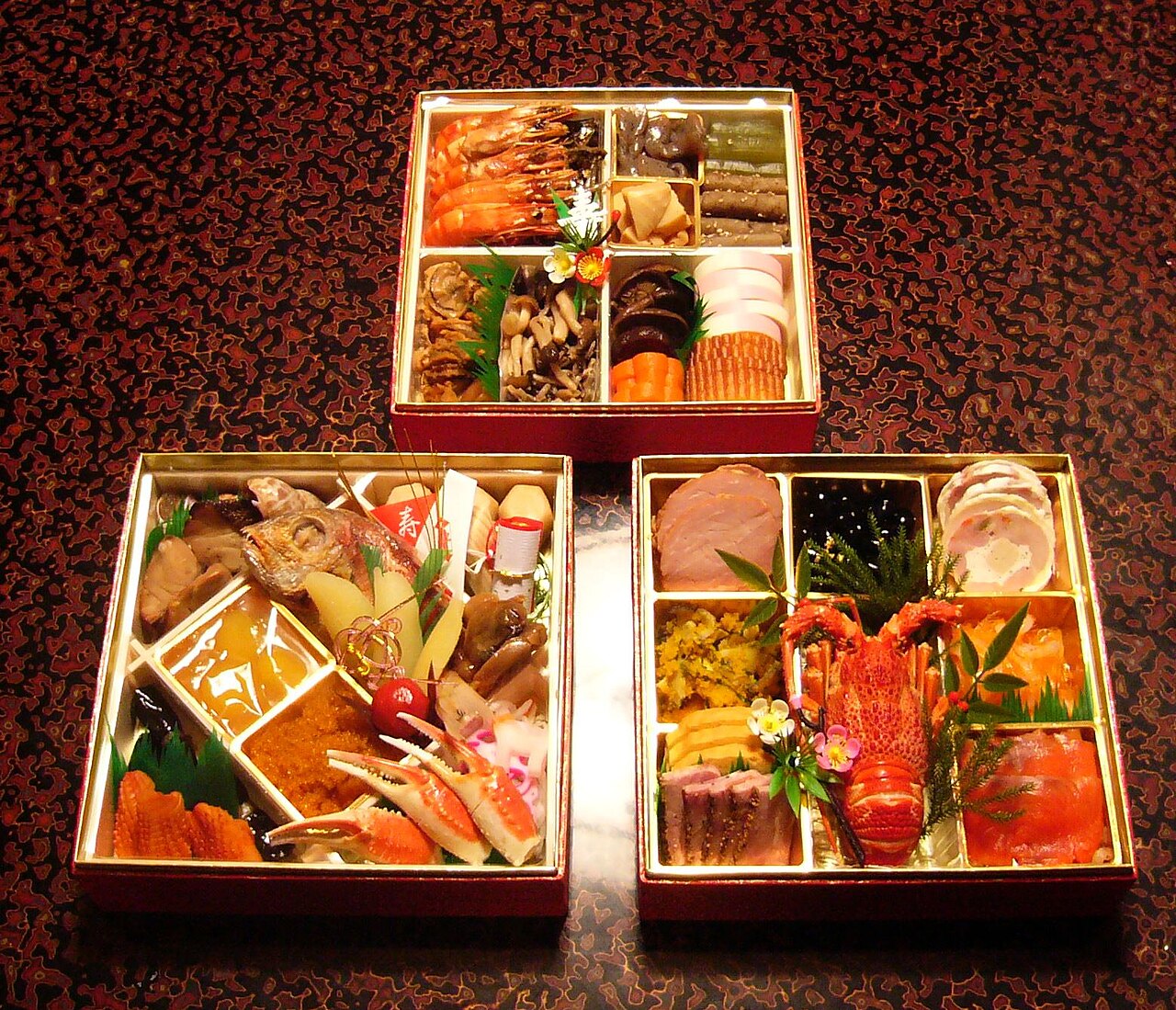
Osechi ryori served in traditional stacked jūbako boxes. Public domain, via Wikimedia Commons.
Formal osechi is served in jūbako, lacquered boxes that stack on top of one another like drawers, traditionally in sets of three, four, or five tiers. The stacking itself is symbolic — piling the boxes higher is meant to "pile up" happiness and good fortune (fuku ga kasanaru, 福が重なる) for the household. A traditional five-tier set assigns a theme to each layer:
| Tier | Contents |
|---|---|
| 1st (ichi-no-ju) | Kuchidori — celebratory appetizers like kuromame, kazunoko, and datemaki |
| 2nd (ni-no-ju) | Grilled seafood, such as 海老 (shrimp) and grilled fish |
| 3rd (san-no-ju) | Simmered seafood and other ocean dishes |
| 4th (yo-no-ju, using 与 instead of 四 to avoid the unlucky reading for "death") | Simmered vegetables (nimono), including 蓮根 |
| 5th (go-no-ju) | Traditionally left empty, symbolizing room for future good fortune to enter |
Modern households, especially smaller families in cities, more commonly use a simpler two-tier box or a single large tray, but the underlying idea of a compartmentalized, stackable container remains constant.
Symbolic Dishes and Their Meanings
Nearly every item in the box is a pun, a visual metaphor, or both. Some of the most iconic dishes:
| Dish | Japanese | Symbolism |
|---|---|---|
| Kuromame | 黒豆 (black soybeans, simmered sweet) | Mame also means "health" and "diligence" — a wish to work and live in good health |
| Kazunoko | 数の子 (herring roe) | The huge number of eggs represents fertility and many descendants |
| Tazukuri | 田作り (candied dried sardines) | Literally "rice-paddy maker" — small fish were once used as fertilizer, so it symbolizes a bountiful harvest |
| Kohaku kamaboko | Red-and-white 蒲鉾 (steamed fish cake) | The red-white color pair (kōhaku) is Japan's classic combination for celebration; the semicircular shape evokes the rising sun |
| Datemaki | 伊達巻 (sweet rolled omelet with fish paste) | Its rolled shape resembles a scroll of books or important documents, symbolizing scholarship and culture |
| Kuri kinton | 栗きんとん (栗きんとん, candied chestnut and sweet potato) | The golden color evokes gold coins and treasure, a wish for wealth |
| Ebi | 海老 (shrimp, often simmered whole with the shell on) | Its bent back suggests the stooped posture of old age — a wish to live long enough to grow a long white beard and bent back |
| Renkon | 蓮根 (lotus root) | Its many holes represent an unobstructed view into the future |
| Konbu-maki | Rolled kelp | Puns on yorokobu (よろこぶ, "to rejoice") |
Every family's box looks a little different, but this logic of wordplay and visual metaphor runs through almost every ingredient chosen.
Cultural Context: Why Cook Everything in Advance?
Osechi's defining feature is that it is entirely prepared before 大晦日 (New Year's Eve) so that no cooking is needed on 元旦 (New Year's Day) or, traditionally, for the first three days of the new year. Several beliefs reinforce this custom:
- Giving the kitchen god a rest. Kamado-gami, the hearth deity, was traditionally left undisturbed at the start of the year, and by extension the person who did most of the cooking — historically the housewife — also got a rare, sanctioned break from kitchen duties during the busiest holiday of the year.
- Avoiding knives. Cutting with a blade on New Year's Day was considered inauspicious, as it symbolically "cuts" good luck or relationships for the year ahead.
- Setting the tone for the year. What one does on January 1st was believed to predict the following 365 days, so a calm, restful start — free of chores, arguments, and labor — was considered important for a fortunate year.
- Practical necessity. In an era before refrigeration and with shops closed for the holidays, dishes had to be preserved through heavy use of sugar, salt, vinegar, and simmering in soy sauce — which is also why osechi flavors tend to be quite sweet and salty compared to everyday Japanese cooking.
The dishes are traditionally eaten starting with a small cup of spiced sake called おとそ (otoso) on New Year's morning, often alongside お雑煮 (ozōni), a mochi soup that is technically a separate dish from osechi itself but is almost always served alongside it.
Regional Variation
Osechi is far from uniform across Japan. The clearest split is between eastern (Kanto) and western (Kansai) styles of ozōni and kamaboko, but many regions also have signature osechi ingredients: herring roe and salmon dishes are prominent in Hokkaido and the Tohoku region, black-soybean specialties from Tanba (in Hyogo Prefecture) are prized nationwide, and Kyoto-style osechi tends to favor delicate, lightly-seasoned simmered vegetables reflecting Kyoto's kyo-ryori tradition. Okinawa, which historically followed a different New Year timeline and cuisine, has its own distinct celebratory dishes rather than a mainland-style jūbako.
Modern Trends: From Homemade to Pre-Order
Preparing a full multi-tier osechi from scratch is labor-intensive, often taking days, and fewer households now have three generations living together to share the work. As a result, pre-order osechi has become a major seasonal business:
- Department stores (depachika food halls) and supermarkets sell elaborately packaged osechi sets months in advance, with early-bird discounts starting as early as October or November.
- Konbini (convenience store) chains and delivery services now offer their own osechi boxes, ranging from budget single-tier sets to luxury tiers featuring crab, uni, and wagyu beef curated by celebrity chefs or hotels.
- Western-style and fusion osechi — French, Italian, or Chinese-influenced boxes — have become popular alternatives to the traditional dishes, especially among younger consumers.
- Pre-made osechi is typically ordered by early December and picked up or delivered on December 30th or 31st, timed exactly so no cooking is required once the new year begins.
Despite these modern conveniences, osechi remains one of the most visible living traditions in Japanese food culture — a box that turns eating itself into an act of wishing for the year ahead.
Related Dictionary Words
New Year (esp. first three days)
cooking; cookery; cuisine; food; dish
jūbako; multi-tiered food box
black soybean
herring roe
prawn; shrimp; lobster
lotus root
mashed sweet potatoes with sweetened chestnuts
(woman's) undersash
kamaboko; steamed seasoned fish paste, usu. in a semicylindrical shape on a strip of wood and sliced to go in soup, etc.
small dried sardines or anchovies (gomame) cooked almost to dryness in soy sauce and sugar
New Year's Eve
New Year's Day; first day of the year
omen; sign of luck