根付
netsukeMiniature carved toggles, once used to fasten hanging pouches to a kimono sash, that evolved into a celebrated Japanese sculptural art form.
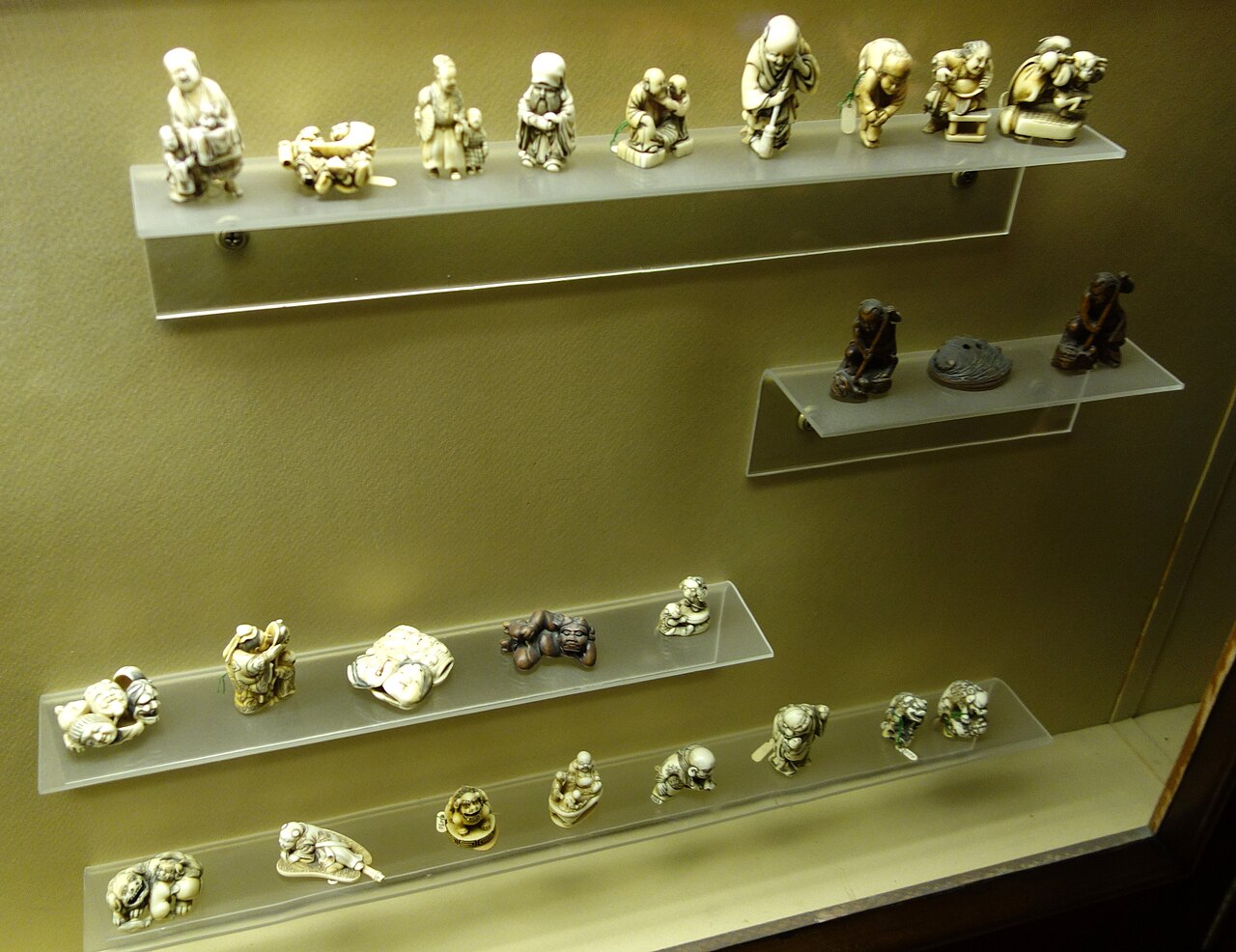
A collection of antique netsuke figures from a US museum's Japanese art holdings. Public domain (CC0), Daderot, via Wikimedia Commons.
Meaning
根付 (netsuke, ねつけ) are small, intricately carved toggles that solved a very practical problem: the traditional 着物 (kimono) has no pockets. Men who needed to carry personal items — a tobacco pouch, a coin purse, a set of writing tools, or a small case of medicine — hung these containers from a cord that looped over the top of the 帯 (obi, sash) and dangled at hip height. Such hanging containers are collectively called sagemono (提げ物, "hanging things"); the most famous type is the inro (印籠), a small stacked case originally used for medicines or seals.
A netsuke was tied to the free end of the sagemono's cord and acted as a counterweight and anchor: pushed up over the top edge of the obi from below, it was too large to slip back through, so the whole assembly hung securely at the wearer's side. The cord ran through a pair of small holes (or a single channel) called the himotoshi, and a sliding bead called an ojime cinched the cord tight against the pouch itself. Netsuke, ojime, and sagemono together made up a complete, wearable carrying system for a garment with no other way to hold anything.
Because a netsuke was worn in plain view, dangling at the waist for anyone to see, it quickly became more than hardware. Carvers turned every netsuke into a tiny sculpture — often no bigger than a walnut — and wearers chose designs that displayed wit, learning, or personal taste. Over the Edo period (1603–1868), netsuke carving matured into a major Japanese decorative art, taken up by dedicated netsuke-shi (根付師, netsuke masters) whose signed work is still collected and studied today.
Forms and Materials
Netsuke are classified by shape as much as by subject. The main traditional categories are:
| Type | Description |
|---|---|
| Katabori (形彫) | Fully three-dimensional figures — animals, people, deities — carved "in the round"; the most common and best-known type |
| Manju (饅頭) | Flat, round discs named after a bean-paste bun, usually carved in shallow relief |
| Sashi (差し) | Long, narrow toggles thrust directly through the obi rather than hung from a cord |
| Kagamibuta (鏡蓋) | A bowl-shaped body (often wood or ivory) topped with a decorated metal lid |
| Ryusa (柳左) | Manju-style netsuke with delicate pierced, lattice-like openwork |
Carvers worked in whatever dense, fine-grained material could take crisp detail and survive years of handling: boxwood and other hardwoods, 象牙 (ivory), stag antler, bone, lacquer, ceramic, coral, and even hornbill casque. Boxwood and ivory were the most prized because their tight grain let a skilled carver render fur, scales, and folds of cloth at a scale of only a few centimeters. A well-made netsuke also had to be functional — smooth-edged and compact enough not to snag on clothing or scratch the wearer — which is part of why the best examples are prized as much for tactile refinement as for visual detail.
Subjects and Symbolism
Netsuke drew on the same visual vocabulary as the rest of Edo-period art and folklore. Common subjects include:
- Animals of the Chinese zodiac (rats, oxen, tigers, rabbits, dragons, and so on), often chosen to match the wearer's birth year
- Folklore and legendary figures — oni (demons), tengu, the Seven Lucky Gods, folk heroes, and scenes from Noh and Kabuki theater
- Everyday and occupational scenes — farmers, fishermen, craftsmen, and street vendors captured mid-task
- Plants, shells, and natural objects, sometimes carved with hidden puns or wordplay in their titles
- Erotica (shunga-adjacent designs), a smaller but well-documented category
Many pieces reward close looking: a monkey might be carved gripping a persimmon exactly where a pun links the animal to a proverb, or a design might reference a specific play or legend that a knowledgeable observer would immediately recognize. This layering of craft, humor, and reference is a large part of why collectors and scholars still study individual 彫刻 (carvings) piece by piece.
Usage
根付は着物の帯に印籠や巾着を下げるために使われた。 Netsuke wa kimono no obi ni inro ya kinchaku o sageru tame ni tsukawareta. "Netsuke were used to hang an inro or a pouch from a kimono's sash."
この根付は象牙でできていて、猿の形をしている。 Kono netsuke wa zōge de dekite ite, saru no katachi o shite iru. "This netsuke is made of ivory and shaped like a monkey."
Today the word rarely describes an item of daily dress — Western clothing with pockets made the whole sagemono system obsolete by the early twentieth century. Instead, "netsuke" mostly comes up in the context of museums, antique auctions, and collecting: a piece is discussed by its carver, school, material, and subject, much like a print or a small bronze.
Cultural Context
Netsuke carving is closely tied to the Edo period, when a growing merchant class had money to spend on personal display but was legally barred by sumptuary laws from many overt luxuries permitted only to samurai. A finely carved netsuke was a discreet way to signal taste and wealth: expensive materials and virtuoso carving were visible only to those who looked closely, in an object small enough to seem modest at a glance.
Early netsuke, from the 17th century, were often simple — a gourd, a bent piece of root, or a shell used more or less as found. As demand grew, professional carvers established regional schools with recognizable house styles, particularly in Edo (Tokyo), Osaka, Kyoto, and Nagoya. The 1781 reference book Sōken Kishō (装剣奇賞) already listed over fifty named netsuke-shi, evidence of how quickly the craft had professionalized. Among the most celebrated are the "Kyoto trio" Tomotada, Masanao, and Yoshinaga, along with later masters whose signed work commands high prices at auction today.
The Meiji era (1868–1912) brought Western dress and the end of everyday netsuke use, but it also opened the craft to a new audience: European and American collectors developing a taste for Japanese art (japonisme) bought netsuke in large numbers, and carvers increasingly made pieces purely for the export and curio market rather than for wear. This shift helped netsuke survive as a living art form even after its original function disappeared, and it is a major reason so many fine historical examples ended up in Western museum collections.
Modern netsuke carving continues as a specialized craft, with contemporary carvers producing new work — sometimes in traditional materials, sometimes in synthetic substitutes as ivory trade restrictions tightened internationally — for a global network of collectors and the International Netsuke Society. The form is also familiar to a wider audience through Edmund de Waal's memoir The Hare with Amber Eyes, which traces a family netsuke collection across a century of European history.
Related Terms
- 印籠 (inro) — the stacked medicine/seal case most commonly hung by a netsuke
- 提げ物 (sagemono) — the general category of hanging containers netsuke were designed to secure
- 緒締め (ojime) — the sliding bead that cinches the cord between netsuke and sagemono
- 根付師 (netsuke-shi) — a professional netsuke carver
Related Dictionary Words
netsuke; carved toggle used to tether a small container to the sash of a robe
inro; seal case; pill box; medicine case
small bag or container hung from one's obi or sword hilt
band (e.g. conduction, valence); belt (e.g. Van-Allen, asteroid, etc.)
kimono; Japanese traditional clothing (esp. full-length)
ivory
craftsman; artisan; tradesman; worker; workman
carving; engraving; sculpture