着物
kimonoJapan's iconic traditional garment, worn for centuries as everyday dress and now reserved for ceremonies, festivals, and special occasions.
Meaning
着物 literally means "thing to wear" (着る + 物), but the word has come to refer specifically to Japan's traditional T-shaped robe, distinguished by its straight-cut panels, wrap-around front, and distinctive wide sash called the 帯. The 和服 — the broader term for all traditional Japanese clothing — finds its most iconic expression in the kimono.
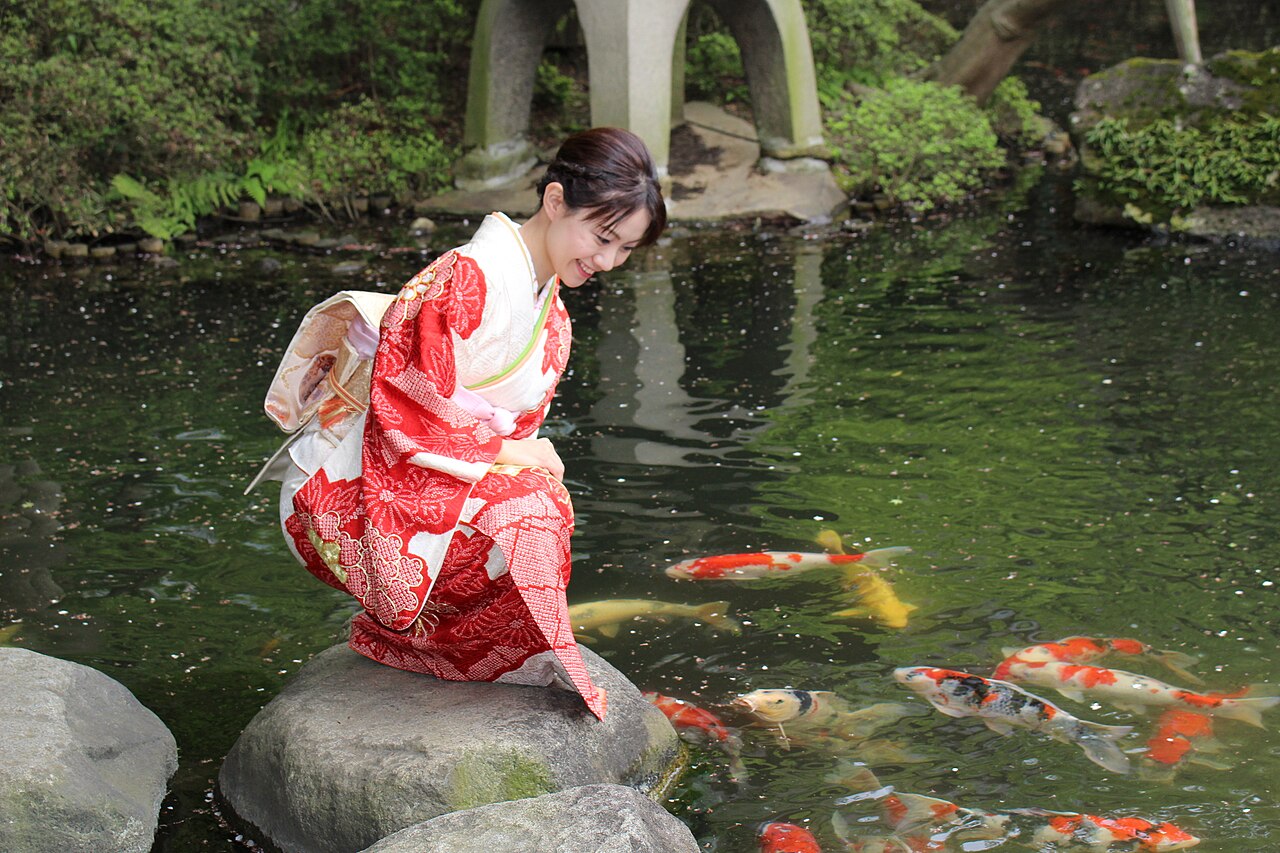
A woman wearing a kimono in a traditional Japanese garden. Photo: H.Hmoderato, CC BY-SA 4.0, via Wikimedia Commons.
A full kimono ensemble is rarely a single garment. It includes the robe itself, an under-robe (長襦袢, nagajuban), the obi sash, numerous cords and padding to create the correct silhouette, tabi socks, and traditional footwear. The 袖 (sleeves) are one of the most visually striking elements, ranging from short sleeves on everyday styles to the dramatically long, swinging sleeves of the formal furisode.
Types of Kimono
Kimono are classified by formality, occasion, and the wearer's age and marital status. Understanding these distinctions is an important part of Japanese etiquette.
| Type | Name | Occasion |
|---|---|---|
| 振袖 (furisode) | Long-sleeved formal | Unmarried young women; 成人式, weddings |
| 留袖 (tomesode) | Short-sleeved formal | Married women; 結婚式 |
| 訪問着 (hōmongi) | Semi-formal | Tea ceremony, formal parties |
| 色無地 (iro muji) | Plain single-color | 茶道, versatile formal |
| 小紋 (komon) | Repeating pattern | Everyday, casual outings |
| 浴衣 (yukata) | Light cotton | Summer 祭り, fireworks |
| 袴 (hakama) | Pleated skirt/trousers | Graduation ceremonies, archery |
振袖 (Furisode) is the most formal kimono for unmarried women. Its sleeve length — sometimes reaching to the ankle — is the defining feature. It is most commonly worn at the 成人式 (Coming-of-Age ceremony) when young women turn twenty, and as wedding guest attire. The elaborate patterns and vivid 色 make furisode among the most visually spectacular garments in Japanese 文化.
浴衣 (Yukata) is the most widely worn type today. Made from lightweight 木綿 or 麻 fabric, yukata are the informal cousin of the kimono — cool enough for summer, easy enough to put on without professional help, and affordable enough to buy new each season. They are ubiquitous at summer festivals and fireworks displays.
留袖 (Tomesode) is the most formal kimono for married women, recognizable by the colorful patterns below the waist only, against an unadorned 黒 or 白 upper body. Mothers of the bride and groom wear kurotomesode (black tomesode) at 結婚式.
The Art of Wearing: 着付け
Putting on a kimono properly, called 着付け (kitsuke, literally "putting on clothes"), is a skill that once took years to master. A full formal dressing involves:
- Undergarments — tabi socks and a thin under-robe
- The kimono — wrapped left side over right (right over left is for the deceased)
- Shaping — cotton padding creates the correct cylindrical silhouette, erasing natural body curves
- The obi — the wide sash tied in one of dozens of traditional knots; the most formal knot, the taiko musubi (drum knot), creates a box shape at the back
- Final adjustments — cords, clips, and a datejime sash hold everything in place
Professional kitsuke instructors exist throughout Japan, and schools such as the Sodetome and Wacoal offer certification courses. Many women and some men choose to take lessons to become self-sufficient.
The rule that the left side always crosses over the right (hidarimae) is fundamental — dressing with the right side on top (migimae) is associated only with preparing bodies for burial and is considered a serious taboo in daily life.
Cultural Context
The kimono's history stretches back more than a thousand years. The basic straight-cut silhouette emerged during the Heian period (794–1185), influenced by Chinese court dress, but the garment evolved into a distinctly Japanese art form during the Edo period (1603–1868). 絹 (silk) weaving and 染める dyeing techniques reached extraordinary heights during this era — regional styles like Kyoto's Nishijin-ori weaving and the resist-dyeing technique of Yuzen became prestigious crafts that survive to this day.
At its peak, the kimono was everyday wear for all of Japan. The Meiji Restoration (1868) brought rapid Westernization, and over the following century, Western clothing gradually replaced kimono for daily use. By the postwar era, kimono had largely retreated from everyday life into formal and ceremonial contexts.
Today, the kimono occupies a complex cultural space. It remains 正装 (formal dress) for major life ceremonies — 成人式, 結婚式, tea ceremony (茶道), graduation, and shrine visits — and its association with Japanese 伝統 and identity is profound. The garment appears prominently in anime, historical dramas (jidaigeki), and traditional arts from kabuki to origami performances.
A revival movement has been underway since the early 2000s, driven by younger Japanese people who wear kimono in more casual, individualistic ways — mixing traditional robes with modern accessories, or pairing antique kimono (リサイクル着物) found at flea markets with contemporary boots. Social media has amplified these "kimono street style" trends.
For tourists, rental kimono shops in historic districts such as Kyoto's Gion and Tokyo's Asakusa offer the experience of wearing one for a day, which has become enormously popular. Wearing kimono while visiting temples, shrines (shinto), and matsuri is seen as a respectful and immersive way to connect with Japanese culture.
Patterns and Symbolism
Kimono 模様 (patterns) carry deep symbolic meaning, and choosing an appropriate pattern for the season and occasion is part of traditional etiquette:
- 松竹梅 (shōchikubai, pine-bamboo-plum) — auspicious, used at New Year and weddings
- 桜 (sakura, cherry blossom) — spring, used during hanami season; never worn out of season in traditional practice
- 菊 (kiku, chrysanthemum) — autumn, also the imperial family's crest
- 鶴 (tsuru, crane) — longevity and auspiciousness, common at weddings
- 波 (nami, waves) — continuity and resilience, associated with the sea
The 季節 rule is strict in traditional practice: wearing cherry blossom patterns in winter, or autumn maple patterns in spring, is considered a breach of etiquette. Modern casual kimono culture is more relaxed about this, but formal wearers still observe the seasonal calendar carefully.
Global Influence
The kimono has had an outsized influence on global fashion. In the late 19th century, European designers became fascinated with Japanese aesthetics — a phenomenon known as Japonisme — and kimono-inspired silhouettes, sleeve shapes, and surface patterns appeared in the work of designers from James Whistler to Coco Chanel. Today, the kimono jacket and kimono-wrap dress are established garments in international fashion, though stripped of their ceremonial significance.
The kimono's status as a symbol of Japan means it regularly appears in international diplomacy and cultural exchange. Japanese dignitaries present kimono as gifts, and the garment is prominently displayed at Olympic ceremonies and cultural exhibitions worldwide.
Related Dictionary Words
kimono; Japanese traditional clothing (esp. full-length)
band (e.g. conduction, valence); belt (e.g. Van-Allen, asteroid, etc.)
sleeve
silk
yukata; light cotton kimono worn in the summer or used as a bathrobe
dressing (esp. in kimono); fitting; helping someone get dressed
Japanese clothes
coming-of-age ceremony
marriage ceremony; wedding; nuptials
tradition; convention
pattern; figure; design
season; time of year
to dye; to colour; to color
to weave