おもてなし
omotenashiThe Japanese ideal of selfless, anticipatory hospitality — reading and meeting a guest's needs before they're ever asked, without expectation of reward.
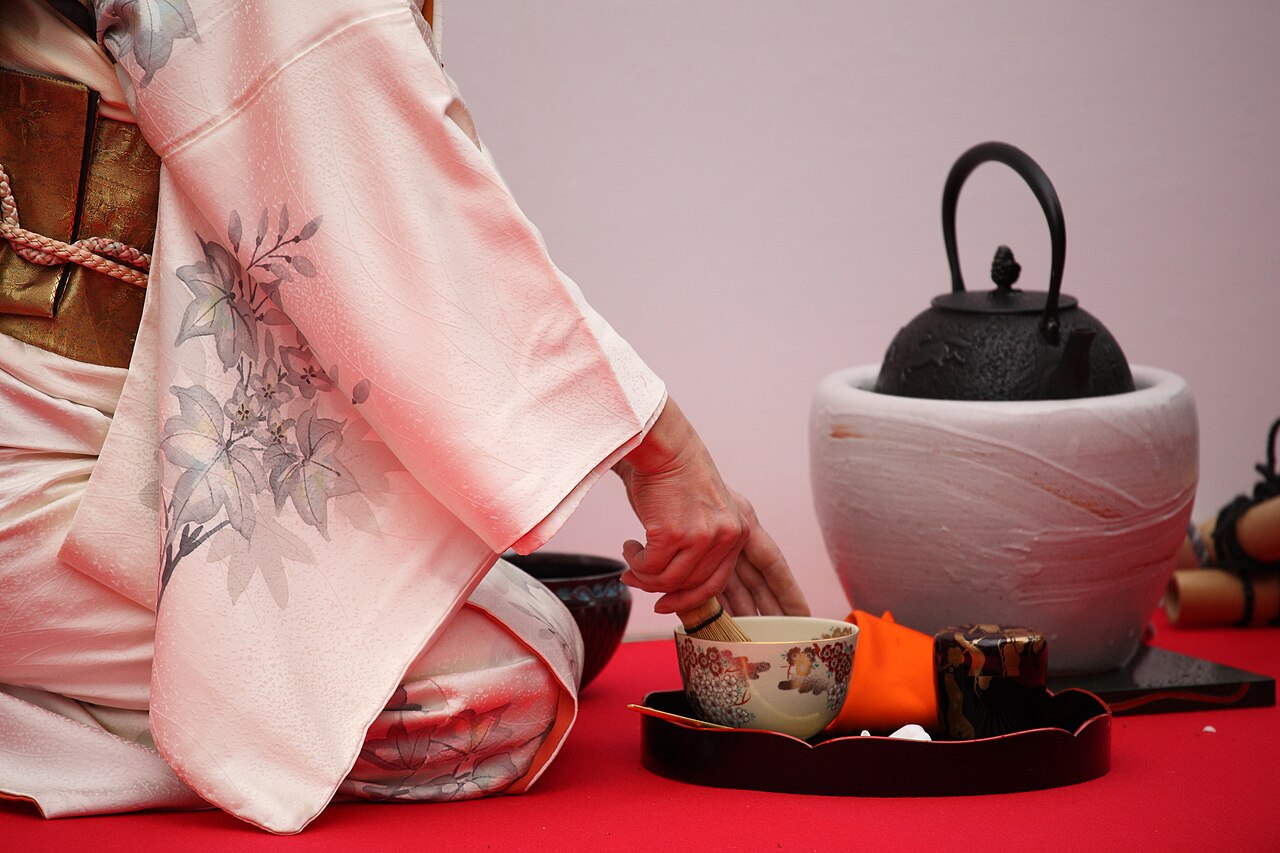
The host at an outdoor tea gathering whisks matcha for guests — the unhurried, detail-oriented care of the tea ceremony is the traditional wellspring of omotenashi. Photo: mrhayata, CC BY-SA 3.0, via Wikimedia Commons.
Meaning
Omotenashi (おもてなし) is usually translated as "hospitality," but the word carries a much deeper sense than the English term suggests. It describes a wholehearted, selfless way of caring for a guest (客, きゃく) — anticipating their needs before they voice them, and attending to every small detail of their comfort without any expectation of reward or recognition.
The word is often analyzed as coming from もてなす (motenasu, "to entertain / to treat [a guest]"), itself built from 持つ (motsu, "to hold") + なす (nasu, "to do/accomplish") — the idea of "holding" and "accomplishing" something for another person with one's full attention. A popular folk etymology also reads the polite prefix お- as standing in for 表なし ("without a front/back"), meaning there is no gap between how a host appears and how they truly feel — no calculation, no hidden agenda, just genuine care. Linguists don't universally accept that second etymology, but it captures something true about how the concept is understood today: omotenashi is supposed to be sincere all the way through, not a performance.
This is what separates omotenashi from ordinary customer サービス (service). Service is typically transactional — you pay, you receive a defined level of care in return. Omotenashi is offered whether or not anyone is watching, and whether or not it will ever be rewarded. A host who practices it tries to sense what a guest needs — a change of temperature, a moment of quiet, a small comfort — and provide it before being asked, then quietly steps back rather than seeking praise.
Cultural Context
Roots in tea ceremony
The philosophy of omotenashi is most closely associated with 茶道 (sadō/chadō, the Japanese tea ceremony). In the tea room, the host (亭主, ていしゅ) prepares for a gathering for weeks: selecting a hanging scroll and flowers to suit the season and the specific guests, choosing utensils that reflect the occasion, sweeping the garden path, and rehearsing each movement so that when guests finally arrive, everything feels effortless and unforced. None of this preparation is visible to the guest — that is the point. Omotenashi is invisible labor performed purely for someone else's benefit.
This ethos is inseparable from 一期一会 (ichigo ichie), "one time, one meeting," a tea-ceremony principle popularized by the 16th-century tea master Sen no Rikyū's circle. It holds that any given gathering can never be exactly repeated — even if the same people meet again, that precise moment, that season, that state of mind will never return. Because the encounter is unrepeatable, the host pours everything into making it as complete and considered as possible, and the guest, in turn, is expected to receive that care with full attention and gratitude. Omotenashi and ichigo ichie are, in effect, two halves of the same idea: the host's selfless effort and the shared understanding that the moment matters precisely because it is fleeting.
Not just service — a mutual spirit
A subtlety often lost in translation is that omotenashi is not purely something a host does to a guest. In its fullest sense, especially within tea ceremony, it describes a mutual spirit: the host prepares with total sincerity, and the guest is expected to appreciate that effort — noticing the choice of flowers, complimenting the scroll, receiving the tea bowl with care. Hospitality, in this framing, is a two-way act of attentiveness, not a one-directional service exchange.
The 2013 Olympic bid
Omotenashi became a household word outside Japan in September 2013, when broadcaster and bid ambassador Christel Takigawa used it in Tokyo's final presentation to the International Olympic Committee in Buenos Aires, promising visitors to the 2020 Games would be welcomed with "the wonderful tradition of omotenashi." She punctuated the word with a distinctive hands-together bow, and the moment was replayed constantly in Japanese media, turning omotenashi into a kind of unofficial national branding term for the Tokyo Olympics — shorthand for warm, meticulous Japanese welcome culture aimed at the millions of visitors expected for the Games (later held, delayed by the pandemic, in 2021).
Usage
Omotenashi shows up constantly in ordinary Japanese life, well beyond tea ceremony and ryokan inns, though it is invoked most explicitly in hospitality and service industries.
日本の旅館では、心のこもったおもてなしを受けられます。 Nihon no ryokan de wa, kokoro no komotta omotenashi o ukeraremasu. "At Japanese ryokan inns, you can experience heartfelt hospitality."
おもてなしの心を大切にしています。 Omotenashi no kokoro o taisetsu ni shite imasu. "We value the spirit of omotenashi."
接客にはおもてなしの精神が求められます。 Sekkyaku ni wa omotenashi no seishin ga motomeraremasu. "Customer service calls for the spirit of omotenashi."
Where you'll encounter it
| Setting | How omotenashi appears |
|---|---|
| Ryokan (旅館) | Staff study a guest's arrival time and preferences in advance; futon are laid out while guests bathe, so they never see it being done |
| Department stores | Elevator attendants, gift-wrapping staff, and greeters who bow to every customer regardless of purchase size |
| Restaurants | A host noticing a cold draft and quietly moving a party to a warmer seat without being asked |
| Tea ceremony (茶道) | Seasonal flowers, scroll, and sweets chosen specifically for that day's guests |
| Airlines & trains | Staff who bow to an empty platform or aircraft after passengers have left |
Related Concepts
- 思いやり (omoiyari) — empathy or consideration for others; the broader emotional disposition that omotenashi puts into hospitality practice.
- 気配り (kikubari) — attentiveness to small details and other people's needs; the practical skill underlying good omotenashi.
- 心遣い (kokorozukai) — a thoughtful gesture or consideration shown to someone, often used to describe a specific instance of omotenashi in action.
- 侘び寂び (wabi-sabi) — the aesthetic of simple, imperfect beauty that shapes the understated, unshowy way omotenashi is usually expressed (a quiet gesture rather than a grand one).
Criticism and Modern Debate
In recent years, some commentators have pushed back on treating omotenashi as an unqualified national virtue. Critics point out that the ideal of hospitality "without expectation of reward" has sometimes been used to justify low wages and unpaid overtime in Japan's service industry, where workers are expected to provide exhaustive, unpaid emotional labor as a matter of professional pride. The word's heavy use as tourism marketing around the 2020 Olympics also drew some eye-rolling domestically, with critics noting a gap between the polished slogan and the everyday strain on service workers expected to embody it.
Related Dictionary Words
once-in-a-lifetime encounter; uniquely precious experience; one lifetime, one meeting
tea ceremony; Way of Tea; sadō
ryokan; traditional Japanese inn
guest; visitor
care; attentiveness; attention; consideration (for others); solicitude
consideration; thoughtfulness; sympathy; compassion; feeling; kindness; understanding; regard; kindheartedness
serving customers; looking after visitors; reception
consideration (for); thoughtfulness; solicitude; care; watchfulness; concern; sympathy
household head; master; host (e.g. of a tea gathering); innkeeper; owner (e.g. of a hotel)
wabi-sabi; aesthetic sense in Japanese art centered on the acceptance of transience and imperfection
service; help; assistance; care; concern
mind; heart; spirit