ワンピース
wanpiisuOne Piece is Eiichiro Oda's mega-hit pirate adventure manga and anime, the best-selling manga series of all time, following Monkey D. Luffy's quest to find the legendary treasure and become the Pirate King.
Meaning
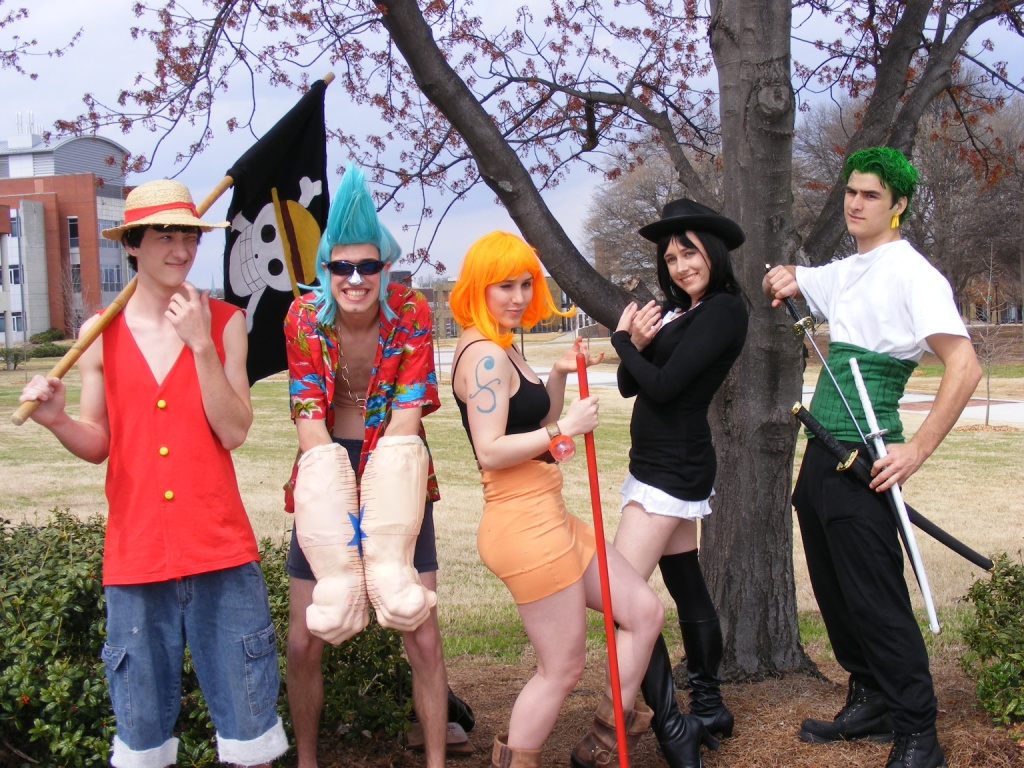
Fans cosplaying the Straw Hat Pirates crew at a convention. Photo: Sparr Risher, CC BY-SA 2.0, via Wikimedia Commons.
ワンピース (One Piece) is a Japanese 少年 (shōnen, "boys'") manga written and illustrated by Eiichiro Oda, serialized in Weekly Shōnen Jump since 1997. It is the best-selling manga series in history, with well over 500 million copies in circulation worldwide, and its anime adaptation has run continuously since 1999 with more than 1,100 episodes. The title refers to "One Piece," the 伝説 (densetsu, "legendary") treasure left behind by the previous Pirate King, Gol D. Roger — the object of a worldwide 冒険 (bōken, "adventure") that drives the entire story.
The series follows Monkey D. Luffy, a young man who ate a mysterious 果実 called a Devil Fruit (悪魔の実, akuma no mi) that turned his body to rubber, at the cost of never being able to swim again. Luffy sets out to sea to assemble a crew, sail to the end of the Grand Line, find One Piece, and become the next Pirate King — a dream stated so simply and so often that it has become the series' emotional anchor.
The World, Devil Fruits, and the Grand Line
One Piece takes place in a fictional world dominated by 海賊 (kaizoku, "pirates"), the 海軍 (kaigun, "Navy" — called the Marines in translation), and secretive world governments. Most of the map is ocean, and the central sea route, the Grand Line, is notorious for chaotic weather and hidden 財宝 (zaihō, "treasure"). Key world-building concepts include:
| Term | Reading | Meaning |
|---|---|---|
| 悪魔の実 | あくまのみ | "Devil Fruit" — eating one grants a superhuman power but permanently removes the ability to swim |
| 海賊王 | かいぞくおう | "Pirate King," the title held by whoever finds One Piece |
| 麦わらの一味 | むぎわらのいちみ | "Straw Hat Pirates," Luffy's crew |
| 覇気 | はき | "Haki," a latent spiritual/willpower-based combat ability awakened by select characters |
| グランドライン | — | "Grand Line," the treacherous sea that must be crossed to reach the final island |
Devil Fruits are the series' signature 能力 (nōryoku, "ability") system: each fruit grants a unique power — turning the eater's body into rubber, fire, or sand, or granting control over gravity, string, or even time in later arcs — but every user shares the same 呪い (noroi, "curse") of being unable to 泳ぐ (oyogu, "to swim"), a real liability on the 船 (fune, "ship") crossing dangerous seas.
The Straw Hat Pirates
Luffy's crew, the Straw Hat Pirates, grows one member at a time, and each recruit joins only after a self-contained story arc resolves their personal struggle. The core lineup includes Roronoa Zoro (a 剣士, kenshi, "swordsman" chasing his own dream of being the world's greatest swordsman), navigator Nami, sniper Usopp, cook Sanji, doctor Tony Tony Chopper (a talking reindeer), archaeologist Nico Robin, shipwright Franky, musician Brook, and helmsman Jinbe. Each has distinct motives, but all share Luffy's captain's flag — the skull-and-crossbones Jolly Roger — and his open, chaotic optimism.
The crew dynamic is the emotional core of the series: despite constant fights, teasing, and wildly different personalities, the 仲間 (nakama, "comrades"/"crew") bond between them is treated as close to sacred. "Nakama" has become one of the most recognizable Japanese loanwords among English-speaking anime fans specifically because of One Piece — it is often left untranslated in fan discussion to capture a sense of found family and loyalty that goes beyond "friend" or "colleague."
海賊王に、俺はなる! (Kaizoku-ō ni, ore wa naru!) "I'm going to become the Pirate King!"
Luffy's catchphrase, repeated throughout the series, distills the whole premise: a simple, stated dream pursued with total sincerity.
Structure and Scale
Oda plans One Piece as one continuous story told through discrete island arcs — East Blue, Alabasta, Skypiea, Water 7, Marineford, Dressrosa, Whole Cake Island, Wano Country, and the ongoing final saga. As of 2026 the manga has passed 1,100 chapters collected into more than 110 巻 (kan, "volumes"), and Oda has stated the story is approaching its ending after roughly three decades of 週刊 (shūkan, "weekly") 連載 (rensai, "serialization"). The manga's scope — every named character, every Devil Fruit, every flashback — is famous for interlocking with almost no wasted detail, which has made it a favorite subject of long-form fan theorizing online.
Cultural Impact
One Piece is a genuine cross-generational phenomenon in Japan and, increasingly, worldwide. Guinness World Records has recognized it as the best-selling manga series by a single author. Its influence extends well beyond the page:
- Anime and film: The TV anime by Toei Animation has aired weekly since 1999, alongside more than a dozen theatrical films, the most successful of which (One Piece Film: Red, 2022) became one of the highest-grossing anime films ever.
- Netflix live-action: A live-action adaptation premiered on Netflix in 2023 to unusually positive reception for a manga adaptation, with a second season arriving in 2026, introducing the story to a large new non-Japanese audience.
- Merchandising and tourism: Straw hat replicas, Devil Fruit-themed snacks, and One Piece-branded collaborations are ubiquitous in Japan, and attractions like the former Tokyo One Piece Tower turned the series into a physical pilgrimage site for fans.
- Vocabulary: Beyond "nakama," terms like "Haki" and "Devil Fruit" have entered general otaku slang as shorthand for hidden potential or a defining special power, used jokingly even outside One Piece discussion.
Related Works
One Piece belongs to the same Weekly Shōnen Jump tradition as Dragon Ball, Naruto, and My Hero Academia — long-running, arc-based 少年 manga built around friendship, effort, and victory (友情・努力・勝利, the magazine's famous editorial mantra). Creator Eiichiro Oda has cited Dragon Ball as a formative influence and is known for an unusually hands-on, detail-obsessed approach to worldbuilding, down to hand-drawing the maps of every island the crew visits.
See Also
- Eiichiro Oda, the series' creator
- Otaku culture that embraces long-running series like this one
- Cosplay, a major venue for expressing One Piece fandom
Related Dictionary Words
companion; fellow; friend; mate; comrade; partner; colleague; coworker; associate
pirate
adventure; venture
dream
friendship; fellowship; camaraderie
freedom; liberty
ship; boat; watercraft; vessel; seaplane
swordsman; swordswoman; fencer
ship's captain; skipper
king; ruler; sovereign; monarch
treasure
the world; society; the universe
legend; folklore; tradition
secret; secrecy; confidentiality; privacy
treasure
navy; naval force
fruit; nut; berry
curse; spell; malediction
to swim
ability; faculty
boy
weekly publication
serialization; serialisation; serial story
roll (e.g. of cloth)