絞り
shiboriA traditional Japanese resist-dyeing technique in which cloth is bound, stitched, folded, or clamped before dyeing (most often with indigo) to create distinctive patterns, historically related to Western tie-dye.
Meaning
絞り (しぼり, shibori) comes from the verb shiboru (絞る), "to wring" or "to squeeze" — an apt name for a family of resist-dyeing techniques in which cloth is bound, stitched, folded, twisted, or compressed before dyeing so that the manipulated sections resist the dye and remain undyed, or lighter, once the fabric is unbound. The word describes the process, not a single pattern, which is why "shibori" covers dozens of distinct methods rather than one technique.
At its core, shibori works on a simple principle: wherever 布 (cloth) is tightly compressed, 染料 (dye) cannot fully penetrate. Release the binding after dyeing and a ghost of the original fabric's shape remains — a dot, a ripple, a pleat-line, a spiderweb — frozen in undyed thread against a field of color. Because the resist is created by physically manipulating the cloth itself rather than by painting or stamping a resist substance onto it, every shibori piece carries traces of the human hands that folded, bound, or stitched it. No two pieces are ever perfectly identical, which is precisely why the technique is prized.
Major Techniques
"Shibori" is really an umbrella term for a wide toolkit of resist methods, each producing a signature pattern:
| Technique | Japanese | Method | Resulting Pattern |
|---|---|---|---|
| Kanoko shibori | 鹿の子絞り | Individual sections of cloth pinched up and bound with thread, one by one | Small, evenly spaced dots resembling a fawn's spotted coat |
| Miura shibori | 三浦絞り | Cloth looped and bound with a hook technique (no knots needed) | Soft, water-like circular patterns |
| Kumo shibori | 蜘蛛絞り | Sections pleated finely and bound in tight, evenly spaced wraps | Radiating, web-like designs (kumo means 蜘蛛, "spider") |
| Nui shibori | 縫い絞り | Cloth stitched with a running 糸 (thread), then the thread is pulled taut before dyeing | Precise, controllable linear or pictorial motifs |
| Arashi shibori | 嵐絞り | Cloth wrapped diagonally around a pole, bound with thread, then scrunched down its length | Diagonal, storm-like striations (arashi means "storm") |
| Itajime shibori | 板締め絞り | Cloth folded accordion-style and clamped between two shaped boards (板) | Crisp, symmetrical geometric shapes |
Kanoko shibori is the oldest and most iconic method, and its dotted motif is so closely associated with the craft that "kanoko" is sometimes used as a near-synonym for shibori itself in casual speech. Arashi shibori, developed relatively late (19th century), is distinctive for using a pole as a dyeing tool rather than binding cloth flat, and it became especially popular with Western fiber artists because it scales easily to long lengths of fabric.
Shibori and Indigo
Although shibori can be dyed in any color, its most famous and historically dominant partner is 藍 (ai, indigo). 藍染め (indigo dyeing) was the everyday dyeing method of premodern Japan: the plant Persicaria tinctoria was fermented into a dye vat, and 木綿 (cotton) or 麻 (hemp) cloth — the fabrics ordinary people could afford — was repeatedly dipped and oxidized to build up its characteristic deep blue.
Indigo was not chosen only for its color. Indigo-dyed cloth was believed to repel insects and snakes and to have mild antiseptic qualities, making it ideal for farmers' and fishermen's work clothes. Combined with shibori's resist patterning, the result was inexpensive cotton garments that were simultaneously practical, durable, and visually striking — a rare combination of function and beauty that came to define folk textiles across Japan. The high contrast between white-resist patterning and deep indigo ground is what makes shibori instantly recognizable even to viewers unfamiliar with the technique's name.
Cultural Context and History
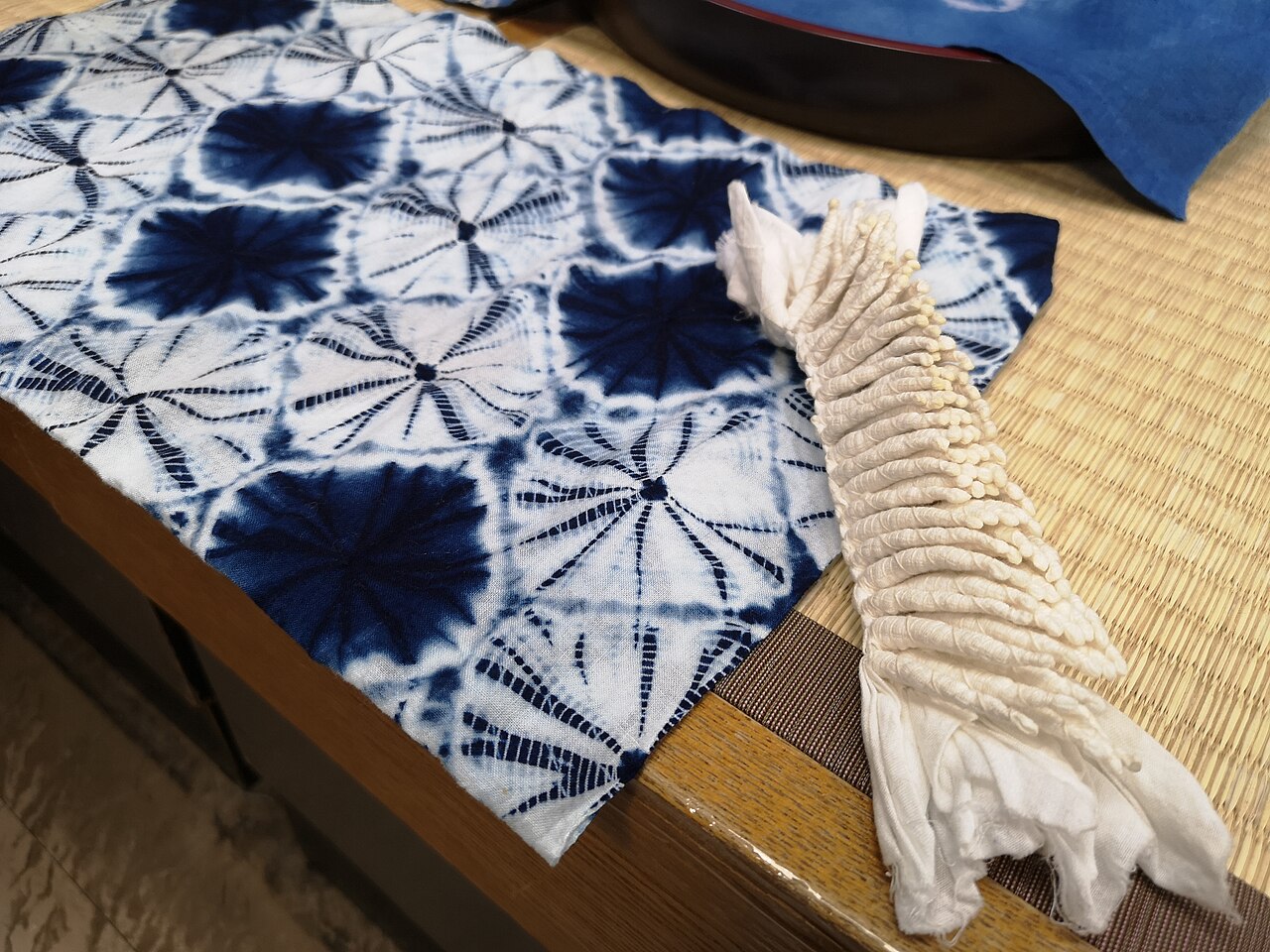
A craftsperson demonstrates hand-binding for kumo-style shibori in Arimatsu, Aichi Prefecture. Photo: 漱石の猫, CC BY-SA 4.0, via Wikimedia Commons.
Resist-dyeing by binding cloth is ancient and not unique to Japan — related techniques appear across Asia, Africa, and pre-Columbian Americas, and shibori is considered a direct historical relative of what English speakers now call "tie-dye." In Japan, the earliest surviving examples date to the 8th century: scraps of shibori-dyed silk are preserved in the Shōsōin repository in Nara, part of the treasure collection of Emperor Shōmu.
Shibori became a true mass craft during the Edo period (1603–1868), when strict sumptuary laws restricted the wealthy 織物 silk brocades that commoners could wear. Denied luxury textiles, ordinary people turned indigo-dyed cotton and shibori's labor-intensive patterning into a respectable, even admired, form of everyday decoration. Because binding thousands of tiny dots by hand required enormous time and 職人 (artisan) skill, elaborate all-over kanoko shibori kimono were themselves a quiet status symbol, despite using "common" cotton rather than silk.
Arimatsu-Narumi Shibori
The town of Arimatsu, now part of Nagoya in Aichi Prefecture, became Japan's undisputed center of shibori production starting in the early 1600s, when a local innkeeper is said to have adapted binding techniques learned from workers passing through on the Tōkaidō highway. Neighboring Narumi developed its own related tradition soon after, and the two towns' output is jointly known as Arimatsu-Narumi shibori.
By the 18th and 19th centuries, Arimatsu had developed over 100 distinct named binding techniques, each historically kept as a closely guarded trade secret of individual family workshops — a division of specialized labor that let the town produce shibori at a scale no single artisan could achieve alone. Arimatsu-Narumi shibori was designated a Japanese Traditional Craft (伝統的工芸品) in 1975, and the town still holds an annual Shibori Matsuri (絞り祭り) festival each June celebrating the 伝統 (tradition). Today Arimatsu's preserved Edo-period streetscape and shibori museum draw visitors as both a heritage site and a working craft town.
Shibori and Tie-Dye
Shibori is frequently described in English-language contexts as "Japanese tie-dye," and while the comparison is a useful entry point, it understates shibori's technical range. Western tie-dye, as it emerged from 1960s counterculture, typically relies on twisting and rubber-banding cloth before applying dye directly by hand — a fast, improvisational process. Shibori encompasses that approach (arashi and kumo shibori both resemble binding-and-dyeing) but also includes stitch-resist (nui) and clamp-resist (itajime) methods that produce far more precise, planned, and repeatable 模様 (patterns), closer to a controlled printmaking process than free-form tie-dye. Historically, shibori was also applied to formal garments like 着物 and 浴衣, giving it a place in mainstream fashion that Western tie-dye did not have until much later.
Modern Revival
Shibori nearly disappeared as an industrial craft in the mid-20th century, as cheaper printed textiles and synthetic dyes undercut hand-bound production. It survived through a combination of UNESCO-style craft preservation efforts, boutique fashion revival, and — since the 2010s — a global surge of interest from independent textile artists and the slow-fashion, natural-dye, and sustainability-minded craft communities. Indigo shibori scarves, tote bags, and home textiles are now widely sold outside Japan, often dyed with natural indigo as a selling point over cheaper chemical dyes.
Contemporary fashion designers have repeatedly drawn on shibori's high-contrast patterning, and DIY shibori kits using rubber bands, wooden blocks, and bottled indigo dye have made the craft accessible to home crafters worldwide, echoing the same broader interest in Japanese textile traditions (sashiko, boro, kumihimo) that has grown alongside the international slow-craft movement.
Related Concepts
- Kanoko shibori (鹿の子絞り) — The oldest and most iconic dotted-pattern shibori technique
- Ai-zome (藍染め) — Traditional Japanese indigo dyeing, shibori's most common dye partner
- Boro (ぼろ) — Patched indigo textile tradition, a close cousin of sashiko and shibori aesthetics
- Sashiko (刺し子) — Indigo-and-white running-stitch embroidery, historically dyed and worn alongside shibori
- Tie-dye — The Western resist-dyeing tradition most often compared to shibori
Related Dictionary Words
shibori; tie-dye; tie-dyeing
dyer's knotweed (Persicaria tinctoria, used to produce indigo dye)
indigo dye
dyes
cloth; fabric; material; textile
cotton (material)
cannabis (Cannabis sativa); hemp (plant)
craftsman; artisan; tradesman; worker; workman
tradition; convention
pattern; figure; design
industrial arts; craft
kimono; Japanese traditional clothing (esp. full-length)
yukata; light cotton kimono worn in the summer or used as a bathrobe
board; plank
thread; yarn; string
spider
cloth dyed in a dapple pattern
textile; fabric