組み紐
kumihimoThe traditional Japanese craft of braiding silk cords on stands like the maru-dai, historically used for samurai armor and sword mountings, now recognized worldwide thanks to Demon Slayer.
Meaning
組み紐 (kumihimo) literally combines 組む (to braid or plait) with 紐 (cord, string), and refers to the centuries-old Japanese art of braiding fine threads — traditionally silk — into strong, decorative cords. Unlike simple three-strand braiding, kumihimo uses dozens of individual threads worked over a stand in a precise rotating sequence, producing intricate round, flat, or hollow cords with geometric patterns running along their length. The resulting cords are prized both for their strength (a braided cord resists stretching and fraying far better than a woven ribbon) and for their beauty, since the braiding structure itself creates the pattern rather than a printed or dyed design.
Traditional Tools and Techniques
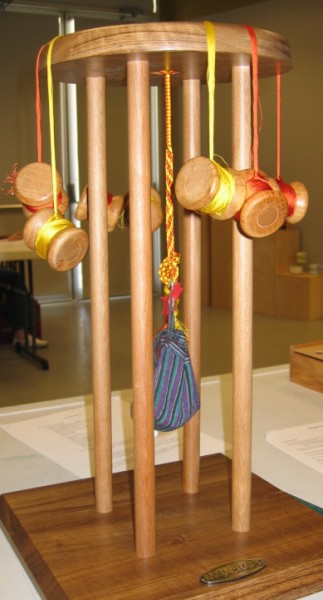
A maru-dai (丸台) stand with silk threads wound on weighted tama bobbins, braided into a cord through the central hole. Photo: Ccassan, public domain, via Wikimedia Commons.
Kumihimo is braided on specialized stands, each suited to a different style of cord:
- 丸台 (maru-dai) — a round-topped wooden stand on four legs, the most common tool. Threads are wound onto weighted bobbins called tama and hang around the stand's circular counterweight (kagami, or "mirror"). The braider sits in front of it, crossing pairs of tama over one another in sequence; gravity and the tama's weight keep tension even as the finished cord is slowly pulled down through the hole in the center.
- Taka-dai (高台) — a larger, loom-like frame with two rows of angled slats, used for flat, wide braids such as the elaborate obi-jime worn with formal kimono. The braider works two shuttles of thread simultaneously, one in each hand, passing them back and forth across the frame — a technique that demands more space and more advanced coordination than the maru-dai.
- Kaku-dai and Ayatake-dai — square and specialized stands for particular cord shapes, used less commonly today but still taught in professional workshops.
A single cord can take anywhere from a few hours to many weeks to complete, depending on the number of threads, the complexity of the pattern, and the braider's skill. Historically, apprentices trained for years before being allowed to braid cords for formal or ceremonial use.
History
Braided cords have been used in Japan since at least the Nara period (710–794), when Buddhist ritual objects and sutras were bound with braided silk imported along the same trade routes as Buddhism itself. But kumihimo's importance grew enormously during Japan's feudal era, when 武士 (samurai) needed strong, precisely-sized cords for practical military use:
- Armor lacing (odoshi) — the lamellar plates of samurai 鎧 (armor) were laced together with long kumihimo cords, whose exact length, tension, and color pattern indicated a warrior's clan and rank.
- Sword mountings — the sageo (cord for securing a scabbard to the wearer's obi) and the tsuka-ito (handle wrapping) of a 刀 were both kumihimo work, valued for the grip and durability a braided cord provides over a flat ribbon.
During the peaceful Edo period (1603–1868), as the demand for military hardware declined, kumihimo artisans redirected their skills toward civilian fashion — most importantly the obi-jime, the decorative cord tied around the obi sash to hold a 着物 closed. This shift preserved the craft through Japan's modernization, and cities like Kyoto and Iga (in Mie Prefecture) became — and remain — the country's leading kumihimo production centers.
Kumihimo Today
Modern kumihimo occupies a small but essential place in traditional dress and ceremony. An obi-jime is still considered a required finishing touch for formal kimono, and its color and pattern are chosen to complement the season and the occasion. In 茶道 (tea ceremony), kumihimo cords are used to tie the fukusa (silk cloth) pouch and other implements, and practitioners learn to handle and even braid simple cords as part of a well-rounded appreciation of traditional craft. Because a hand-braided silk obi-jime from a workshop like Iga Kumihimo or Kyoto's Domyo can take a skilled artisan a full day or more to complete, fine examples are treated as small works of art, sometimes passed down as heirlooms.
Demon Slayer and the Global Kumihimo Boom
Kumihimo's profile outside Japan changed dramatically after the 2019 anime adaptation of Koyoharu Gotouge's manga 鬼滅の刃 (Kimetsu no Yaiba, "Demon Slayer"). The character Nezuko Kamado wears a braided cord tied around a bamboo muzzle to suppress her demonic urges — an unmistakably kumihimo-style cord rendered in loving detail by the animation studio ufotable. The protagonist Tanjiro's hanafuda (flower-card) patterned earrings are similarly framed by braided cord work, and other characters wear kumihimo hair ties and accessories throughout the series.
The show's massive global popularity — it became one of the best-selling manga franchises in history and its films broke Japanese box-office records — sent a wave of curious fans searching for "Nezuko cord" and "how to make kumihimo." The effects have been concrete and measurable:
- Kits and tutorials — craft retailers both in Japan and abroad reported shortages of beginner kumihimo disk kits (the small foam or plastic disks used for simple four- or eight-strand braiding at home), and YouTube and TikTok tutorials recreating Nezuko's cord accumulated millions of views.
- Tourism to braiding studios — workshops in Kyoto and the historic braiding town of Iga saw a rise in visitors, particularly younger and international travelers, booking hands-on maru-dai lessons as an anime-pilgrimage activity alongside visits to locations associated with the series.
- Crossover product lines — several kumihimo suppliers and craft brands released official or fan-inspired "Nezuko cord" kits and colorways, explicitly marketing traditional techniques through the anime's branding.
For a centuries-old craft that had been quietly sustained mostly by kimono culture and hobbyist fiber artists, this sudden association with one of the decade's biggest anime franchises introduced kumihimo to an entirely new, much younger, and much more international audience — a rare case of a traditional Japanese handicraft riding a modern pop-culture wave rather than fading from it.
Related Terms
| Term | Reading | Meaning |
|---|---|---|
| 帯締め | obijime | Braided cord tied over an obi sash on kimono |
| 丸台 | maru-dai | Round braiding stand, the most common kumihimo tool |
| 高台 | taka-dai | Frame loom for wide, flat braids |
| 下緒 | sageo | Cord for securing a sword scabbard |
| 縅 | odoshi | Lacing cords used to assemble samurai armor |
Related Dictionary Words
braid; plaited cord
decorative string used to hold a kimono sash in place
braiding stand with a circular top
samurai; warrior
armor; armour
sword (esp. Japanese single-edged); katana
tea ceremony; Way of Tea; sadō
kimono; Japanese traditional clothing (esp. full-length)
Demon Slayer: Kimetsu no Yaiba (manga, anime)
string; cord