太鼓
taikoTraditional Japanese barrel drums with roots stretching back over a millennium, now celebrated worldwide through thunderous ensemble performance and iconic rhythm games.
What is Taiko?
太鼓 (taiko, literally "fat drum" or "great drum") is the umbrella term for a family of Japanese percussion instruments that have been central to the country's cultural and spiritual life for well over a thousand years. The word covers a wide range of drum sizes and constructions, from small handheld instruments to enormous festival drums that can weigh hundreds of kilograms.
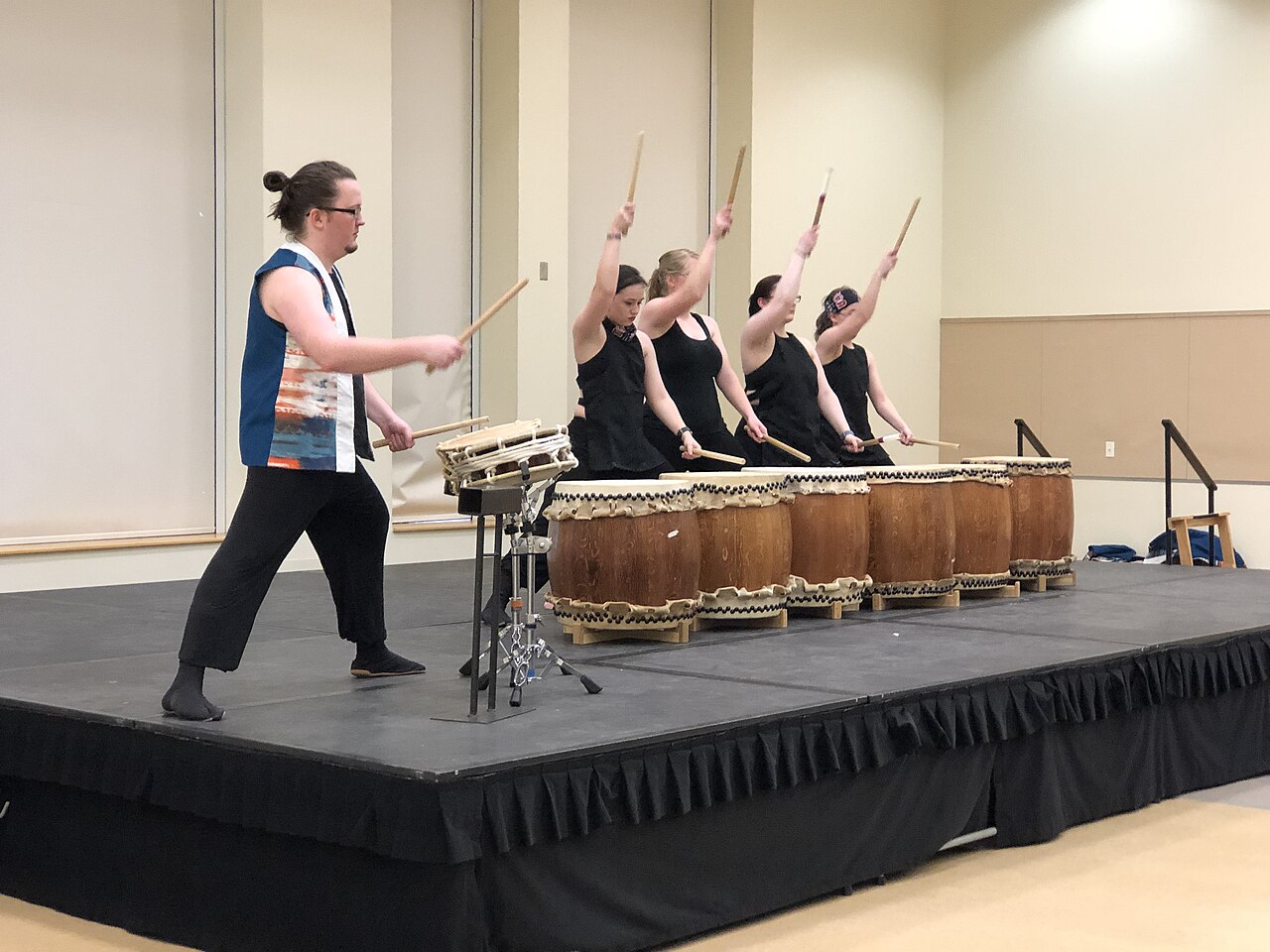
Taiko ensemble performance. Photo: Mbrickn, CC BY-SA 4.0, via Wikimedia Commons.
In everyday Japanese, 太鼓 also appears in the expression 太鼓判を押す (たいこばんをおす, taiko-ban wo osu), meaning to give something a stamp of approval — the drum's round seal shape became a metaphor for endorsement.
History
Archaeological evidence places drum-like instruments on the Japanese archipelago as far back as the Jomon period (c. 10,000–300 BCE), though the barrel-style 太鼓 recognizable today arrived with influences from continental Asia around the 6th century CE, alongside Buddhism.
For much of Japan's history, taiko occupied a sacred role. Buddhist temples and Shinto shrines incorporated drums into ritual ceremony — the resonant boom was thought to ward off evil, summon deities, and mark the rhythm of prayer. Simultaneously, taiko carried utilitarian weight in the military: battlefield commanders used large war drums (陣太鼓, jin-daiko) to signal troop movements and set the pace of an advance.
The instrument also found its way into Japan's classical performing arts. 音楽 forms such as gagaku (雅楽, imperial court music), noh (能), and kabuki (歌舞伎) all feature specific taiko variants as integral parts of their soundscapes. Seasonal 祭り across the country developed their own regional drumming traditions, many of which survive unchanged today.
Types of Taiko Drums
The taiko family is diverse. The most common types are:
| Name | Japanese | Description |
|---|---|---|
| Nagado-daiko | 長胴太鼓 | "Long-body drum" — the quintessential barrel drum, carved from a single log, with two rawhide heads fastened by iron tacks |
| Odaiko | 大太鼓 | "Great drum" — massive festival drums, some exceeding 2 metres in diameter, struck by a single performer |
| Shimedaiko | 締め太鼓 | Shallow, rope-tensioned drum used in noh and folk ensembles; produces a sharp, crisp crack |
| Uchiwa-daiko | 団扇太鼓 | Fan-shaped handheld drum associated with Buddhist chanting |
| Okedo-daiko | 桶胴太鼓 | Lighter stave-constructed drum, often slung over the shoulder for processional use |
All taiko are struck with sticks called bachi (撥). The 皮 (drumhead) is typically cowhide; the body is traditionally carved from 竹 or zelkova wood, though modern drums also use laminated materials.
Kumi-daiko — Ensemble Drumming
和太鼓 (wa-daiko, "Japanese drum") is the modern term that distinguishes native Japanese drums from Western instruments, and it is most closely associated with kumi-daiko (組太鼓), ensemble drumming.
Kumi-daiko as a structured performing art is surprisingly recent. In 1951, jazz drummer Daihachi Oguchi discovered an old piece of taiko sheet music and was struck by a simple question: why did nobody play taiko together? He assembled a group and invented the first kumi-daiko ensemble — multiple drums of different sizes played simultaneously, combined with choreographed physical movement and vocal shouts (kakegoe, 掛け声).
The format exploded in the 1960s and 1970s. Groups such as Ondekoza (鬼太鼓座) and later Kodo (鼓童, established 1981 on Sado Island) transformed kumi-daiko into high art, blending 伝統 folk technique with theatrical staging and athletic physical discipline. Kodo in particular became Japan's most internationally recognized taiko ensemble, touring the world and establishing the "Earth Celebration" festival on Sado Island.
演奏 in a kumi-daiko group demands both physical stamina and deep rhythmic precision. Players must synchronize リズム patterns across many drums while maintaining powerful, full-body striking technique — taiko is often described as much a martial art as a musical one.
Taiko in Modern Culture
Today taiko has spread far beyond Japan. North America, Europe, Australia, and Brazil all have active taiko communities, many seeded by the Japanese diaspora. University taiko clubs are common on US campuses, and groups like San Francisco Taiko Dojo (founded 1968) have been instrumental in carrying the art overseas.
Within Japan, taiko remains central to summer festivals (夏祭り, natsumatsuri) and seasonal events. The thunderous beat of large festival drums is inseparable from the atmosphere of a traditional 祭り. Schools, community centers, and corporate team-building programs all incorporate taiko training — its combination of physical exertion, rhythm, and group coordination makes it appealing well beyond traditional performance contexts.
Professional troupes such as Yamato (ヤマト) and TAO stage elaborate theatrical shows that blend taiko with acrobatics and visual spectacle, selling out concert halls internationally.
Taiko no Tatsujin — The Game
太鼓の達人 (Taiko no Tatsujin, "Drum Master" or "Taiko Prodigy") is a rhythm game franchise by Bandai Namco that has become one of Japan's most beloved arcade institutions since its launch on February 21, 2001.
The premise is simple: players use two drumsticks to hit a large taiko drum controller, matching on-screen notes that scroll from right to left. Red notes (ドン, don) hit the drum face; blue notes (カッ, ka) strike the rim. A cheerful mascot character named Don-chan (どんちゃん) — a round red drum with a face — guides players through hundreds of songs.
The game's song library spans J-pop, anime themes, classical music, folk songs, and Vocaloid tracks, making it genuinely cross-generational. A grandparent and grandchild can both enjoy the same cabinet. Over its 24-year run the franchise has produced more than 60 releases across arcade, console, and mobile platforms, consistently dominating Japanese rhythm-game charts.
For many younger Japanese people, 太鼓の達人 is their first meaningful encounter with the taiko drum — a gateway to appreciating the real instrument's cultural weight.
Cultural Significance
The sound of taiko carries a primal resonance that cuts across centuries of Japanese cultural change. Whether shaking the ground at a summer festival, anchoring a sacred Shinto ceremony, powering a world-tour performance by Kodo, or cheerfully welcoming players in a game center, the 太鼓 remains a living thread connecting contemporary Japan to its deepest roots.
Its global spread reflects a broader appetite for participatory, physically demanding musical forms — and a growing recognition that the 鼓 heartbeat at the center of Japanese communal life is something universal.