神道
shintoJapan's indigenous spiritual tradition centred on reverence for kami — sacred spirits believed to inhabit nature, places, and ancestors — practiced through shrine rituals, seasonal festivals, and everyday acts of purification.
Meaning
神道 (shinto) literally combines 神 (kami, "spirit" or "deity") and 道 (michi/dō, "way" or "path") — the Way of the Kami. It is Japan's oldest spiritual tradition, rooted in the belief that sacred beings called kami inhabit all of 自然: mountains, rivers, trees, rocks, storms, and the forces of creation itself. There is no single founder, no canonical holy scripture, and no creed demanding exclusive commitment. Shinto is less a religion in the Western sense than a living relationship between people, place, and the invisible forces that animate the world.
The word kami resists clean translation. It encompasses the great deities of 神話 such as Amaterasu (the sun goddess) as well as the spirit residing in an ancient cedar tree, a sacred waterfall, or the soul of a revered 祖先. Anything that inspires awe — that is felt to possess extraordinary vitality or mysterious power — may be called kami. Classical texts mention "eight million kami" (八百万の神, yaoyorozu no kami), a poetic way of saying the sacred is everywhere.
Key Concepts
Kami and Kannagara
Kami are not omnipotent gods standing apart from creation; they are immanent, woven into the fabric of the natural world. The ideal way of living in harmony with their flow is called kannagara — going with the kami's way, remaining attuned to the sacred order of things.
Musubi — Vital Energy
Musubi (結び) is one of Shinto's most important principles: the generative, binding energy through which kami bring forth life, growth, and connection. The word is related to musubu (to tie or bind), which is why shimenawa — the thick twisted straw ropes seen at shrines — visually embody musubi, marking a boundary where sacred energy is especially present.
Harae — Purification
Central to Shinto practice is 禊 (misogi, ritual purification by water) and harae (祓, ceremonial purification). The underlying idea is that impurity (kegare) — whether from contact with death, illness, moral transgression, or simply the dust of everyday life — clouds the soul like tarnish on a mirror. Purification removes that tarnish, restoring brightness (精神 and clarity).
Ma — Sacred Interval
The concept of ma (間) — interval, pause, negative space — pervades Shinto aesthetics and ritual. The empty gravel gardens of shrines, the deliberate silence before a prayer, the gap between the torii and the main hall: all are expressions of ma, a receptive space in which the sacred can be felt.
Shrine Anatomy
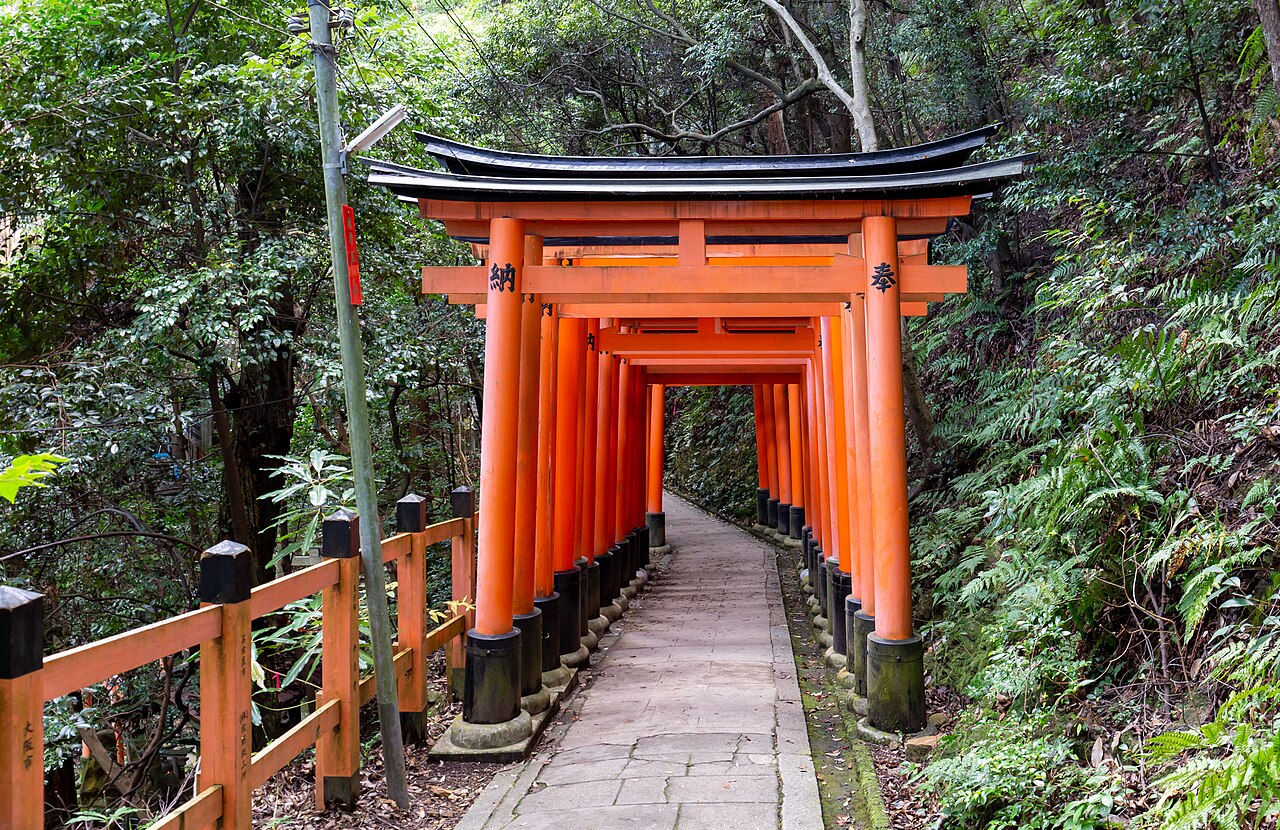
The senbon-torii (thousand torii gates) of Fushimi Inari Taisha, Kyoto. Public domain (CC0), via Wikimedia Commons.
A 神社 (jinja, Shinto shrine) is not primarily a place of congregational worship but a dwelling — a place where kami reside and can be approached. Moving through a shrine is itself a ritual journey.
| Element | Japanese | Role |
|---|---|---|
| Torii gate | 鳥居 | Marks the boundary between everyday and sacred space |
| Temizuya | 手水舎 | Purification fountain; visitors rinse hands and mouth before proceeding |
| Sandō | 参道 | The approach path leading to the main buildings |
| Honden | 本殿 | The innermost sanctuary housing the go-shintai (divine body of the kami) |
| Haiden | 拝殿 | The hall of worship where visitors pray and priests perform rites |
| Shimenawa | 注連縄 | Sacred twisted rope marking a kami's presence |
| Shide | 紙垂 | White zigzag paper streamers attached to shimenawa and wands |
| Ema | 絵馬 | Wooden wishing plaques left by worshippers |
| Omikuji | おみくじ | Paper fortune slips drawn at the shrine |
When approaching the haiden, visitors observe a quiet protocol: bow twice, clap twice, hold a silent prayer, then bow once more (二礼二拍手一礼, ni-rei ni-hakushu ichi-rei).
お守り (omamori, protective charms) are sold at shrines and embody the kami's protection — see the dedicated article on omamori for details.
Major Kami and Shrines
Amaterasu and Ise Jingū
Amaterasu-Ōmikami (天照大御神, the Great Deity Illuminating Heaven) is the supreme kami of the sun and progenitor of the imperial family according to the Kojiki (古事記, Japan's oldest chronicle, 712 CE). She is enshrined at Ise Jingū in Mie Prefecture — Japan's most sacred shrine complex, consisting of the Inner Shrine (Naikū) dedicated to Amaterasu and the Outer Shrine (Gekū) dedicated to Toyouke, kami of food and agriculture. Ise is so sacred that the main buildings are rebuilt from scratch every twenty years (shikinen sengū), a ritual renewal that has continued for over 1,300 years.
Inari and Fushimi Inari Taisha
Inari is the kami of rice, agriculture, foxes, and 商売 (commerce). The head shrine, Fushimi Inari Taisha in Kyoto, is famous for its thousands of vermilion torii gates (千本鳥居, senbon-torii) winding up a forested mountain. Foxes (kitsune) serve as Inari's messengers; white fox statues flank the approaches at Inari shrines across Japan.
Meiji Jingū
Located in the heart of Tokyo, Meiji Jingū enshrines the spirits of Emperor Meiji (1852–1912) and Empress Shōken. It receives the largest hatsumode crowds in Japan each New Year — over three million visitors in the first three days of January.
Izumo Taisha
Izumo Taisha in Shimane Prefecture enshrines Ōkuninushi-no-Mikoto, kami of nation-building and matchmaking. Every October (called Kannazuki, "month without kami" in most of Japan), the eight million kami are said to gather at Izumo for a divine assembly, which is why October is called Kamiarizuki ("month with kami") there.
Shinto in Daily Life
Hatsumode — First Shrine Visit
初詣 (hatsumode) is the first shrine or temple visit of the New Year, typically during the first three days of お正月. Families pray for health, safety, and good fortune in the coming year, draw omikuji fortune slips, and buy new omamori. It is one of the most universally observed customs in Japan, practiced even by people who would not describe themselves as religious.
Shichi-Go-San
七五三 (shichi-go-san, "seven-five-three") marks the ages 3, 5, and 7 as spiritually significant milestones in a child's life. Families dress children in formal kimono and visit a shrine in November, giving thanks to kami for the child's healthy growth and praying for their continued wellbeing.
Weddings
Shinto 結婚 ceremonies (shinzen kekkon) take place in the shrine's haiden. The priest purifies the couple with a wand (ōnusa), prayers (norito) are recited, and the couple shares three cups of sake (san-san-kudo) in a ritual binding them to each other and to the kami.
Matsuri
祭り (matsuri, festivals) are among Shinto's most vibrant expressions. Originally 儀式 rites to welcome, entertain, and thank kami — ensuring good harvests, warding off plague, celebrating seasonal turning points — matsuri evolved into elaborate communal celebrations with processions, portable shrines (mikoshi), music, and dance. See the dedicated matsuri article for a full exploration.
Everyday Encounters with Shinto
Beyond formal events, Shinto permeates ordinary life. A small roadside stone enshrining a local kami (dosojin), the ritual first-of-season offerings to the kami of the family business, the 神主 (kannagi/kannushi, shrine priest) performing a blessing at a new building's groundbreaking (jichinsai) — these quiet 伝統 observances stitch the sacred into the fabric of daily existence.
Shinto and Buddhism: A Long Entanglement
When Buddhism arrived in Japan from the Korean peninsula around the 6th century CE, it did not displace Shinto but merged with it in a centuries-long process of syncretism known as shinbutsu-shūgō (神仏習合, "amalgamation of kami and buddhas"). Kami came to be understood as local manifestations of buddhas and bodhisattvas (honji suijaku theory). Buddhist temples and Shinto shrines shared the same precincts, priests served both traditions, and the distinction between a 信仰 in kami and a 信仰 in the Buddha was rarely experienced as a contradiction.
This synthesis lasted over a thousand years until 1868, when the new Meiji government — seeking to elevate the emperor's divine authority as a political tool — issued the Kami and Buddhism Separation Decree (shinbutsu bunri rei). Shrines and temples were forcibly separated, Buddhist imagery removed from shrine precincts, and a wave of anti-Buddhist destruction (haibutsu kishaku) swept through parts of the country. 神仏 分離 remade the religious landscape of Japan almost overnight.
State Shinto vs. Folk Shinto
The Meiji period institutionalised a form of State Shinto (kokka shinto) that framed Ise Jingū and emperor veneration as 国家 civic duties rather than religion — a rhetorical move that allowed compulsory participation regardless of personal belief. State Shinto was used to build nationalist sentiment leading up to and through World War II. After Japan's defeat in 1945, the Allied Occupation issued the Shinto Directive, disestablishing state support for Shinto and separating it from government.
Folk Shinto (minkan shinto) refers to the vast grassroots layer of practice: local tutelary shrines (ujigami), agricultural and seasonal rites, protective deities at crossroads, household god-shelves (kamidana) — the everyday 文化 of living with kami that exists largely outside formal institutions and has continued largely unchanged through all political upheavals.
Not Quite a "Religion"
One of the most striking features of Shinto is that most Japanese people who participate in its practices — visiting shrines on New Year, attending shichi-go-san, having a Shinto wedding — do not identify as "Shinto believers" in any exclusive sense. Surveys consistently show that while the number of Shinto shrine members (registered with specific shrines) amounts to tens of millions, the vast majority of Japanese people also practice Buddhist funerary rites without feeling any inconsistency.
This is not hypocrisy or confusion. It reflects a genuinely different relationship between practice and belief: in Shinto, what matters is participation — the act of visiting, purifying, expressing gratitude, asking for blessing — not doctrinal assent. You do not need to believe in kami as literal beings to feel the stillness of a cedar grove, to wash your hands at the temizuya and feel something settle, or to write a wish on an ema and hang it with thousands of others. That felt quality of attention — reverence without theology — is, perhaps, what Shinto has always been.
Related Terms
Related Dictionary Words
Shinto; Shintoism
Shinto shrine
torii (Shinto shrine archway)
purification ceremony (performed with water); ritual purification; ablutions
festival; feast; matsuri
charm; amulet; talisman
first shrine visit of the New Year
shichi-go-san; 7-5-3 day; festival day for children aged 7, 5 and 3 held on or around November 15
Buddhism