ボーカロイド
bookaroidoVOCALOID is Yamaha's singing voice synthesis technology, and the term also names the entire producer-driven music culture — spanning Hatsune Miku and dozens of other voicebanks — that grew up around it on Niconico Douga.
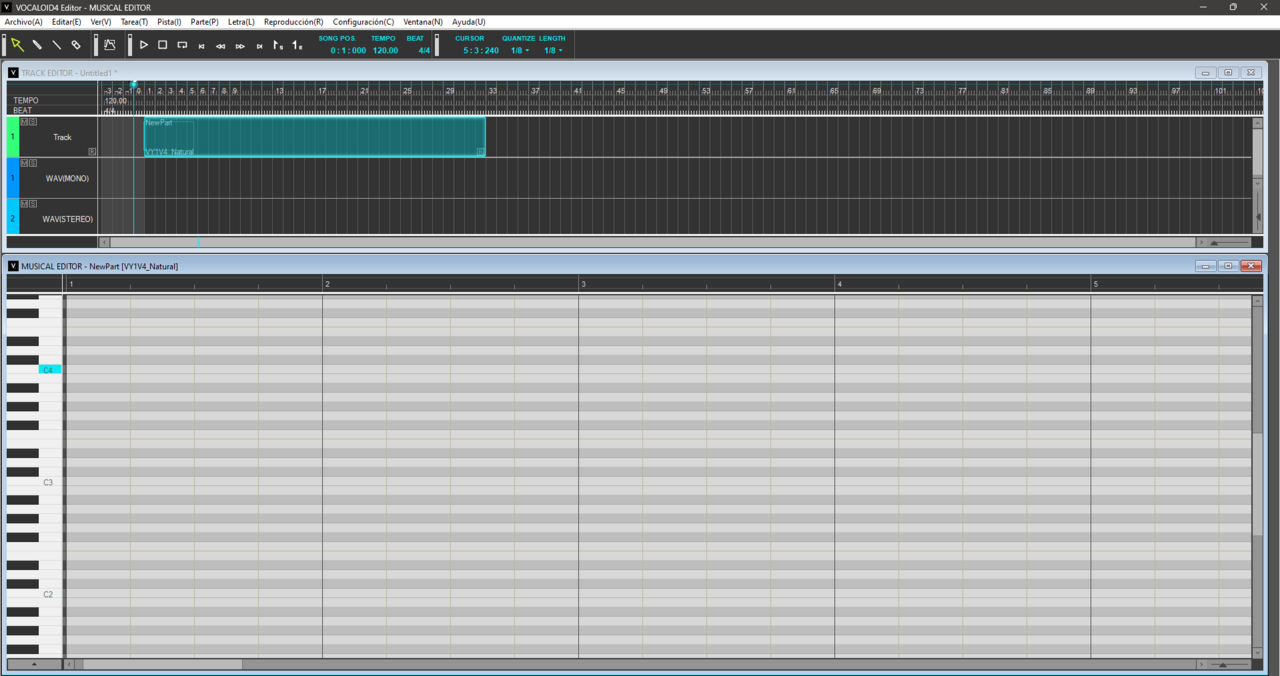
The VOCALOID4 editor: composers type in a melody and lyrics on a piano-roll grid, and the engine sings the result. Public domain (CC0), via Wikimedia Commons.
Meaning
VOCALOID (ボーカロイド, bōkaroido) is a singing voice synthesis engine developed by Yamaha Corporation. Feed it a melody and lyrics on a piano-roll grid, and it sings the line back in a synthesized human voice, built from 波形 samples recorded by real voice actors and voice actresses. The name has since expanded far beyond the engine itself: it also refers to the individual character "voicebanks" sold as VOCALOID products (like 初音ミク, Kagamine Rin and Len, or Megurine Luka), and — most broadly — to the entire grassroots 音楽 culture of amateur and semi-professional composers who write, arrange, and release 楽曲 using these synthetic voices instead of a human 歌手.
This article covers VOCALOID as software and phenomenon. For the specific character who became its most famous voicebank, see the separate article on Hatsune Miku.
How It Works
A VOCALOID ソフト doesn't generate a voice from nothing — it reassembles a real recorded voice. A voice actor spends dozens of hours in a studio recording every possible Japanese phoneme and phoneme-to-phoneme transition. That library of 音声 fragments becomes a "voicebank." The composer then works in a piano-roll editor: notes for pitch and rhythm along the vertical and horizontal axes, with 歌詞 typed under each note. The engine stitches together the matching fragments, smooths the transitions, and applies pitch and dynamics curves the user draws in by hand — 音程, vibrato, breathiness, and stress are all manually 調整, which is part of why a good VOCALOID arrangement takes real craft, not just typing in words.
This is fundamentally different from booking a live 演奏 by a human singer — there's no 依頼 to a vocalist, no studio booking, no schedule to coordinate. A single person can compose, arrange, and "sing" a finished song alone, which is the detail that made everything else possible.
History
| Year | Milestone |
|---|---|
| 2000–2003 | Yamaha and the Universitat Pompeu Fabra in Barcelona research concatenative singing synthesis |
| 2004 | VOCALOID engine ships; first commercial voicebanks (LEON, LOLA, Miriam) target English-speaking markets |
| 2004 | MEIKO, the first Japanese-language VOCALOID voicebank, is released by Crypton Future Media |
| 2006 | KAITO, a male Japanese voicebank, follows |
| 2007 | VOCALOID2 engine ships; Crypton releases Hatsune Miku, whose cute character art and low price (about ¥15,000) trigger an explosion of amateur 作曲 on Niconico Douga |
| 2007–2008 | Kagamine Rin/Len and Megurine Luka join Crypton's lineup; MEIKO and KAITO get retroactively folded into the same "Vocaloid family" |
| 2009–2013 | VOCALOID3 brings English and Chinese voicebanks (IA, GUMI/Megpoid, and others), and dozens of independent voice providers license the engine |
| 2014 | VOCALOID4 adds cross-synthesis and finer growl/vibrato controls |
| 2018–2022 | VOCALOID5 and VOCALOID6 modernize the editor; meanwhile newer engines (Synthesizer V, CeVIO AI) begin drawing producers away with more natural-sounding neural synthesis |
The Voicebank Family
Hatsune Miku is the most famous VOCALOID, but she was never alone. Some of the best-known voicebanks:
| Voicebank | Developer | Released | Notes |
|---|---|---|---|
| MEIKO | Crypton Future Media | 2004 | First Japanese VOCALOID; an adult female voice |
| KAITO | Crypton Future Media | 2006 | First major male Japanese voicebank |
| 初音ミク (Hatsune Miku) | Crypton Future Media | 2007 | The breakout hit; global mascot of the whole genre |
| 鏡音リン・レン (Kagamine Rin/Len) | Crypton Future Media | 2007 | Twin voicebanks, one female (Rin), one male (Len) |
| 巡音ルカ (Megurine Luka) | Crypton Future Media | 2009 | First Crypton voicebank with bilingual Japanese/English singing |
| GUMI (Megpoid) | Internet Co., Ltd. | 2009 | Popular with independent producers; voiced by Megumi Nakajima |
| IA | 1st Place | 2012 | Known for the theme song of the anime film Coppelion |
| VY1 / VY2 | Yamaha | 2011 | Yamaha's own "flat," genderless in-house voicebanks |
Each voicebank has its own tone, timbre, and fanbase, and producers often pick one deliberately to suit a song's mood rather than defaulting to Miku.
The "P" (Producer) Culture and Niconico Douga
VOCALOID's cultural explosion happened almost entirely on Niconico Douga, the video-sharing site whose scrolling, real-time comments turned watching a video into a shared event. A composer who releases VOCALOID 動画 there is called a ボカロP (bokaro P, "Vocalo-Producer") — the "P" borrowed from music-industry credits for "Producer." Early hit-makers like ryo (of supercell), kz (livetune), wowaka, DECO*27, and Jin built entire careers from Niconico uploads, and some went on to major-label deals, anime tie-ins, and international tours performing as human artists behind a projected Miku.
A song's success used to be tracked visibly through Niconico's ranking pages and "殿堂入り" (hall-of-fame) status once a video passed a million views, which gave the whole scene a game-like, communal feel. Two adjacent genres grew directly out of this ecosystem: 歌ってみた ("tried singing"), where human singers cover VOCALOID songs, launching many "歌い手" (utaite) careers, and 踊ってみた ("tried dancing"), dance covers of VOCALOID and idol tracks. Both categories are still Niconico staples and remain deeply tied to the source material's popularity.
Cultural Impact
Before VOCALOID, writing a pop song meant either singing it yourself or finding, booking, and paying a vocalist. VOCALOID removed that bottleneck: a bedroom 制作者 with a laptop, a 打ち込み sequencer, and a voicebank could release a finished, professional-sounding single alone, at 2 a.m., for free. That 独立 from the traditional 商業 music industry produced an enormous wave of amateur experimentation — some of it strange, some of it now considered classic modern J-pop — and gave a launching pad to songwriting 才能 who might never have been signed by a label the traditional way.
It also reshaped how a "character" could function in 音楽: Miku and her VOCALOID peers aren't performers with a biography — they're blank, communal avatars that thousands of unrelated composers, illustrators, and animators all draw, dress, and voice differently. A given Miku 楽曲 says more about its individual producer's style than about "Miku" as a fixed persona, which is part of why the ecosystem produced 二次創作 (derivative fan works) on an almost unprecedented scale — fan-made PVs, doujin albums, and cover videos, most of it under Crypton's unusually permissive "Piapro Character License."
By the 2010s this had gone fully global: Crypton's "Miku Expo" world tours, official crossovers with games and fashion brands, and localized VOCALOID voicebanks in English, Chinese, Korean, and Spanish carried the phenomenon well outside Japan.
Beyond VOCALOID: Related and Successor Technologies
VOCALOID was never the only singing synthesizer, and by the 2020s it wasn't even the most technically advanced one:
- UTAU — a free, fan-made singing synthesizer released in 2008 as a DIY alternative, letting anyone record and share their own voicebank without licensing fees. Its most famous voicebank, Kasane Teto, began as an April Fools' joke.
- CeVIO (and later CeVIO AI) — a rival engine from Frontier Works/Techno-Speech whose voicebanks (like IA and Nana Takahashi) crossed over into VOCALOID-adjacent fandom.
- Synthesizer V — a newer, neural-network-based engine from Dreamtonics (2018 onward) known for noticeably more natural-sounding singing, which has drawn many producers away from older VOCALOID engines.
- VOCALOID:AI and VOCALOID6 — Yamaha's own answer, applying machine learning to close that naturalness gap while keeping the original piano-roll workflow.
None of these has displaced VOCALOID's cultural footprint — the term is still used loosely to describe the whole genre of synthetic-singer music, regardless of which specific engine actually produced the vocal.
Related Terms
- ボカロP (bokaro P) — a producer who writes and releases VOCALOID songs
- 歌ってみた (utatte mita) — "tried singing," human cover versions of VOCALOID songs
- 踊ってみた (odotte mita) — "tried dancing," dance cover videos
- 中の人 (naka no hito) — literally "the person inside," the human voice actor behind a voicebank
- DTM (デスクトップミュージック, desktop music) — home music production, the broader hobby VOCALOID belongs to
Related Dictionary Words
music
singer
song; singing
voice
composition; synthesis; compounding; combining
voice; speech; sound of a voice
technology; engineering
composition (of music); setting; writing music
musical composition; tune
video (esp. digital); video clip; clip
contribution (to a newspaper, magazine, etc.); submission; post (on a blog, social media, etc.)
song lyrics; words of a song; libretto
independence; self-reliance; supporting oneself; being on one's own
derivative work (usu. unauthorized and produced by fans, e.g. dōjinshi, fanfiction)
producer (of film, theatre, TV, etc.); maker; creator; developer