山伏
yamabushiMountain ascetic hermit-monks of Shugendo, Japan's syncretic religion of Shinto-Buddhist mountain worship, known for white robes, conch-shell horns, and austere training in the peaks of Dewa Sanzan, Yoshino, and Omine.
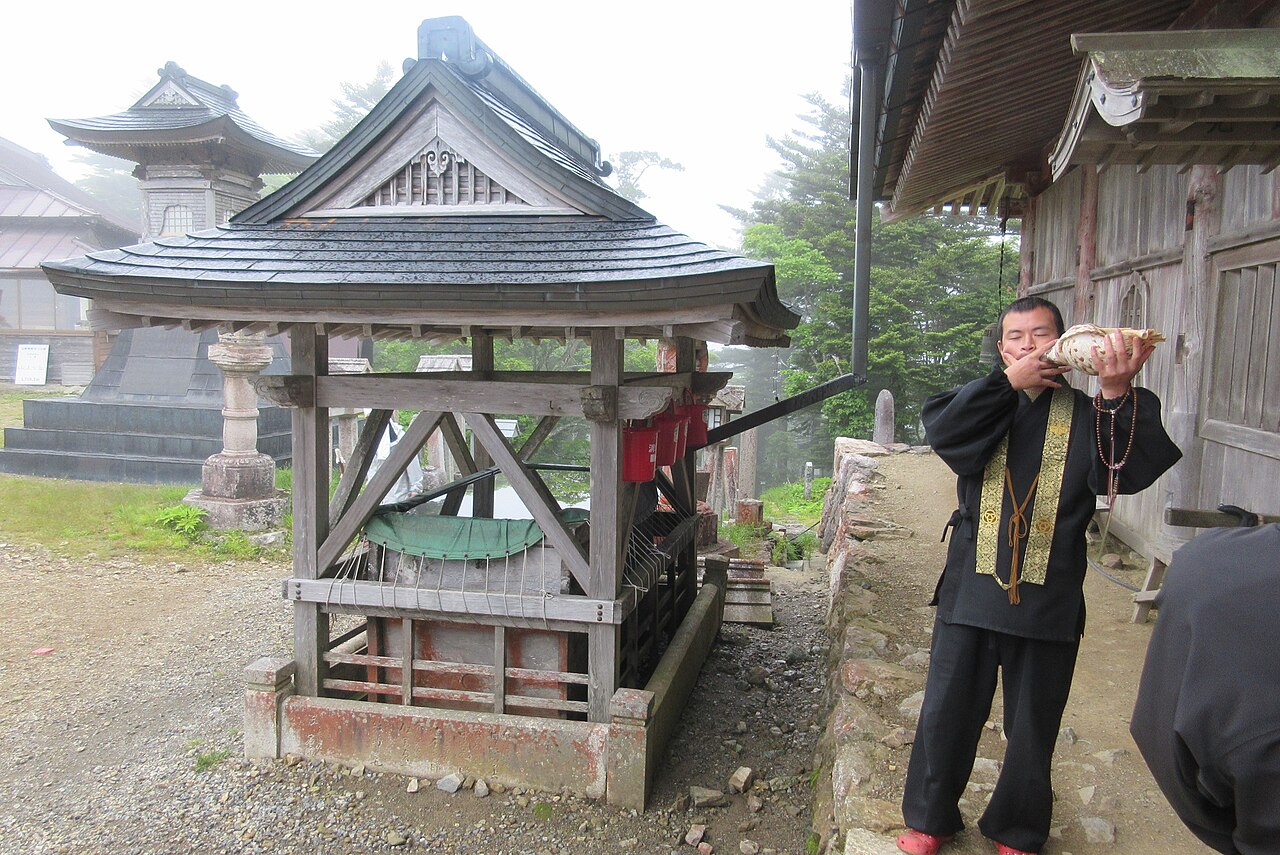
A yamabushi practitioner in full ceremonial dress at Ominesan-ji, Mt. Omine, Nara Prefecture. Photo: Richard Noll, CC BY-SA 4.0, via Wikimedia Commons.
Meaning
山伏 (yamabushi) literally means "one who lies prostrate in the mountains" — from 山 (yama, "mountain") and 伏す (fusu, "to lie down/prostrate"). The term describes practitioners of 修験道 (Shugendo, "the way of testing and training"), a distinctly Japanese religious tradition that fuses mountain worship, Shinto kami veneration, esoteric Buddhism, and folk elements of Onmyodo and Daoism into a single ascetic path.
Yamabushi occupy a category of their own — not quite Buddhist monks, not quite Shinto priests, but mountain hermit-ascetics who traditionally lived at the edge of settled society. They would withdraw into remote peaks for intense 修行 (shugyo, ascetic training) and then descend to villages to perform exorcisms, blessings, healing rites, and fortune-telling for ordinary people who could not undertake such austerities themselves.
Distinctive Garb
A yamabushi's appearance is instantly recognizable, and nearly every item of the outfit carries symbolic weight:
| Item | Japanese | Meaning |
|---|---|---|
| Small black cap | 頭巾 (tokin) | Worn on the forehead; represents the Buddha and is said to "seal in" worldly, distracting thoughts |
| Pure white robe | 白装束 (shiroshozoku) | The color associated with death and purification — entering the mountain is symbolically entering the womb of the mountain deity to be reborn |
| Pompom sash | 結袈裟 (yuigesa) | A simplified Buddhist stole with six pompoms representing the six realms of existence |
| Conch-shell horn | 法螺貝 (horagai) | Blown to signal fellow practitioners across valleys, ward off evil spirits, and mark the rhythm of rituals |
| Wooden staff | 錫杖 (shakujo) | A ringed staff whose jingling announces the bearer's approach and is said to drive away harmful creatures and spirits underfoot |
| Straw sandals / pom shoes | 八ツ目草鞋 (yatsumewaraji) | Suited to steep, rocky mountain trails |
| Small black-lacquered box | 笈 (oi) | A portable shrine/backpack carrying sutras, images, and ritual implements on long pilgrimages |
Ascetic Practices
Shugendo training centers on deliberately harsh physical ordeals meant to burn away ego and awaken innate spiritual power (this is where the word shugyo, training, and the "testing" in Shugendo converge):
- Waterfall meditation (滝行, takigyo) — standing beneath a cold mountain waterfall while chanting sutras or mantras, sometimes for hours, to purify body and mind.
- Fire rituals (護摩, goma) — a large bonfire ceremony in which practitioners feed wooden sticks inscribed with wishes or negative traits into flames, invoking the fire deity Fudo Myo-o to burn away impurity. The dramatic saito goma outdoor fire ritual is a major public spectacle at sites like Mt. Omine and Mt. Haguro.
- Mountain pilgrimage circuits (峰入り, mineiri / 巡礼, junrei) — multi-day treks along fixed routes through sacred peaks, sleeping in caves or simple lodges, chanting, and performing rites at numbered stations.
- Nightwalking and vigils — walking mountain trails at night without lights, relying on chant and breath.
- Fasting and cold-water austerities performed in the days leading up to a major peak entry.
The practices are less about doctrine than direct bodily experience: yamabushi believe that enlightenment and spiritual power (験力, genriki) are attained not through study alone but by physically confronting the mountain itself, understood as the living body of a kami and a Buddhist mandala at once.
Sacred Training Grounds
Three mountain regions are especially associated with Shugendo:
- Dewa Sanzan (出羽三山) in Yamagata Prefecture — Mt. Haguro, Mt. Gassan, and Mt. Yudono, collectively representing birth, death, and rebirth. Dewa Sanzan has hosted yamabushi practice for over 1,400 years and remains the most active living center of the tradition today.
- Yoshino and Omine (吉野・大峰) in Nara Prefecture — the traditional heartland of Shugendo since the 7th century, connected by the Okugake-michi pilgrimage trail; Mt. Omine (Sanjo-ga-take) is still off-limits to women, preserving a controversial pre-modern restriction.
- Kumano (熊野), also in the Kii Peninsula, whose three grand shrines were historically linked to Yoshino/Omine as one continuous pilgrimage network, jointly inscribed as a UNESCO World Heritage Site ("Sacred Sites and Pilgrimage Routes in the Kii Mountain Range").
Historical Role
Shugendo traces its founding to En no Gyoja (役小角, also En no Ozunu), a semi-legendary 7th-century ascetic credited with opening the Omine mountains to religious practice and said to have subdued mountain spirits into becoming his servants. Over the following centuries Shugendo absorbed Tendai and Shingon esoteric Buddhist ritual, Shinto kami worship, and Onmyodo cosmology, producing the thoroughly syncretic tradition (神仏習合, shinbutsu-shugo, "fusion of kami and Buddhas") that dominated Japanese popular religion for most of its history.
Yamabushi served practical village roles beyond ritual: as itinerant healers, diviners, mediators of local disputes, and even messengers or intelligence-gatherers whose mountain routes and cover identity made them useful to feudal lords — a reputation later fictionalized as a link between yamabushi and ninja.
The Meiji government's 1868 policy of shinbutsu bunri (forced separation of Shinto and Buddhism), followed by an 1872 edict banning Shugendo outright as a "superstitious" mixed religion, devastated the tradition; many yamabushi were forced to become either Shinto priests or Buddhist monks exclusively, and countless mountain temples were dismantled or repurposed. Shugendo was only legally permitted to reorganize after 1945, and lineages at Dewa Sanzan, Yoshino, and elsewhere have spent the postwar decades rebuilding.
Modern Presence
Shugendo remains a living practice rather than a historical relic. Temples and lodges (宿坊, shukubo) around Dewa Sanzan and Yoshino continue seasonal peak-entry retreats for ordained practitioners, and in recent years several groups — most visibly the Dewa Sanzan-based Yamabushido collective — have opened short, English-guided yamabushi training retreats aimed at international visitors. These typically compress waterfall meditation, a night hike, fire ritual, and vegetarian shojin ryori meals into a one-to-three-day program, framed as an intensive antidote to modern digital burnout rather than a full ordination.
This packaging of Shugendo as an experiential wellness retreat has driven a wave of travel-media coverage (National Geographic, The Diplomat, and various Japan travel outlets have all profiled it), turning a once-obscure ascetic order into a recognizable bucket-list experience for adventurous travelers to Tohoku and the Kii Peninsula.
Yamabushi in Popular Culture
The yamabushi silhouette — white robe, black tokin cap, conch horn — recurs throughout Japanese folklore, Noh and Kabuki theater (where mountain ascetics often appear as exorcists confronting demons), and later in anime, manga, and video games as a stock archetype for a mystical mountain hermit or warrior-priest. The tengu, a mountain goblin often depicted with a yamabushi's cap and pompom sash, is widely thought to be a folkloric caricature of the yamabushi themselves.
Related Dictionary Words
yamabushi; practitioner of Shugendō
Shugendō; Japanese mountain asceticism incorporating Shinto and Buddhist concepts
training; practice; discipline; study
waterfall
white clothing
homa; Buddhist rite of burning wooden sticks to ask a deity for blessings
pilgrimage; pilgrim
Shinto-Buddhist syncretism
religion that worships mountains as sacred (e.g. Shugendō); mountain worship
headgear (esp. one made of cloth); hood; kerchief; cap; skullcap; hat
khakkhara (staff topped with metal rings traditionally carried by monks); pewter staff
ascetic; pilgrim; devotee