ヤンキー
yankiiA Japanese delinquent youth subculture from the 1970s-90s known for pompadour hairstyles, altered school uniforms, customized motorcycles, and a rebellious-but-secretly-sentimental image that lives on as a beloved archetype in manga, anime, and fashion.
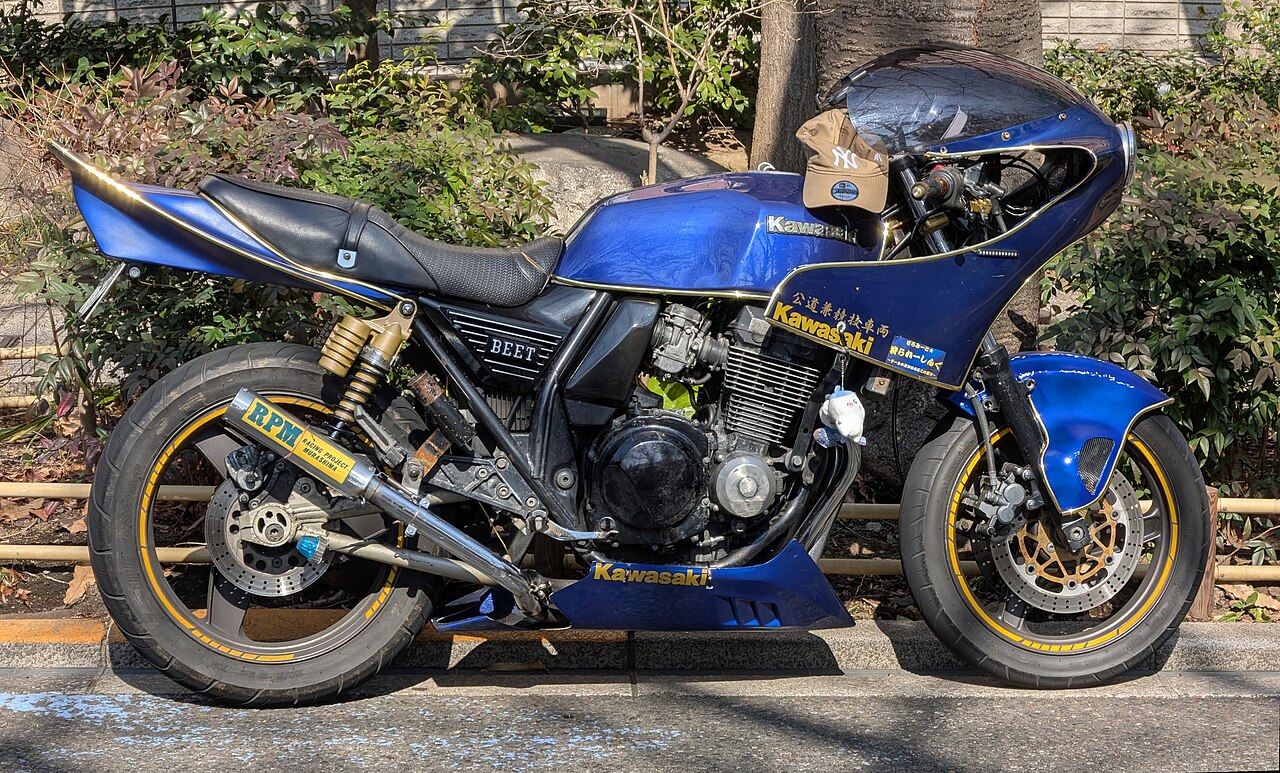
A modern bosozoku-style customized motorcycle in Roppongi, Tokyo — the loud exhaust pipes and flamboyant paint job echo the same aesthetic that defined yankii biker culture at its peak. Photo: Syced, CC0, via Wikimedia Commons.
ヤンキー (yankii) is the umbrella term for Japan's working-class delinquent youth subculture that dominated the country's streets, schoolyards, and pop culture from the 1970s through the 1990s. A yankii (also spelled "yankee" in English-language writing about the phenomenon) is instantly recognizable by a set of exaggerated visual signals — bleached or permed hair, deliberately mangled 制服, and a swaggering, tough-guy posture — that marked someone as 不良: a "bad kid" who rejected the conformity of mainstream Japanese school life.
Meaning
At its core, yankii describes a style and attitude rather than a strict organization. It overlaps with — but is broader than — 暴走族 (bōsōzoku), which refers specifically to organized motorcycle gangs who ride in packs and terrorize public roads. Every bōsōzoku rider is a yankii, but not every yankii rides a motorcycle; the term also covers the 番長 (banchō, the gang leader at a school), the tsuppari girl in an ankle-length skirt, and countless kids who simply dressed and talked the part without ever joining a formal group.
The visual grammar of yankii style is remarkably consistent:
| Element | Description |
|---|---|
| Hair | Bleached blond or brown, often in a pompadour called リーゼント (rīzento, from "regent") |
| Boys' uniform | 学ラン (gakuran) lengthened, collar embroidered, buttons removed |
| Girls' uniform | セーラー服 (sailor uniform) with a dramatically lengthened skirt, shortened top |
| Outerwear | 特攻服 (tokkōfuku), a long, boldly 刺繍-covered military-style coat worn by bōsōzoku members |
| Vehicles | バイク (motorbikes, also called 単車) with straight exhaust pipes and raised handlebars, or lowered "shakotan" cars |
| Posture | Slouching, wide-legged stance, narrowed eyes — collectively called sukeban swagger for girls |
This whole look is called ツッパリ (tsuppari, literally "sticking out" or "pushing back"), a near-synonym for yankii style that emphasizes the attitude of defiantly refusing to blend in.
Etymology
The word yankii is a loanword from English "Yankee." In the 1960s-70s, Japanese slang used "yankee" (often written ヤンキー) to describe anything flashy, foreign-flavored, or Americanized — Osaka street vendors reportedly used it for loud, garish clothing imported or inspired by American GIs and Californian car and biker culture. Over the following decade the word narrowed from "flashy/American-style" to specifically mean the loud, rebellious teenagers who adopted that aesthetic, and by the 1980s it had become the standard term for Japan's delinquent youth subculture nationwide — completely detached from its original American reference.
Cultural Context
Yankii culture emerged from Japan's rapid postwar urbanization, when working-class and rural teenagers — often facing limited academic prospects — built an alternative status hierarchy around toughness, loyalty, and style rather than grades. School became a stage for 反抗 (rebellion): torn-up uniforms and dyed hair were a visible middle finger to the rigid conformity Japanese secondary schools demanded. Regional bōsōzoku gangs, with their 特攻服 jackets and modified motorcycles, drew heavy visual inspiration from kamikaze pilots and prewar military uniforms, giving the movement a nostalgic, almost theatrical nationalism layered under its rebellious surface.
The subculture peaked in the 1980s and early 1990s, when bōsōzoku membership numbers were at their highest and yankii fashion was inescapable in working-class neighborhoods. From roughly the mid-1990s onward, real-world numbers declined sharply — stricter policing, Japan's shrinking youth population, and changing fashion trends (gyaru and other subcultures drew away the same demographic) all contributed. Japanese police reported bōsōzoku membership falling by more than 90% between its 1980s peak and the 2010s.
The Soft-Hearted Delinquent Trope
Even as the real subculture faded, yankii became one of the most enduring character archetypes in manga, anime, and dorama. A defining trope is that beneath the scary exterior, a yankii is secretly 優しい (kind-hearted) and even 涙もろい (quick to cry) — fiercely loyal to friends, protective of the weak, and bound by an old-fashioned code of 義理人情 (giri-ninjō, duty and human feeling) that the "good kids" around them have supposedly lost. This softens the delinquent image into something sympathetic and even aspirational.
Classic examples include:
- Rokudenashi Blues (ろくでなしBLUES) — Masanori Morita's manga about a hot-blooded high-school delinquent, a foundational entry in the genre
- Crows Zero — Takashi Miike's film adaptation of Hiroshi Takahashi's Crows manga, centered on rival delinquent factions at a notoriously violent high school
- Characters adjacent to GTO (Great Teacher Onizuka) — a reformed biker-gang leader turned teacher who channels his yankii past into protecting his students
- Countless shōnen and shōjo side characters who are the school's feared 番長 but turn out to be the story's most loyal friend
「見た目は怖いけど、あいつ本当は優しいんだよ。」 "He looks scary, but he's actually really kind." — a stock line used to introduce a yankii character in manga and anime
Decline and Legacy
By the 2000s, sociologists were describing the yankii subculture as being in decline as a lived, everyday identity, even as its fashion and archetypes never left popular culture. Fewer teenagers dye their hair blond and modify motorcycles today, but the aesthetic persists through:
- Manga and anime — the delinquent-with-a-heart-of-gold remains a stock character across genres, from comedy to romance
- Retro fashion revivals — vintage tsuppari and sukeban (delinquent girl) styling occasionally resurfaces in Japanese street fashion, treated with the same ironic nostalgia Western fashion gives to 1980s punk
- "Yankii mama" and "mote-kei" — later slang terms describing young mothers or style trends that trace a visible lineage back to yankii fashion sensibilities
- Regional pride — some rural areas still treat a mild yankii aesthetic (dyed hair, modified light trucks) as an accepted marker of local, working-class identity rather than outright delinquency
Today, calling someone a yankii is as likely to reference a nostalgic 昭和-era pop-culture archetype as an actual troublemaker — a testament to how thoroughly this once-feared subculture was absorbed into the mainstream imagination.
Related Dictionary Words
bad; poor; inferior; defective
leader of a group of juvenile delinquents
boy's school uniform (usu. a black jacket with a stand-up collar and loose trousers)
sailor suit; middy uniform
Regent hairstyle; ducktail; Pompadour
tokkōfuku; type of long jacket worn by bōsōzoku biker gang members, etc.
young motorcycle-riding delinquents; bōsōzoku
opposition; resistance; insubordination; defiance; hostility; rebellion
easily moved to tears; given to weeping; lachrymose
tender; kind; gentle; graceful; affectionate; amiable
Shōwa era (1926.12.25-1989.1.7)
uniform
motorcycle; motorbike; bike
duty and humanity; (a sense of) moral obligation and humane feelings
two-wheeled motor vehicle; motorcycle; motorbike
embroidery