草間彌生
Kusama YayoiYayoi Kusama is a Japanese contemporary artist whose polka-dot patterns, Infinity Mirror Rooms, and pumpkin sculptures have made her one of the world's best-known and best-selling living artists.
Meaning
草間彌生 (Kusama Yayoi) is the name of Japan's most internationally famous living artist, born in 1929 in Matsumoto, Nagano. She is instantly recognizable by her signature visual language: obsessive 水玉 (polka dot) patterns, mirrored "Infinity Rooms," and giant spotted 南瓜 (pumpkin) sculptures. Kusama herself is as much a part of the artwork as the objects she makes — she frequently appears in public wearing dot-covered outfits and a signature bright red bob wig, blurring the line between artist and artwork.
Her work is inseparable from her own account of hallucinations she has experienced since early childhood, in which fields of 点 (dots) and flower patterns would spread and multiply until they swallowed her surroundings, her own body, and her sense of self. Rather than treat this purely as a medical condition, Kusama transformed it into an artistic philosophy she calls self-obliteration (自己消滅, jiko shōmetsu) — the idea that a single dot, repeated to 無限 (infinity), dissolves individual identity into the vastness of the universe. "A polka-dot has the form of the sun," she has said, "which is a symbol of the energy of the whole world and our global life, and also the form of the moon, which is calm. Round, soft, colorful, senseless and unknowing... polka dots become movement. Polka dots are a way to infinity."
「一つ一つの水玉が消滅していく、それが自己消滅です。」 "Each and every polka dot disappearing — that is self-obliteration."
Signature Works and Motifs
Polka Dots (水玉模様)
Dots are Kusama's foundational visual unit. In her paintings and "Infinity Net" (無限の網) canvases from the late 1950s, she covered vast 円 (circular) fields with tiny, repeated, near-identical loops and dots, creating surfaces that seem to vibrate and extend beyond the canvas edge — an early, radical form of what critics later called proto-Minimalism, achieved years before the American male artists more commonly credited with the style.
Infinity Mirror Rooms
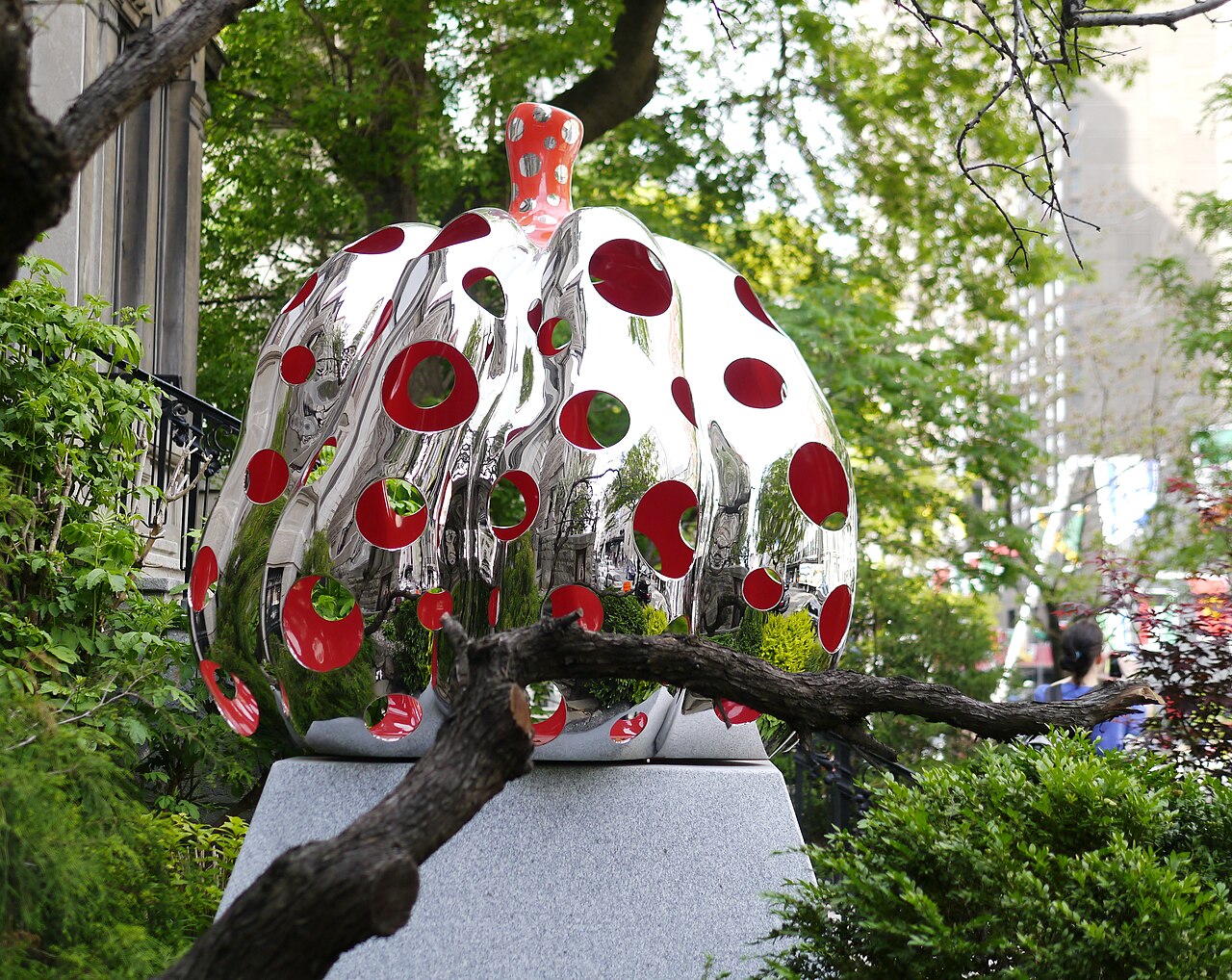
A Kusama pumpkin sculpture installed as part of "La Balade pour la Paix," an open-air museum in Montreal. Photo: art_inthecity, CC BY 2.0, via Wikimedia Commons.
First created in 1965, the Infinity Mirror Rooms are walk-in installations lined with mirrors, lights, and often water or floating objects, engineered so a visitor standing inside appears surrounded by an endless 鏡 field of repeating lights or dots stretching in every direction. Kusama has built dozens of variations across six decades — Infinity Mirrored Room — The Souls of Millions of Light Years Away (2013) is among the best known. In the smartphone era these 部屋 (rooms) became a viral sensation: museum shows regularly cap visitors to 30–60 seconds per person and still draw hours-long lines, since the immersive, intensely photogenic spaces are shared endlessly on social media. Her 2023 collaboration with Louis Vuitton — which covered flagship stores worldwide in giant polka-dot sculptures of Kusama herself — introduced her imagery to an even broader global audience.
Pumpkins (かぼちゃ)
The spotted yellow-and-black pumpkin is Kusama's most merchandised and most photographed motif. She has described the pumpkin's "humorous, warm-hearted form" and its "generous unpretentiousness" as a kind of self-portrait, tracing the attachment back to childhood visits to her family's seed nursery business. Her large-scale Pumpkin sculptures — including the iconic yellow pumpkin permanently installed on a pier on Naoshima, the "art island" in Japan's Seto Inland Sea — have become some of the most-photographed contemporary artworks in the world.
Narcissus Garden
For the 1966 Venice Biennale, Kusama staged an unauthorized guerrilla installation titled Narcissus Garden: 1,500 mirrored plastic spheres spread across the lawn outside the Italian Pavilion, which she sold to passersby for 1,200 lire each — a performance-as-critique of the commercialization of the 芸術家 (art world) that got her installation shut down by biennale organizers. She has since restaged versions of the piece with thousands of spheres floating on ponds and canals at venues worldwide.
Biography
Kusama was born on March 22, 1929, into a family of seed merchants in Matsumoto, Nagano Prefecture. Her childhood was marked by a difficult family life and the onset of visual and auditory hallucinations, which she began recording in drawings from around age ten. After studying Nihonga (traditional Japanese painting) in Kyoto, she left for New York City in 1957, arriving with almost no money but a fierce determination to enter the American 前衛 (avant-garde) art scene.
Through the late 1950s and 1960s Kusama was a fixture of the New York art world, exhibiting alongside — and influencing — artists like Andy Warhol, Claes Oldenburg, and Donald Judd, while also staging provocative nude "body festival" happenings and anti-war demonstrations. Despite this influence, as a Japanese woman working in a scene dominated by American men, she often struggled for recognition and financial stability, and later described feeling that some of her ideas were appropriated by better-connected peers.
In 1973, exhausted and in declining health, Kusama returned to Japan. In 1977 she voluntarily admitted herself to a psychiatric hospital in Tokyo, where she has lived by choice ever since; each day she walks to a nearby studio to paint and create, returning to the hospital at night. Far from ending her career, this period has been enormously productive — she has produced major new bodies of work, written novels and poetry, and seen her global reputation grow from cult figure to blockbuster museum draw. The Yayoi Kusama Museum, a five-story gallery dedicated entirely to her work, opened in Tokyo's Shinjuku ward in 2017.
Cultural Significance and Legacy
Kusama is consistently ranked among the best-selling living female artists at auction, and her museum retrospectives regularly become the best-attended shows of the year at institutions worldwide, from the Hirshhorn in Washington D.C. to the Tate Modern in London and the 美術館 circuit across Asia. Her 反復 (repetition)-based aesthetic has proven exceptionally suited to social media — a single Infinity Room photo can travel worldwide, turning gallery visits into pilgrimage-like events with ticketed timed-entry slots that sell out in minutes.
Beyond her commercial and popular success, Kusama occupies an important place in art history as a woman and a Japanese artist who anticipated — and arguably shaped — movements like Pop Art, Minimalism, and installation art that are more often credited to her American contemporaries. Her open discussion of mental illness and her choice to live in a psychiatric institution while continuing to create at an extraordinary pace has also made her a widely cited figure in conversations about art, trauma, and resilience. At over 95 years old, she continues to produce new work daily, describing art as the only thing that has kept her alive.
Related Terms
| Term | Reading | Meaning |
|---|---|---|
| 水玉模様 | みずたまもよう | polka-dot pattern |
| 自己消滅 | じこしょうめつ | self-obliteration |
| 前衛芸術 | ぜんえいげいじゅつ | avant-garde art |
| 統合失調症 | とうごうしっちょうしょう | schizophrenia |
Related Dictionary Words
drop of water
polka dots
pumpkin (Cucurbita sp.); squash
mirror; looking-glass
room; chamber
infinity; infinitude; eternity
self; oneself
extinction; extinguishment; disappearance; vanishing; termination; lapse
artist
mind; spirit; soul; heart; ethos
hospital; clinic; doctor's office; doctor's surgery; infirmary
art museum; art gallery
repetition; iteration
advance guard; vanguard
schizophrenia
dot; spot; point; speck; mark
yen (currency of Japan)