よさこい
yosakoiA high-energy Japanese team dance style born in Kōchi in 1954, danced with wooden naruko clappers to music blending tradition and pop, now celebrated at huge festivals nationwide including Sapporo's YOSAKOI Sōran.
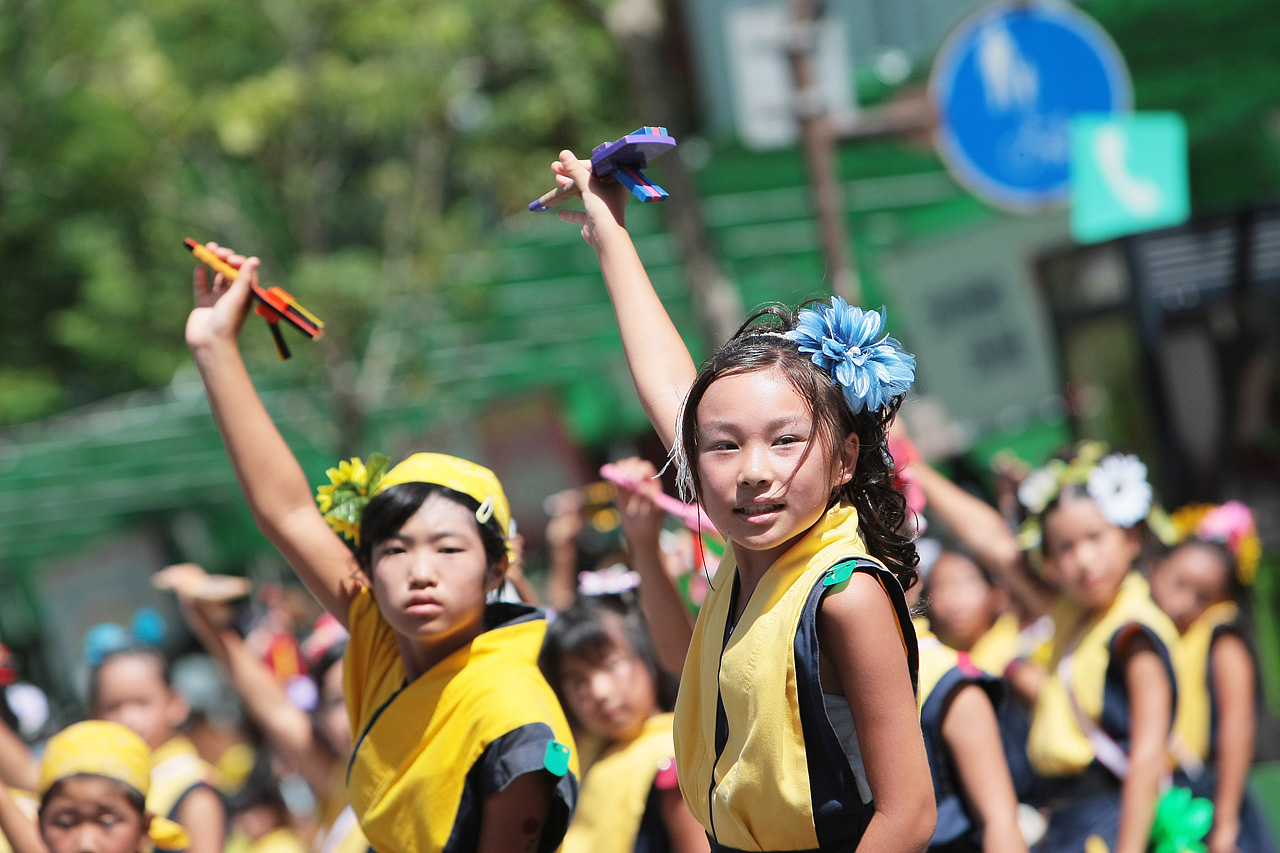
Dancers perform at the Kochi Yosakoi Matsuri, the festival where yosakoi began. Photo: 工房やまもも, CC BY 2.0, via Wikimedia Commons.
Meaning
よさこい (yosakoi) is a high-energy style of Japanese team 踊り (odori, "dance") performed by large groups — anywhere from a few dozen to several hundred people — moving in synchronized choreography to upbeat music while holding 鳴子 (naruko), small wooden clappers that snap rhythmically in each dancer's hands. Teams (often called yosakoi-ren, 連) design their own music, choreography, flags, and elaborate matching 衣装 (isō, "costumes") each year, then compete or simply perform together at massive street festivals.
Unlike more restrained, centuries-old classical Japanese dance forms, yosakoi is deliberately loud, fast, and expressive. Songs mix traditional Japanese melodic phrases with rock, samba, hip-hop, J-pop, or electronic music, and choreography ranges from flowing fan work to jumping, spinning, and full-team formations reminiscent of a marching band show crossed with a rave.
Usage
The word is almost always used as a noun referring to the dance style itself, a specific performance, or the festivals built around it.
今週末、高知でよさこい祭りがあります。 Konshūmatsu, Kōchi de Yosakoi Matsuri ga arimasu. "This weekend there's the Yosakoi Festival in Kōchi."
大学のよさこいサークルに入りました。 Daigaku no yosakoi sākuru ni hairimashita. "I joined my university's yosakoi club."
鳴子を鳴らしながら踊るのが楽しい。 Naruko o narashinagara odoru no ga tanoshii. "It's fun to dance while clacking the naruko."
Dancers, students, and local governments across Japan now use "yosakoi" as a generic category — much like "samba" or "salsa" describes a style rather than one fixed routine — with hundreds of regional variants (Sōran-bushi-influenced Sapporo style, Shibuya's urban style, and campus club styles all fall under the same umbrella).
Cultural Context
Origin in Kōchi, 1954
Yosakoi was created in 1954 in 高知 (Kōchi) City, on the island of Shikoku, as a way to boost the local economy and community spirit during the difficult postwar recovery years. Modeled partly on the Awa Odori of nearby Tokushima, the first Yosakoi Festival ("よさこい祭り", Yosakoi Matsuri) was held in August 1954 with around 750 dancers across 21 teams. The name comes from an old local Tosa-dialect phrase, yosakoi, meaning roughly "come at night" — taken from the folk song "Yosakoi Bushi," a courting song traditionally sung during festival nights, which is still quoted in nearly every yosakoi performance's music today.
From the beginning, organizers set only two hard rules that all teams still follow: the 音楽 (ongaku, "music") must include a phrase from the Yosakoi Bushi melody or lyrics, and every dancer must carry naruko. Everything else — costume design, 振り付け (furitsuke, "choreography"), music genre, formation, use of moving stages or trucks — is left entirely up to each team, which is why yosakoi looks so different from team to team while still being recognizably one tradition.
The naruko clapper
The naruko (鳴子) is yosakoi's signature prop: a small handheld wooden instrument, traditionally used by farmers in rice paddies to make noise and scare birds away from crops. Each dancer holds one in each hand, and the clacking sound doubles as a rhythmic accent and a visual flourish, since dancers twirl and snap them in time with the choreography. Naruko today come in painted and lacquered versions in every color imaginable, matched to a team's costume theme.
Teams, costumes, and competition
Modern yosakoi is organized around teams (連, ren) — company groups, school clubs, neighborhood associations, or dedicated dance troupes — each of which commissions original music and choreography, sews or rents custom costumes redesigned every year around a theme, and rehearses for months. At major festivals, teams parade and perform at multiple stages across a city over several days, judged on originality, energy, and how well they balance tradition with innovation. Awards and rankings exist, but much of the appeal for 参加 (sanka, "participation") is the community-building itself — bringing together students, coworkers, and neighbors of all ages into one team.
Spread nationwide: Sapporo and beyond
Yosakoi remained mostly a Kōchi phenomenon until 1992, when a Hokkaido University student who had performed in Kōchi brought the idea to Sapporo, fusing it with the local folk song "Sōran Bushi" to create YOSAKOI Sōran (YOSAKOIソーラン). The resulting YOSAKOI Sōran Festival in Sapporo grew explosively and is now one of the largest dance festivals in Japan, drawing over two million spectators and tens of thousands of dancers across hundreds of teams each June. Its success inspired yosakoi-style festivals across the country — Tokyo, Nagoya, Shizuoka, and dozens of other cities now hold their own versions — as well as university and workplace yosakoi clubs that treat it as both a competitive art form and casual hobby.
| Festival | Location | Founded | Notes |
|---|---|---|---|
| よさこい祭り (Yosakoi Matsuri) | Kōchi | 1954 | The original; birthplace of the style |
| YOSAKOIソーラン祭り (YOSAKOI Sōran Festival) | Sapporo | 1992 | Largest by attendance; fuses yosakoi with Sōran Bushi |
| Various regional festivals | Nationwide | 1990s–present | Hundreds of local variants across Japan |
Why it endures
Yosakoi's loose rulebook — just naruko and a nod to Yosakoi Bushi — is exactly what let it spread and mutate for seven decades without losing its identity. It functions simultaneously as competitive performance art, community bonding activity, tourism draw, and a rare space where centuries-old 伝統 (dentō, "tradition") and current pop music comfortably share a stage. Alongside taiko drumming, it's one of the most visible participatory (rather than purely spectator) art forms at Japanese summer matsuri.