アメカジ
amekajiAmekaji is the Japanese fashion subculture built around meticulous, often superior reproductions of American workwear, vintage denim, Ivy League prep, and military surplus.
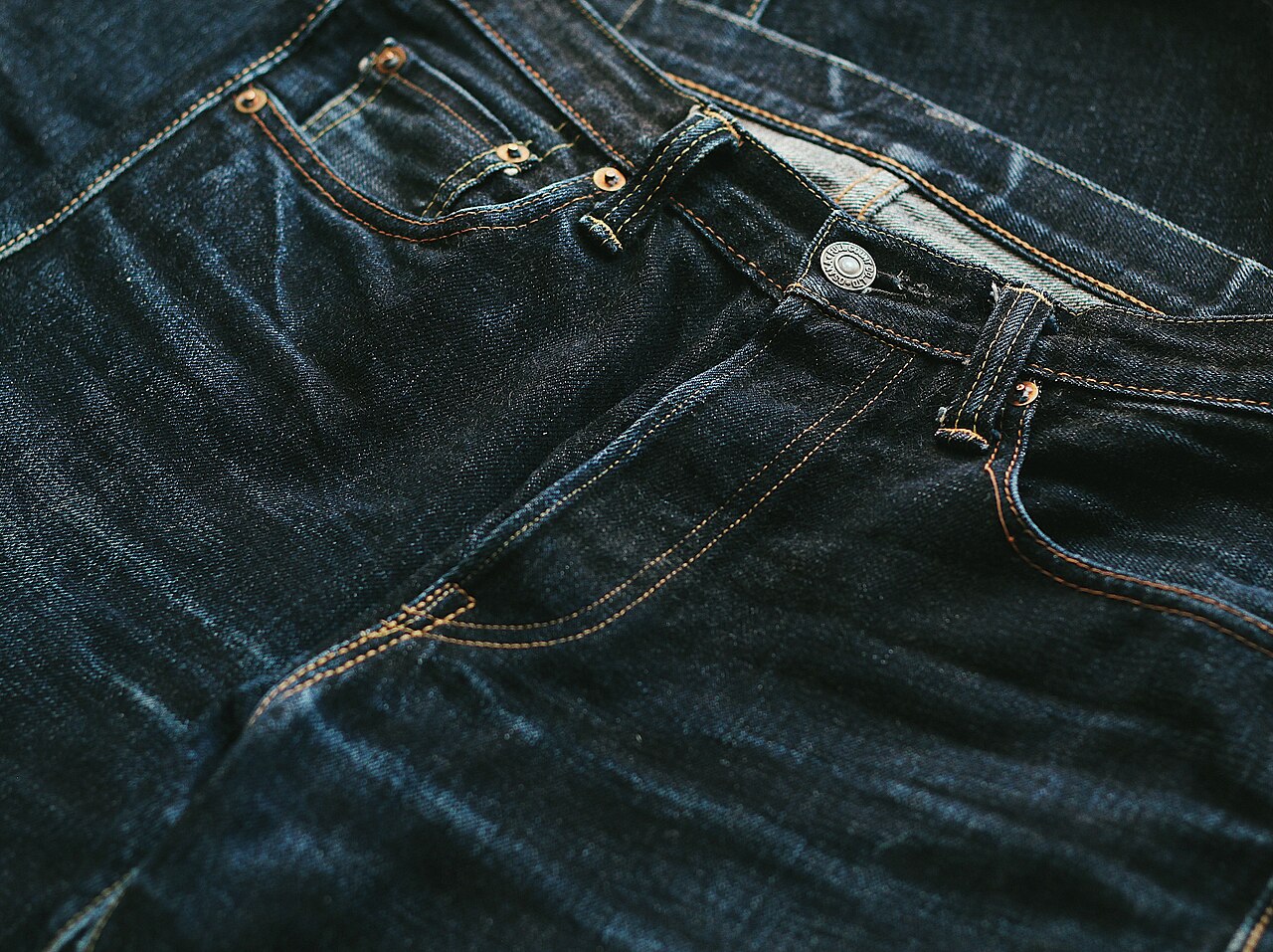
Natural "honeycomb" fading on jeans from Full Count, an Osaka heritage-denim label — the kind of hyper-detailed reproduction of vintage American workwear that defines amekaji. Photo: Coldwrld, CC BY-SA 4.0, via Wikimedia Commons.
Meaning
Amekaji (アメカジ) is short for アメリカン・カジュアル (amerikan kajuaru, "American casual"), and refers to a Japanese fashion スタイル built around reproducing and refining classic American clothing: デニム jeans, military surplus, Ivy League prep, biker leather, and workwear. It is less a single look than an obsessive philosophy — most amekaji brands and shops are less interested in following American style loosely than in reconstructing it down to the stitch count, the loom, and the dye vat, often producing garments considered more faithful to the "real" vintage American original than anything currently made in the United States.
The word sits alongside other native fashion-tribe terms like ギャル or 森ガール, but describes a movement that is decades older and, unusually, one whose most devoted practitioners tend to be adult men rather than teenagers — collectors who can discuss a jean's 織物 weave or a jacket's 縫製 technique with the seriousness of a sommelier.
Usage
Amekaji is used both as a fashion category and as a lifestyle identity.
彼はアメカジ系のファッションが好きで、古着屋によく通っている。 Kare wa amekaji-kei no fasshon ga suki de, furugiya ni yoku kayotte iru. "He likes amekaji-style fashion and often visits secondhand clothing stores."
このジーンズは岡山の職人が作った復刻版だよ。 Kono jīnzu wa Okayama no shokunin ga tsukutta fukkoku-ban da yo. "These jeans are a reproduction made by an artisan in Okayama."
Shoppers describe brands, shops, and even whole neighborhoods as "amekaji-kei" (アメカジ系, "amekaji-style"), and denim collectors specifically use アメカジ to distinguish rugged, workwear-inflected outfits from more polished domestic labels.
Cultural Context
From Ivy League to Miyuki-zoku
Amekaji's roots trace to the American cultural flood that followed Japan's postwar occupation, when 米軍 bases and 進駐軍 surplus stores gave ordinary Japanese their first close look at American clothing. The movement crystallized in 1951 when Kensuke Ishizu founded VAN Jacket, importing the East Coast "Ivy League" collegiate look — button-down shirts, chinos, three-button blazers — to a country rebuilding its own sense of style. Through the magazine Men's Club and the 1965 photo book Take Ivy (a meticulous documentary study of actual American campus dress), Ishizu didn't just sell clothes; he taught Japan how to read and reproduce a foreign wardrobe with near-anthropological precision, a habit that has defined Japanese fashion subcultures ever since.
The style's first real youth movement, the Miyuki-zoku (みゆき族), gathered on Tokyo's Miyuki-dori in the mid-1960s wearing VAN's Ivy look so faithfully that police rounded them up as juvenile delinquents in 1964 — the same year Ishizu was tapped to design the Tokyo Olympics uniforms, instantly legitimizing the "American" look as sophisticated rather than scandalous.
Building a better vintage America
Where Ivy style borrowed a silhouette, the denim side of amekaji became a project of outdoing the source material entirely. In 1965, Kojima's Big John released Japan's first domestically sewn jeans; by 1973, using fabric woven at the century-old Kurabo mill in Okayama, Big John's "World" line became the first jeans made from 100% Japanese materials. Crucially, Japanese mills kept running vintage American shuttle looms — narrow, slow machines that produce the self-finished "selvedge" edge and irregular texture of pre-1950s American ジーンズ long after American factories had switched to cheaper, wide projectile looms. Combined with the region's centuries-old indigo-dyeing tradition, this let Okayama craftsmen manufacture denim that behaves, fades, and ages more like original mid-century Levi's than anything Levi's itself was still making — a point of national pride summarized in the common claim that Japan makes "better American jeans than America."
Kojima, Ura-Harajuku, and global amekaji brands
Kojima, in Okayama Prefecture, remains amekaji's spiritual capital: a small city whose Jeans Street is lined with dye workshops, repair ateliers, and heritage labels, and whose denim is treated internationally as its own regional appellation, similar to Champagne or Parma ham. Brands built on this foundation — Warehouse's meticulous 1940s-50s Levi's reproductions, Kapital's patchwork-and-boro reinterpretations of workwear, Evisu's hand-painted seagull back pockets — turned reverence for American originals into distinctly Japanese design languages of their own.
In the 1990s and 2000s, a parallel current emerged in the back streets of 原宿 known as Ura-Harajuku, where labels such as A Bathing Ape and NEIGHBORHOOD fused amekaji's workwear and military DNA with hip-hop and skate influence, seeding the streetwear boom that now dominates global menswear. Today amekaji's fingerprints are everywhere international "heritage" and "Americana" fashion trends surface — raw denim forums, workwear reissues, and premium streetwear all trace an unbroken line back to Kojima's mills and VAN Jacket's original Ivy League gospel.
Variations and Related Terms
| Term | Meaning |
|---|---|
| アメトラ (Ametora) | "American Traditional" — the Ivy League/prep side of amekaji |
| 裏原宿 (Ura-Harajuku) | "Back Harajuku" streetwear scene of the 1990s-2000s |
| みゆき族 (Miyuki-zoku) | 1960s Tokyo youths who pioneered Ivy style in Japan |
| ジャパンヴィンテージ (Japan Vintage) | Umbrella term for Japanese-made reproduction Americana |
| 岡山デニム (Okayama denim) | Denim woven and sewn in the Kojima/Okayama region |
See Also
- Sukajan (スカジャン), the embroidered souvenir jacket that grew from the same postwar American-military contact
- Harajuku, the Tokyo district central to Japan's fashion-subculture scene
Related Dictionary Words
old clothes; secondhand clothing
craftsman; artisan; tradesman; worker; workman
Okayama (city, prefecture)
denim
indigo dye
US armed forces
occupying forces (esp. of the Allies in Japan after World War II)
republication; reissue; reprinting; reproduction
second hand clothes shop
youth culture
rapid economic growth (esp. that of Japan in the post-WWII period)
Western-style clothes (cf. traditional Japanese clothes)
vintage (year, wine)
shop that carries a selection of products from several different brands
jeans