スカジャン
sukajanA boldly embroidered satin bomber jacket born as a GI souvenir in postwar Yokosuka, now a recognized icon of Japanese street fashion.
Meaning
スカジャン (sukajan) refers to a satin or twill bomber-style jacket covered in large, colorful 刺繍 (embroidery) — dragons, tigers, eagles, koi, cherry blossoms, tigers fighting dragons, an outline map of Japan, and phrases like "Souvenir from Japan" are all classic motifs. The name is a portmanteau: suka from Yokosuka (横須賀), the port city where the style was born, and jan, a clipped pronunciation of the English word "jumper" (ジャンパー). Structurally the jacket follows an American varsity/bomber cut — ribbed collar, cuffs, and hem, a front zipper, and often a contrasting reversible lining — but the dense embroidery covering the back and front panels is what makes it unmistakably Japanese.
Origin: Yokosuka and the Occupation
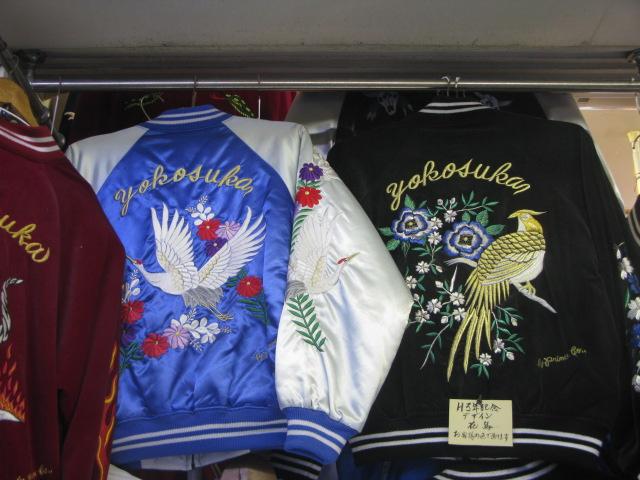
A sukajan on display near Dobuita Street (どぶ板通り), Yokosuka — the birthplace of the style. Public domain, via Wikimedia Commons.
The jacket's story begins in the years right after World War II, during the Allied 進駐軍 (occupation forces) presence in Japan. Yokosuka hosted — and still hosts — a major U.S. Navy base, and local tailors along streets like Dobuita-dori began stitching custom embroidery onto souvenir jackets for 米兵 (American servicemen) who wanted a flashy, one-of-a-kind memento of their tour in Japan to take home. Silk-thread embroidery was a technique Japanese craftspeople already used on kimono linings and haori, and applying it to a Western-style jacket produced something genuinely new — neither fully American nor fully traditional Japanese.
Some of the earliest jackets are said to have reused leftover parachute silk or サテン 生地 (satin fabric) originally intended for military supply, a detail that became part of sukajan folklore even after the style industrialized around purpose-woven satin. Early motifs blended American military imagery (squadron patches, "Japan" lettering, eagle-and-globe designs) with the Japanese subjects GIs found exotic and desirable — tigers, dragons, geisha, and Mount Fuji sold well because they were what buyers wanted, not necessarily what a tailor would have chosen. Embroidery skill and imagery are also sometimes traced back through Yokosuka's earlier history as an Imperial Japanese Navy town, and through soldiers 復員 (repatriated) from postings in 満州 (Manchuria) and mainland Asia, who brought needlework techniques and motifs home with them after the war.
Design Conventions and Motifs
A classic sukajan follows a fairly consistent formula. The base 洋服 (Western-style garment) is 仕立て as a bomber/varsity jacket — ribbed collar, cuffs, and hem, zip front — in satin or a satin-like synthetic, frequently reversible with two different color schemes and two different embroidery sets on either side. The back carries the largest, boldest design (a dragon, tiger, or eagle in full spread), the front panels carry smaller paired motifs, and text — a place name, "Japan," a unit name, or the wearer's own name — is often stitched somewhere on the chest or sleeve.
Common motif pairings and their associations:
| Motif | Common meaning/association |
|---|---|
| 龍 (dragon) | Power, imperial authority, protection |
| 虎 (tiger) | Strength, courage; dragon-vs-tiger is a classic paired design |
| 鷲 (eagle/hawk) | American military insignia influence, ambition |
| 鯉 (koi) | Perseverance, success against adversity |
| 桜 (cherry blossom) | A quintessentially Japanese seasonal symbol, popular with foreign buyers |
| Map of Japan / "Japan" text | Straightforward souvenir signaling — where the wearer had been |
From Bad-Boy Symbol to Respected Fashion
By the 1960s–70s, sukajan had drifted from tourist novelty into Japanese street culture itself. Its loud, maximalist embroidery and association with military-adjacent, foreign, and port-town glamour made it attractive to 不良 (delinquent) youth subcultures — motorcycle gangs (暴走族, bosozoku) and, at the more organized extreme, ヤクザ affiliates adopted the jacket alongside other flamboyant garments like 特攻服 (tokkō-fuku) as a way of broadcasting toughness and outsider identity. That reputation stuck to the jacket for decades, and older Japanese audiences can still read a sukajan as a faintly rebellious garment in a way a plain bomber jacket wouldn't be.
From the 1990s onward, that same loud confidence was reframed as a fashion asset rather than a threat. Vintage Americana and workwear collectors overseas — and Japanese designers reinterpreting their own postwar history — rehabilitated the sukajan as a legitimate menswear icon. Specialist labels such as TAILOR TOYO, based in Kobe, rebuilt the jacket using historically accurate looms, dyes, and hand-guided embroidery machines to reproduce 1950s originals stitch-for-stitch, turning something once dismissed as a cheap 土産 (souvenir) into a collector's item worth hundreds of dollars. International streetwear and luxury houses have referenced or directly produced sukajan-style pieces, and the jacket now regularly appears on runways and in Tokyo street-fashion districts like Harajuku and Shibuya, worn with no delinquent connotation at all.
Sukajan Today
The jacket occupies an unusual dual identity: it's simultaneously sold as an inexpensive tourist item in souvenir shops across Japan (still often literally reading "Souvenir from Japan" on the back) and produced as a serious, expensive collector's garment by specialist 職人 (craftsman) workshops. Both versions trace back to the same Yokosuka tailors improvising for departing GIs eight decades ago, which is part of what makes sukajan such a clean case study in how a piece of Occupation-era souvenir 文化 (culture) can end up recognized worldwide as authentically, iconically Japanese — despite being, at its origin, made by Japanese hands specifically to satisfy American taste.
Related Terms
- スーベニア (souvenir) — the loanword sukajan makers still use for the genre of embroidered jacket
- 特攻服 — the boxier, slogan-embroidered "tokkō" jackets worn by bōsōzoku, a visual cousin of the sukajan within delinquent fashion
- 和彫り (wabori) — traditional Japanese tattooing, which shares much of the same dragon/tiger/koi iconography and the yakuza association
Related Dictionary Words
embroidery
American soldier; US serviceman; US servicewoman
occupying forces (esp. of the Allies in Japan after World War II)
tokkōfuku; type of long jacket worn by bōsōzoku biker gang members, etc.
tiger (Panthera tigris)
eagle (Accipitridae family)
common carp (Cyprinus carpio); koi carp
cherry tree; cherry blossom; sakura
local specialty or souvenir bought as a gift while travelling
Western-style clothes (cf. traditional Japanese clothes)
tailoring; sewing; cut
craftsman; artisan; tradesman; worker; workman
bad; poor; inferior; defective
young motorcycle-riding delinquents; bōsōzoku
(member of the) yakuza; gangster; mobster
culture; civilization; civilisation
souvenir
(short) jacket; blouson; windbreaker; jumper
Manchuria
demobilization; demobilisation; repatriation
satin
cloth; fabric; material; texture