アニソン
anisonShort for anime song (アニメソング), the genre of music created for anime openings, endings, and soundtracks — now a major pillar of Japanese popular music.
Meaning
アニソン (anison) is a contraction of アニメ (anime) and the English word song. It refers to the genre of 音楽 (music) composed for and associated with anime — most commonly オープニング (opening) and エンディング (ending theme songs), as well as 挿入歌 (insert songs) woven into episodes.
The longer form アニメソング (anime song) is also used, but the clipped form anison is dominant in everyday speech and industry writing alike.
アニソンはアニメの世界観を音楽で表現する。 Anison expresses the world of anime through music.
Cultural Context
Origins (1960s–1970s)
The genre traces its birth to 1963, when the first televised anime, Astro Boy (鉄腕アトム), aired with a memorable theme 曲. Early anison was cheerful and character-focused — simple melodies that helped children identify with heroes and robots.
Through the 1970s, dedicated anison 歌手 (singers) emerged. Ichiro Mizuki (水木一郎), nicknamed アニキ and the "Emperor of Anime Songs", recorded over 1,200 anison titles across his career. Despite their popularity among fans, anison artists faced industry snobbery: mainstream kayōkyoku (歌謡曲) performers refused to share stages with them, treating the genre as children's entertainment.
Mainstreaming (1980s–1990s)
The 1980s and '90s brought a pivotal shift. Major J-pop acts — TM NETWORK, JUDY AND MARY, and later ZARD — began recording anime themes, dissolving the barrier between anison and mainstream pop. The era produced landmark songs: "Cruel Angel's Thesis" (残酷な天使のテーゼ) from Neon Genesis Evangelion (1995) became one of the most recognised Japanese songs ever recorded and remains a karaoke staple decades later.
Global Explosion (2000s–present)
The 2000s saw the rise of dedicated anison labels and artists who built international followings — supercell, LiSA, Aimer, and fripSide among them. Global streaming platforms accelerated the crossover: when Demon Slayer debuted in 2019, LiSA's "Gurenge" topped Japanese charts and reached listeners worldwide who had never engaged with J-pop before.
By the 2020s, the line between anison and mainstream J-pop had blurred almost entirely. YOASOBI, Official HIGE DANdism, Kenshi Yonezu, and Creepy Nuts all chart-topped with anime tie-in singles while maintaining mainstream careers.
Usage
In everyday speech
| Expression | Meaning |
|---|---|
| アニソンを歌う | to sing an anime song |
| アニソン縛りのカラオケ | a karaoke session limited to anime songs |
| アニソン好き | someone who loves anime music |
| 神アニソン | a divine/legendary anime song |
今日のカラオケはアニソン縛りにしよう! Let's make today's karaoke anime songs only!
Song types
Anison fans use precise terminology for song placement:
| Term | Abbreviation | Meaning |
|---|---|---|
| オープニングテーマ | OP | Opening theme |
| エンディングテーマ | ED | Ending theme |
| 挿入歌 | — | Insert song (mid-episode) |
| 主題歌 | — | Theme song (general) |
| イメージソング | — | Character image song |
The Live Concert Scene
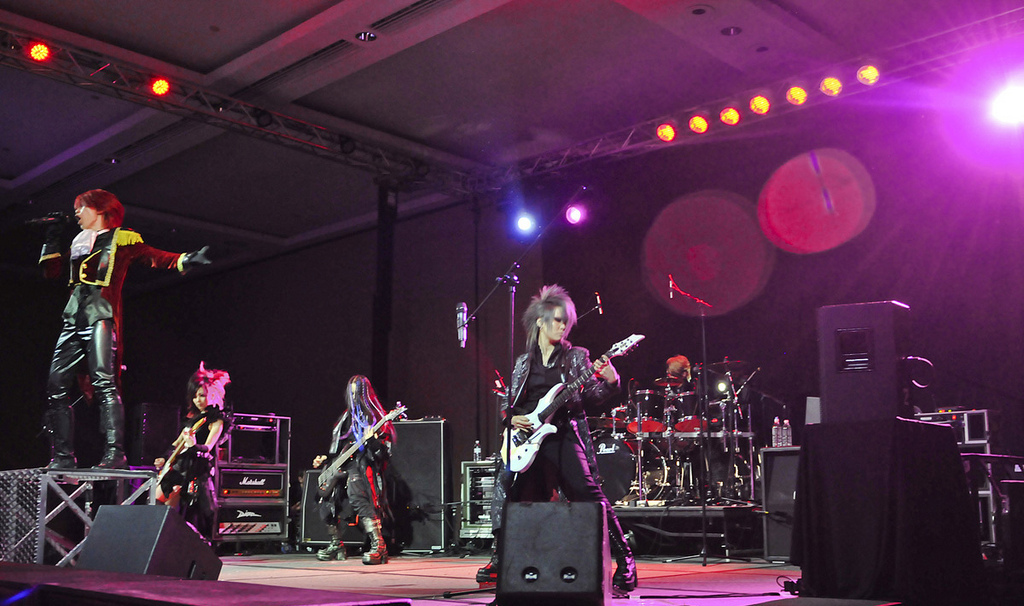
An anison live performance at an anime convention. Photo: Dalton Smith, CC BY 2.0, via Wikimedia Commons.
Anison has its own thriving ライブ (live) culture. Animelo Summer Live (アニメロサマーライブ), held annually at Saitama Super Arena since 2005, draws up to 37,000 fans over two days and is the world's largest anison concert event.
At concerts, dedicated ファン perform ヲタ芸 (wotagei) — synchronised glowstick routines and chant patterns specific to each song. The calls follow established conventions known among fans, creating a participatory experience unique to anison culture.
Anison and Voice Actors
A distinctive feature of anison is the role of 声優 (voice actors). Since the 1990s it has been common for voice casts to record in-character songs under the name of the fictional unit they portray — Love Live!, THE IDOLM@STER, and Macross being landmark examples. Some voice actors — Nana Mizuki, Mamoru Miyano — have built parallel solo music careers and headline arena tours.
This overlap between anime and アイドル culture means anison straddles multiple industries simultaneously.
Related Terms
| Term | Reading | Meaning |
|---|---|---|
| アニメソング | あにめそんぐ | Full form of anison |
| OP / ED | — | Opening / Ending abbreviations |
| タイアップ | — | Tie-up; commercial licensing of a song to an anime |
| キャラソン | — | Character song; a song sung by (or as) a character |
| アニサマ | — | Short for Animelo Summer Live |
| ヲタ芸 | をたげい | Fan cheer-dance performed at concerts |
Related Dictionary Words
music
singer
song; singing
composition; piece of music; song; track (on a record)
voice actor or actress (radio, animation, etc.)
theme song
background music; (movie or commercial) soundtrack; featured songs
opening; start; launch
ending
performer (usu. in a boy band or girl group) with an image cultivated to foster a dedicated fan following; Japanese idol
fan; enthusiast; lover (of)
live (broadcasting, music, etc.)
type of dancing and shouting performed by fans at concerts (usu. idol concerts)