BABYMETAL
bebii metaruA Japanese group that fuses cute idol-pop vocals and choreography with extreme heavy metal instrumentation, becoming an unlikely global metal-festival headliner.
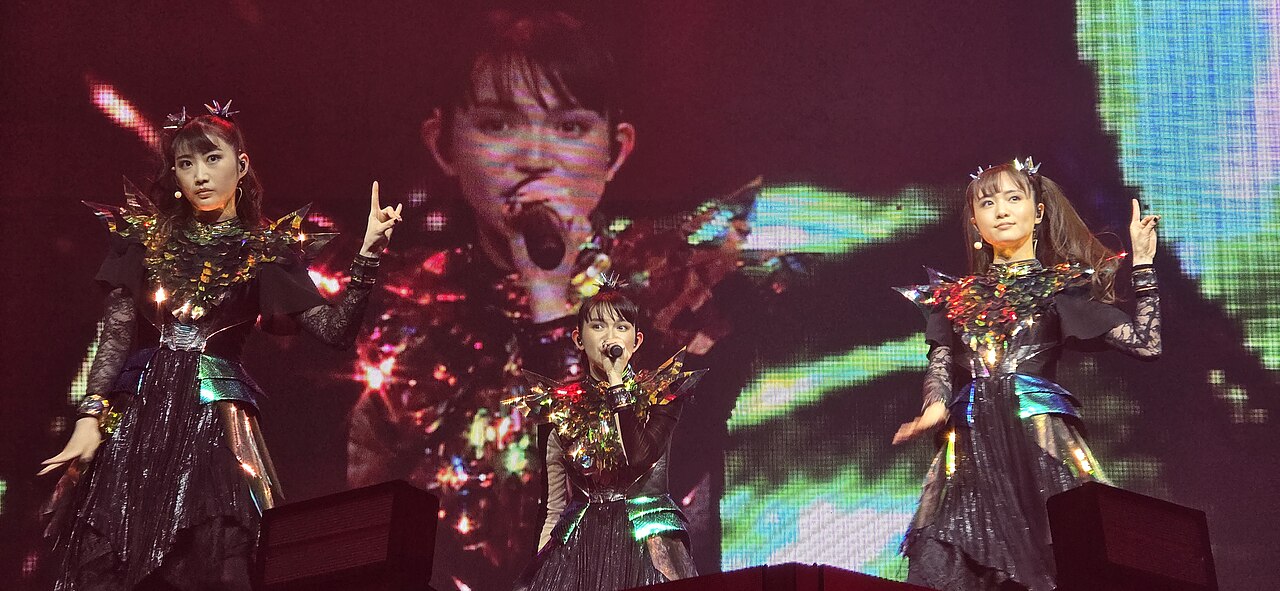
BABYMETAL performing at AFAS Live, Amsterdam, 13 May 2025. Photo: DragonFury, CC BY-SA 4.0, via Wikimedia Commons.
Meaning
BABYMETAL (ベビーメタル, bebii metaru) is a Japanese music group that welds two things that, on paper, should not go together: the bright, cute choreography and unison vocals of a Japanese idol group, and the double-bass drumming, blast beats, and shredding guitar riffs of heavy 金属 (metal) music. Fans and critics alike call the resulting genre "kawaii metal" (かわいいメタル) — a portmanteau capturing the deliberate collision of 可愛い idol aesthetics with an extreme rock genre traditionally coded as loud, aggressive, and almost exclusively male.
The name is a straightforward compound of "baby" — a nod to the group's origin as teenage idol performers — and "metal." On stage, the two (now three) lead vocalist-dancers front the show, while a separate, rotating cast of session musicians called the Kami Band (神バンド) provides the instrumentation. It's a pun: 神 (kami) means both "god" — as in "the amazing band" — and is a homophone of 紙 ("paper"), since the musicians originally performed masked and silhouetted, like paper cutouts, to keep the spotlight on the vocalists.
Usage
BABYMETAL functions as both a proper noun (the group's name) and, increasingly, shorthand for the hybrid genre it popularized.
BABYMETALは「アイドル」と「メタル」を融合させた音楽グループだ。 BABYMETAL wa "aidoru" to "metaru" o 融合saseta 音楽 gurūpu da. "BABYMETAL is a music group that fuses 'idol' and 'metal.'"
海外のメタルファンの間でBABYMETALの人気が爆発的に広がった。 Kaigai no metaru fan no aida de BABYMETAL no ninki ga bakuhatsuteki ni hirogatta. "BABYMETAL's popularity exploded among overseas metal fans."
Outside Japan, "kawaii metal" or "idol metal" is sometimes used as a broader genre label for acts that followed BABYMETAL's template, though BABYMETAL remains by far the best-known example, and the group is often cited as a gateway act that introduced Western metal fans to Japanese pop culture more broadly.
Cultural Context
From Sakura Gakuin side project to independent act
BABYMETAL began in 2010 as a metal-themed sub-unit within Sakura Gakuin (さくら学院), a rotating school-themed idol group run by the talent agency Amuse in which members "graduate" as they age out, much like students leaving an actual school. The original trio — Suzuka Nakamoto (SU-METAL), Moa Kikuchi (MOAMETAL), and Yui Mizuno (YUIMETAL) — were still young teenagers when producer and Kami Band guitarist Mikio Fujioka began writing thrash- and death-metal-inflected backing tracks for their idol choreography. The project became a fully independent act in 2013, after SU-METAL's graduation from Sakura Gakuin, releasing the single "Ijime, Dame, Zettai" and a self-titled debut album.
YUIMETAL left the group in October 2018 for health reasons, and SU-METAL and MOAMETAL continued as a duo for several years. In 2023, Momoko Okazaki — previously one of the group's backing dancers, known as an "Avenger" — was unveiled as the group's third member, MOMOMETAL, restoring the trio format that has defined BABYMETAL's 舞台 (stage) presence since.
An unlikely global breakthrough
Heavy metal has long been a niche 音楽 genre in Japan, and an idol group built around it looked, on paper, like a novelty act with a short shelf life. Instead, BABYMETAL became one of the most improbable Japanese music exports of the 2010s. A viral music video for "Gimme Chocolate!!" and word of mouth among Western metal fans turned the group into a fixture of the international festival circuit. Key milestones include:
| Milestone | Year | Significance |
|---|---|---|
| Surprise Sonisphere Festival slot, UK | 2013 | Early breakout moment with Western metal audiences |
| Metal Resistance world tour begins | 2016 | First headline world tour, played to sold-out venues across Europe, the US, and Japan |
| Headline show, Wembley Arena, London | April 2016 | First Japanese act ever to headline the venue; released as the live album Live at Wembley |
| Support slot for Metallica and Guns N' Roses, Tokyo | January 2017 | Shared a bill with two of metal and rock's biggest acts, on home turf |
| Download Festival, UK | Multiple years | Repeated appearances at one of the world's largest metal festivals, including a surprise set alongside DragonForce |
| Momometal joins, restoring the trio | 2023 | Group reformed as a three-member act after five years as a duo |
BABYMETAL's success is often explained by how sincerely it commits to both halves of its fusion: the metal instrumentation, largely composed and performed by the Kami Band, is technically demanding and played completely straight, while the vocals, choreography, and stage presentation retain the saccharine polish of mainstream アイドル idol pop. Rather than parody either genre, BABYMETAL treats the combination as a genuine artistic statement, which is a large part of why it won over metal purists who might otherwise have dismissed it as a novelty act. The group's rise also mirrors a broader pattern in which distinctly Japanese pop-culture hybrids — from ヴィジュアル系 visual kei to vocaloid music — find outsized followings abroad even when the source genre (idol pop) has a limited audience outside Japan.
Legacy
BABYMETAL's crossover success opened the door for other "kawaii metal" and idol-metal acts, and cemented the idea that idol group formats and extreme music are not mutually exclusive. Two decades into the idol industry's history of tightly formulaic acts, BABYMETAL demonstrated that a genre mashup, if executed with full commitment on both sides, could turn a teenage idol side-project into a globally touring act capable of headlining venues once reserved for legacy Western rock and metal bands.