文楽
bunrakuBunraku is Japan's classical puppet theater, blending large hand-operated puppets, chanted narration, and shamisen music into a single performance.
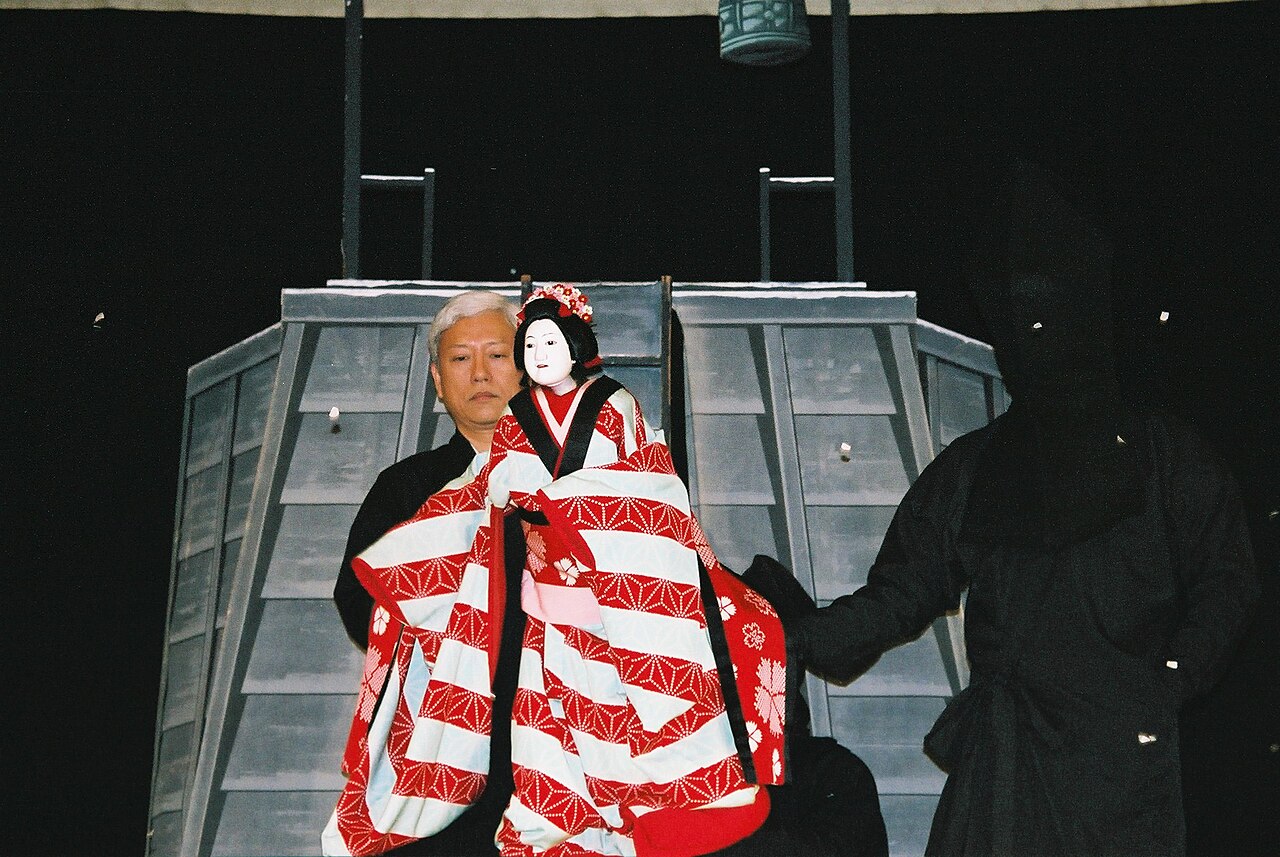
A scene from a bunraku puppet play. Photo: Kate Nevens, CC BY 2.0, via Wikimedia Commons.
Meaning
文楽 (ぶんらく, bunraku) is Japan's classical puppet theater, one of the country's three major traditional performing arts alongside 能 (noh) and 歌舞伎 (kabuki). Its more formal name is 人形浄瑠璃 (にんぎょうじょうるり, ningyo joruri) — literally "puppet joruri," referring to the chanted narrative singing style called 浄瑠璃 that the plays are built around. "Bunraku" itself comes from the Bunrakuza (文楽座), a theater founded in Osaka in the early 19th century that became so central to the art form that its name eventually became the generic term for the whole tradition.
What makes bunraku distinctive is that it fuses three separate crafts into a single performance: large, finely carved puppets manipulated in full view of the audience, a chanted narration that voices every character and describes the action, and shamisen music that drives the emotional pacing. Unlike Western puppetry, the puppeteers make no attempt to hide — they stand on stage in black robes, and audiences quickly learn to look past them and see only the puppet's performance.
The Three Core Roles
Bunraku performance rests on three specialists working in tight coordination, referred to collectively as sangyo-itchi (三業一致, "unity of the three arts"):
| Role | Japanese | Function |
|---|---|---|
| Puppeteer | 人形遣い (にんぎょうづかい) | Operates the puppet's movement |
| Chanter | 太夫 (たゆう) | Narrates and voices all characters |
| Shamisen player | 三味線弾き | Provides musical accompaniment and emotional cues |
The puppets and puppeteers. A major bunraku puppet is roughly 1.2 to 1.5 meters tall and requires three puppeteers working together: the omozukai (主遣い, "main operator") controls the head and right arm and is the only one whose face is uncovered; the hidarizukai (左遣い, "left operator") controls the left arm and hand props; and the ashizukai (足遣い, "foot operator") controls the legs and feet (female puppets typically have no legs at all — the ashizukai simulates the movement of a kimono hem instead). The two supporting puppeteers wear black hoods and robes known as kurogo (黒衣), a convention meant to signal "not present" to the audience even though they are standing in plain sight. It takes years of apprenticeship before a puppeteer is trusted to control a puppet's head and right arm — a performer typically spends a decade or more on feet and legs alone before advancing.
The chanter. The 太夫 sits to the side of the stage on a small rotating platform and single-handedly voices every character in the scene, shifting pitch, cadence, and emotional register for each, while also narrating scene descriptions in the third person. A skilled tayu can voice an elderly man, a young woman, and a villain in successive lines without ever breaking the flow of the story. The chanting style itself, 浄瑠璃 — more specifically the gidayu-bushi (義太夫節) style used in bunraku — was systematized by the chanter Takemoto Gidayu in late 17th-century Osaka and remains the technical foundation of the art form today.
The shamisen player. A thick-necked variant of the 三味線 called the futozao is used in bunraku for its deep, percussive tone. The player does not simply accompany the chanter — the two rehearse as a matched pair for years, and the shamisen's phrasing anticipates and shapes the chanter's delivery, underscoring tension, comic beats, and tragedy in real time.
Origins in the Edo Period
Bunraku's roots lie in the 江戸時代 (Edo period, 1603–1868), when puppetry traditions already present in Japan — including simple traveling puppeteer performances — merged with the newly popular joruri chanting style and the shamisen, an instrument introduced from Okinawa via the mainland in the 16th century. By the late 1600s in Osaka, these three elements had combined into a mature theatrical form performed in dedicated playhouses for paying urban audiences.
The playwright most associated with bunraku's golden age is Chikamatsu Monzaemon (近松門左衛門, 1653–1725), often called Japan's Shakespeare. Working closely with the chanter Takemoto Gidayu, Chikamatsu wrote both grand historical dramas (jidaimono) and, more influentially, domestic tragedies (sewamono) about ordinary townspeople trapped between duty and desire. His 1703 play Sonezaki Shinju (曽根崎心中, "The Love Suicides at Sonezaki") was a sensation that established the double-suicide love tragedy as a defining bunraku genre; another of his masterworks, 心中天網島 ("The Love Suicides at Amijima"), remains a staple of the repertoire today. These plays dramatize the tension between 義理 (giri, social obligation) and 人情 (ninjo, human feeling) — a conflict that recurs throughout premodern Japanese storytelling, including in kabuki, which frequently adapted bunraku scripts for live actors.
Bunraku reached its commercial peak in the 18th century, at times even outdrawing kabuki in Osaka. Its popularity declined through the 19th and 20th centuries as film, and later television, drew audiences away, but a small number of dedicated troupes preserved the tradition. Today the National Bunraku Theatre (国立文楽劇場) in Osaka, opened in 1984, is the art form's principal home, with additional performances held at the National Theatre in Tokyo.
UNESCO Recognition
In 2003, bunraku was proclaimed a Masterpiece of the Oral and Intangible Heritage of Humanity by UNESCO, and in 2008 it was formally inscribed on the Representative List of the Intangible Cultural Heritage of Humanity — the same list that later recognized 能 and kabuki. The designation was intended to support the transmission of bunraku's specialized skills, which take decades to master and depend on a shrinking pool of professional performers trained through Japan's National Theatre apprenticeship program.
Bunraku and Its Sister Arts
Bunraku sits alongside noh, kabuki, and 落語 (rakugo) as one of Japan's classical stage traditions, but each has a distinct character:
- Noh is slow, masked, and spiritually restrained, drawing on Buddhist and Shinto themes.
- Kabuki is a live actor's theater known for its stylized, flamboyant performances — and it borrowed so many plots and staging conventions from bunraku that some kabuki plays are essentially adaptations of bunraku scripts.
- Rakugo is solo comic storytelling with no puppets, music, or scenery.
- Bunraku is unique in centering the puppet itself as the star, with the human performers — chanter, shamisen player, and puppeteers — working in service of an illusion of life in an inanimate figure.
Cultural Context
Bunraku's audience appeal has always rested on emotional intensity: stories of thwarted love, family duty, and tragic sacrifice, delivered through a puppet whose carved face is fixed but which, in a master puppeteer's hands, appears to breathe, hesitate, and weep. Japanese audiences and critics alike have long described watching a great bunraku performance as forgetting the puppeteers are there at all — the puppet, chanter, and shamisen fuse into a single dramatic voice.
Because of the years of training required for each of the three roles, bunraku is often cited as an example of Japan's iemoto system of artistic transmission, in which technique, repertoire, and performance style are handed down through structured apprenticeship rather than open instruction. This has helped preserve the tradition with remarkable fidelity, but it also makes it vulnerable — a major reason UNESCO's Intangible Cultural Heritage designation specifically highlights transmission and training as areas needing support.
人形浄瑠璃文楽は、太夫、三味線、人形遣いの三業が一体となって物語を紡ぐ日本の伝統芸能です。 Ningyo joruri bunraku is a traditional Japanese performing art in which the three crafts of chanter, shamisen, and puppeteer become one to weave a story.
Related Dictionary Words
bunraku; Japanese puppet theatre (theater)
Japanese puppet theatre in which recited narrative and dialog is accompanied by a shamisen (forerunner of bunraku)
jōruri; type of dramatic recitation accompanied by a shamisen (associated with Japanese puppet theater)
high-ranking noh actor
shamisen; samisen; three-stringed Japanese lute
doll; puppet; marionette
left puppeteer (bunraku); manipulates the left arm
foot puppeteer (bunraku)
black clothes
duty; sense of duty; honor; honour; decency; courtesy; debt of gratitude; social obligation
humanity; empathy; kindness; sympathy
Edo period (1603-1868)
Shinjuu Ten no Amijima (Love Suicides at Amijima) - play by Chikamatsu, film by Masahiro Shinoda
intangible cultural heritage