落語
rakugoA traditional form of Japanese comedic solo storytelling in which a seated performer (rakugoka) depicts an entire cast of characters using only voice, expression, and two small props.
Meaning
落語 (rakugo) literally means "fallen words" or "story with a fall" — a name that captures both the art form's comic spirit and its defining structure: every story ends with a twist, a wordplay, or a comedic drop known as the ochi (落ち, "fall" or "punchline"). The 落語家 (rakugoka), the solo performer, never rises from their seated position on a square cushion (座布団) atop a raised platform called the 高座 (kōza). Armed with nothing but a folding fan (扇子) and a small hand towel, they give voice to shopkeepers, samurai, ghosts, children, and bumbling commoners — switching between characters with nothing more than a slight tilt of the head and a shift in register.
Performance
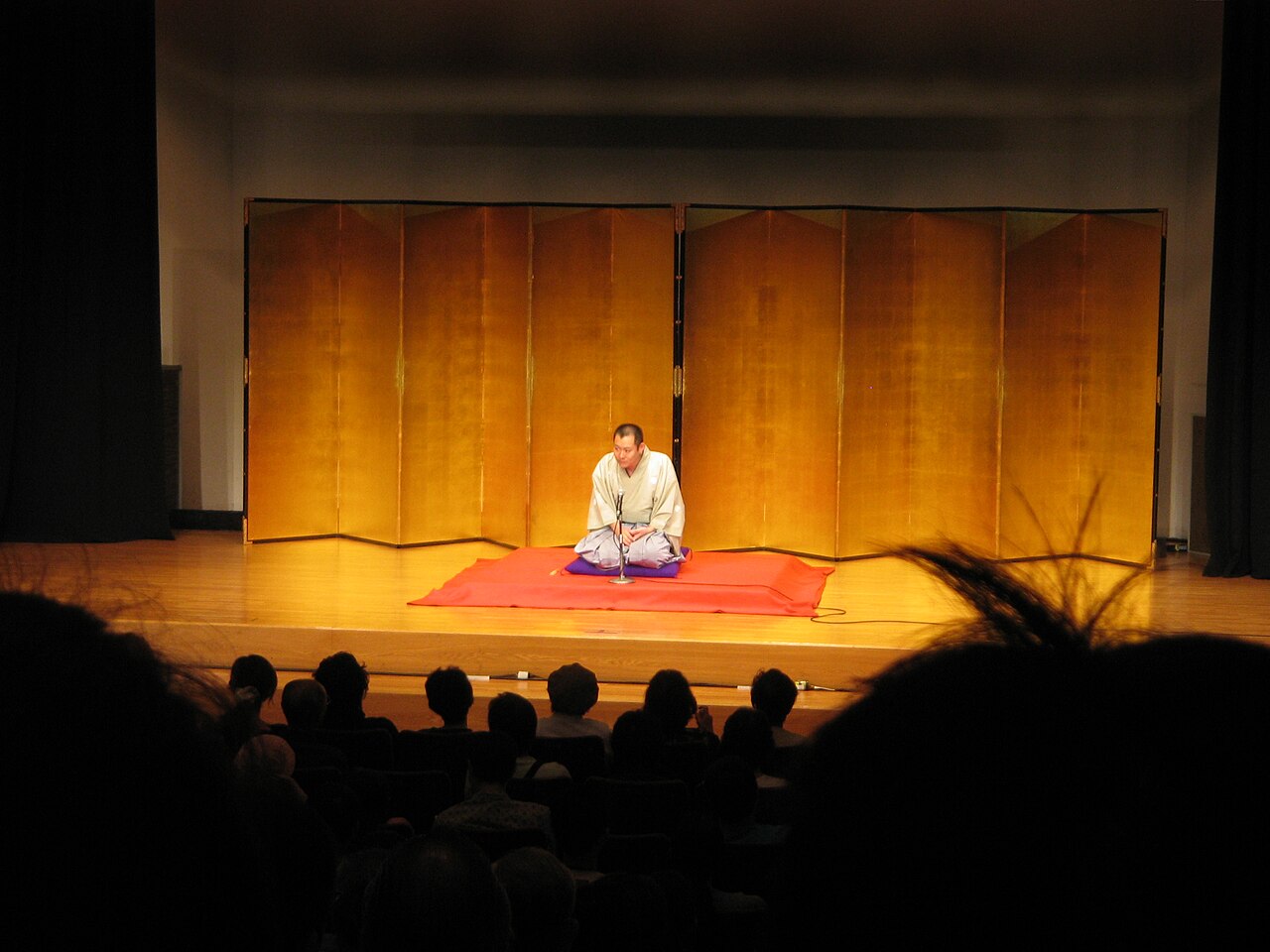
A rakugoka performs seated on the kōza at the Rakugo Sanma Festival. Photo: vera46, CC BY 2.0, via Wikimedia Commons.
A full rakugo performance unfolds in three broad movements:
- Makura (枕, "pillow") — The rakugoka opens with a short, conversational preamble — anecdotes, observations, or jokes — used to warm up the audience and ease them into the story's setting and era.
- Honban (本番, "the main piece") — The rakugoka launches into the classical story itself, voicing all characters through changes in pitch, speed, and direction of gaze. The 扇子 becomes a writing brush, a pair of chopsticks, or a sake flask; the tenugui cloth doubles as a book, a wallet, or a sleeping head.
- Ochi (落ち, "the drop") — The story snaps shut on a punchline, often a groan-worthy pun or a perfectly circular callback to the opening. Without a satisfying ochi, the performance is considered incomplete.
The two major regional schools carry distinct flavors:
| School | Region | Character |
|---|---|---|
| 江戸落語 (Edo rakugo) | Tokyo | Dry, fast-paced, sharp wit |
| 上方落語 (Kamigata rakugo) | Osaka/Kyoto | Warmer, more theatrical, uses a small table |
Cultural Context
Rakugo's roots reach back to the early Edo period. Buddhist monks used comic storytelling — called setsuwa — in sermons to hold their congregations' attention. By the 17th century, professional storytellers had emerged in Kyoto, Osaka, and 江戸 (Edo, present-day Tokyo), performing in makeshift theaters. The 寄席 (yose) — dedicated variety halls — became the rakugo venue of choice from the 18th century onward, often featuring rakugo alongside other 芸能 (performing arts) such as magic, acrobatics, and narrative singing.
Rakugo's social function was crucial: it was 芸 for the common people. In an era of strict class hierarchy, the 客 (audience) at a yose was a rare space where merchants, craftspeople, and laborers gathered as equals to 笑い (laugh) at the foibles of the powerful — a miserly landlord, a corrupt official, or a pompous samurai who cannot hold his sake.
The 伝統 (tradition) nearly collapsed after World War II, as cinema, television, and later the internet drew audiences away. Yet the art endured. From the 1950s onward, a generation of master rakugoka revived the form, and television broadcasts introduced millions of viewers to the 物語 (stories). Today, renowned performers such as Tatekawa Shinosuke and Katsura Sunshine perform in English, bringing rakugo to international 舞台 (stages).
Repertoire and Story Types
The classical repertoire contains roughly 500 named stories handed down through lineages of master-to-apprentice transmission. Stories are broadly divided into two registers:
- Kokkei-banashi (滑稽噺) — Pure comic tales. The most famous include Jugemu (a child given a comically long name) and Toki Soba (a man who tricks a noodle vendor by counting to nine very fast).
- Ninjō-banashi (人情噺) — Sentimental stories with emotional depth, sometimes ending in tragedy rather than laughter. These require particular mastery and are often reserved for experienced performers.
Performers occasionally create shin-sakuhin (新作, new works) addressing contemporary life — smartphone addiction, overwork culture, or life in modern Tokyo — expanding the repertoire while preserving its core structure.
Apprenticeship and Rank
Becoming a rakugoka is a long journey. An aspiring performer enters as a live-in apprentice (弟子, deshi) under a master, handling household chores for years before being allowed to perform publicly. The formal progression in the Tokyo tradition runs:
| Rank | Collar Color | Stage |
|---|---|---|
| 前座 (meza) | Black | Junior apprentice, assists backstage |
| 二ツ目 (futatsume) | Purple/white | Performs independently |
| 真打 (shin-uchi) | White | Full master, may take apprentices |
Promotion to shin-uchi (真打) — the highest rank — typically takes fifteen or more years.
Rakugo in Popular Culture
The 2016 anime 昭和元禄落語心中 (Shōwa Genroku Rakugo Shinjū) brought rakugo to a new generation of fans worldwide, depicting the postwar golden age of the art form with unusual reverence for its details. The manga あかね噺 (Akane-Banashi, 2022–present) follows a teenage girl fighting to become a shin-uchi and has further sparked youth interest.
English-language rakugo performances are now held regularly in Tokyo and abroad, with performers adapting classical stories or creating entirely new ones. The art's reliance on language, timing, and imagination — rather than elaborate sets or costumes — makes it uniquely portable across cultures.
Related Dictionary Words
rakugo; traditional Japanese comic storytelling; comic story (told by a professional storyteller)
rakugo story teller; comic story teller
platform; stage; upper seat; pulpit
folding fan
entertainment hall (for rakugo, manzai, magic, music, etc.); vaudeville theater (theatre); music hall
tradition; convention
public entertainment; performing arts
laugh; laughter
story; tale; narrative; account; fable; legend
Edo (shogunate capital; former name of Tokyo); Yedo
zabuton; flat floor cushion used when sitting or kneeling; usu. rectangular
stage (of a theatre, concert hall, etc.)
guest; visitor
haori (Japanese formal coat)
art; craft; accomplishment; artistic skill; technique; performance