能
nohJapan's oldest surviving classical theater form, dating to the 14th century, blending masked dance, poetry, and music into a deeply spiritual performance art recognized by UNESCO.
Meaning
能 (noh) is Japan's oldest surviving classical performing art, a form of 舞踊 — musical theater that fuses masked dance, chanted poetry, and 音楽 into a single, highly refined art form. The word 能 means "skill" or "talent," reflecting the extraordinary mastery required to perform it. A single Noh play can last between one and two hours, unfolding at a deliberate, almost meditative pace that is unlike any other theatrical tradition in the world.
Noh is performed on a distinctive hinoki cypress 舞台 (stage) that has remained almost unchanged for six centuries. The principal performer, called the シテ (shite, "the one who acts"), often wears an iconic 能面 — a carved wooden mask — to embody spirits, gods, women, old men, or demons. The supporting actor, the ワキ (waki), typically plays a traveling monk or official and does not wear a mask.
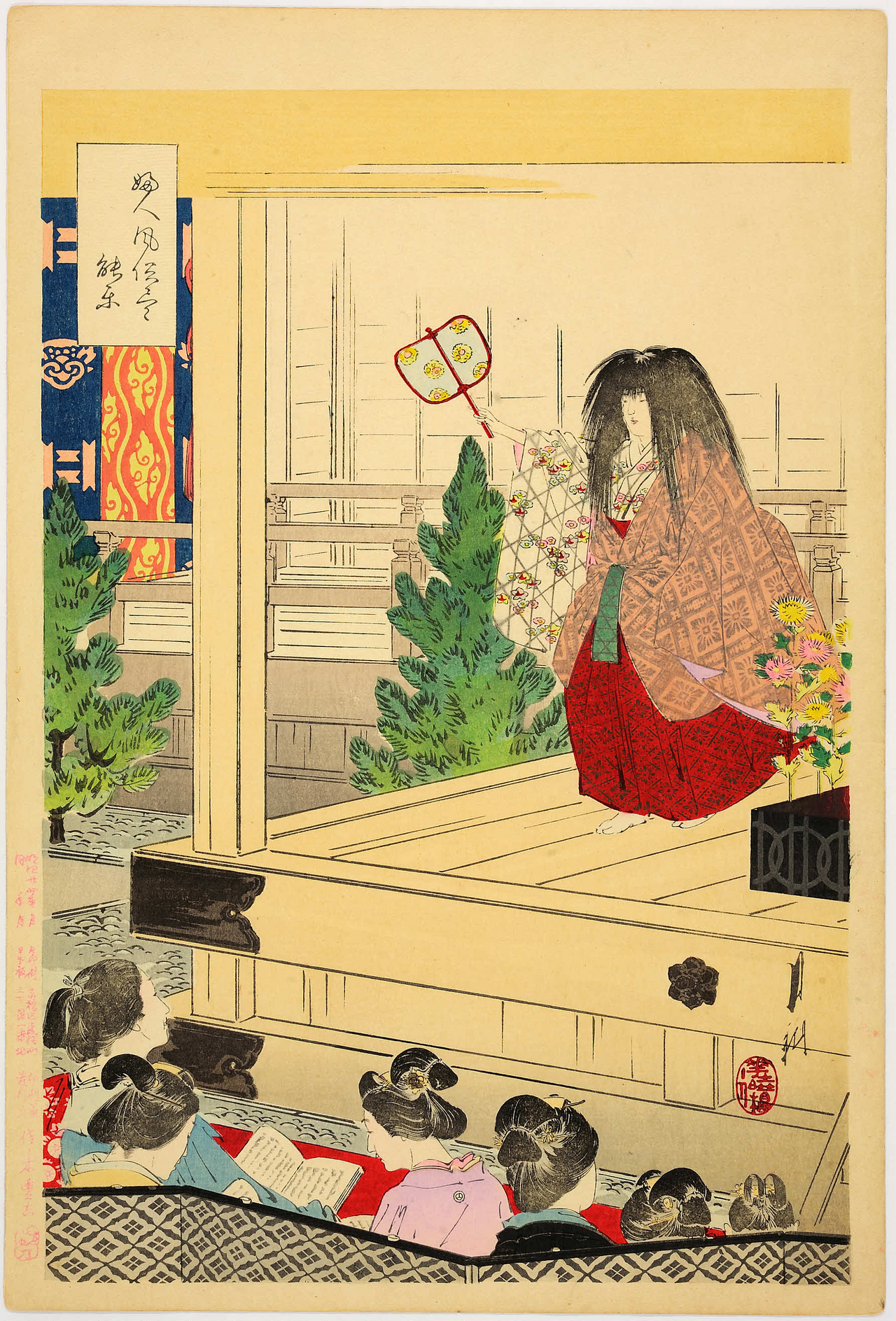
Noh theater performance depicted by Ogata Gekkō, 1891. Public domain, via Wikimedia Commons.
History
Noh emerged in the 14th century from earlier ritual performing arts, particularly sarugaku (猿楽), a form of acrobatic entertainment with roots in both Japanese folk performance and influences from the Asian mainland. The art was decisively shaped by Kan'ami Kiyotsugu (観阿弥清次, 1333–1384) and his son Zeami Motokiyo (世阿弥元清, 1363–1443), widely regarded as the greatest figure in Noh's history.
In 1374, Zeami performed before the young shogun Ashikaga Yoshimitsu, who became an enthusiastic patron. Under this aristocratic sponsorship, Zeami transformed the earthy sarugaku into an elevated art of 精神al depth and poetic beauty. He wrote over 100 plays (about half the current Noh repertoire), composed the essential theory treatises on Noh aesthetics — most famously Fūshikaden (風姿花伝) and Zeami Jūrokubu-shū — and codified the concept of yūgen (幽玄), an aesthetic of profound, mysterious beauty that lies at the heart of Noh.
Noh was closely associated with the warrior class and the Shogunate through the Muromachi and Edo periods, performed at official ceremonies and religious festivals. The five schools of Noh that survive today — Kanze (観世), Hōshō (宝生), Komparu (金春), Kongō (金剛), and Kita (喜多) — were all established or recognized during this era.
In 2001, Noh (together with 狂言) was proclaimed a UNESCO Masterpiece of the Oral and Intangible Heritage of Humanity, and it was inscribed on the UNESCO Intangible Cultural Heritage list in 2008.
The Noh Stage
The Noh 舞台 is one of the most distinctive performance spaces in world theater. The main stage (本舞台, honbutai) is a raised square platform approximately 6 meters on each side, constructed of polished hinoki (Japanese cypress) wood. It is covered by a sweeping roof in the style of a Shinto shrine, supported by four pillars.
Four architectural elements define the Noh stage:
| Element | Japanese | Function |
|---|---|---|
| Main stage | 本舞台 (honbutai) | Principal performance area |
| Bridge | 橋掛り (hashigakari) | Entrance runway from the left |
| Back stage | 後座 (kōza) | Musicians' area |
| Chorus seat | 地謡座 (jiutaiza) | Where the chorus sits |
The 橋 (hashigakari) is particularly significant: it is the long, diagonal passageway along which the shite makes a slow, processional entrance. This bridge represents the boundary between the world of the living and the supernatural realm. A 松 (pine tree) painted on the back wall behind the stage — the kagami-ita — is the only scenery. Its symbolic presence, rooted in the Shinto association of pines with 神s and spirits, frames every performance.
Noh Masks
The 能面 (noh mask) is perhaps the most iconic element of Noh theater. These carved wooden masks are objects of profound aesthetic and spiritual significance, and skilled mask carvers (面打師, omenbushi) are considered living national treasures.
A Noh mask transforms the wearer into a different being. Crucially, the masks are designed with subtly ambiguous expressions: tilted slightly downward, the 面 appears sorrowful; tilted upward into the light, it appears to smile or glow with intensity. This technique — called 照らす and 曇らす ("to illuminate" and "to cloud") — allows a skilled performer to convey complex emotional shifts through the slightest movement of the head.
The main categories of Noh masks include:
- Ko-omote (小面) — A young woman's face, representing beauty and gentleness
- Hannya (般若) — A jealous woman transformed into a demon, with horns and a terrifying grimace
- Okina (翁) — An ancient, benevolent old man, used only in the ritual Okina play
- Chūjō (中将) — A noble young warrior, often a ghost
- Yase-otoko (痩男) — An emaciated male spirit from the underworld
Not all characters wear masks. The waki (supporting actor) and kyōgen performers typically do not, grounding the supernatural world of the shite in a recognizable human perspective.
Types of Noh Plays
Noh plays are traditionally categorized into five types (goban-date, 五番立), each associated with a specific type of protagonist and performed in a set order during a full-day program:
| Type | Japanese | Subject |
|---|---|---|
| Waki-noh | 脇能 | Gods; auspicious, celebratory |
| Shura-mono | 修羅物 | Warriors; the 武士's spirit trapped in hell |
| Katsura-mono | 鬘物 | Women; grace and beauty |
| Kyōjo-mono / Zatsu-noh | 狂女物 / 雑能 | Madwomen, living people, demons |
| Kiri-noh | 切能 | Demons and supernatural beings; rapid, powerful finale |
Many celebrated plays center on the spirit of a person — often a 幽霊 — who returns to re-enact a past event or seek release from attachment. A wandering monk (the waki) encounters a mysterious figure, who eventually reveals their true identity as a spirit seeking 鎮魂 (spiritual consolation). This narrative structure, called mugen-noh (夢幻能, "dream-vision Noh"), is the dominant form of the repertoire.
Famous plays include Matsukaze (松風), about two fisherwoman sisters who loved a nobleman; Atsumori (敦盛), about a warrior's 幽霊 who revisits the moment of his death; and Dōjōji (道成寺), in which a scorned woman's jealousy transforms her into a serpent.
Kyōgen: The Comic Interlude
狂言 (kyōgen, literally "wild words") is the comic counterpart to Noh. In a traditional full-day Noh program, kyōgen plays are performed between the serious Noh pieces, providing comedic relief and contrast. Where Noh deals with the supernatural, the aristocratic, and the profoundly spiritual, kyōgen features everyday characters — servants, husbands, wives, merchants — in farcical, witty situations.
Kyōgen uses everyday spoken language rather than Noh's archaic chanted poetry, and its performers use exaggerated physical 演技 without masks (usually). The two art forms are inseparable: collectively they are called Nōgaku (能楽), and they share the same UNESCO heritage designation. Today's two main kyōgen schools are Okura (大蔵) and Izumi (和泉).
Music and Chant
The soundscape of Noh is entirely acoustic and deliberately sparse. The hayashi (囃子), or 囃子 ensemble, consists of:
- Fue (笛) — A transverse bamboo flute with a distinctive piercing tone
- Ko-tsuzumi (小鼓) — A small hand drum held at the shoulder
- Ō-tsuzumi (大鼓) — A larger hip drum
- Taiko (太鼓) — A stick drum, used only in certain play types
The text is delivered as utai (謡), a form of heightened chanting somewhere between speech and song. The jiutai (地謡), a chorus of eight or more seated at the side of the stage, sings much of the narrative and descriptive poetry. Silence itself is a musical element — extended pauses called ma (間) are as significant as the sounds that surround them.
Cultural Context
Noh's relationship with 神道 is deep. Many plays are staged at 神社 (shrines) as ritual offerings, and the Okina play — the most ancient piece in the repertoire — is understood less as theater than as a sacred 祈り (prayer) ceremony. The pine tree on the back wall is not decoration but an invitation to the divine.
Noh embodies the Japanese aesthetic concept of yūgen (幽玄) — a mysterious, subtle, and profound beauty that is felt rather than understood. Everything in Noh is reduced to essence: a single gesture can represent a journey; a lowered gaze can represent weeping. Zeami wrote that the highest Noh performance conveys its deepest emotions not through action, but through monomane no hana ga chirite nochi — the flower that blooms after the performance of imitation has scattered.
Noh is closely related to:
- 歌舞伎 (kabuki) — which emerged in the 17th century partly as a popular counterpart to Noh's aristocratic refinement, incorporating more dramatic movement and color
- 茶道 (tea ceremony) — which shares the same Muromachi-era aesthetics of wabi-sabi restraint and mindful presence
- 神道 — whose ritual performance traditions are the spiritual roots from which Noh grew
Modern Noh
Today Noh is performed by a small but dedicated community of professional actors, many from families that have maintained the tradition for generations. The major Noh schools operate theaters in Tokyo, Kyoto, and Osaka, and there are roughly 1,500 professional Noh performers in Japan.
Full-day programs (taikai, 大会) following the traditional five-play structure are rare outside of special occasions; more commonly, one or two plays are performed alongside kyōgen pieces. Contemporary directors and playwrights have also created new Noh works (shinsaku-noh, 新作能) on modern themes, and international collaborations have introduced Noh movement and masks into Western opera and theater.
For visitors to Japan, watching a Noh performance — even briefly — offers an unparalleled encounter with a living 伝統 (tradition) that has survived, almost unaltered, for more than 600 years.
Related Dictionary Words
talent; gift; function
noh mask
kyogen; farce presented between noh plays or during the interlude of a noh play
accompaniment for traditional performances (noh, kabuki, etc.); orchestra; band
stage (of a theatre, concert hall, etc.)
mask
tradition; convention
art; the arts
acting; performance
dancing; dance
repose of a soul
mind; spirit; soul; heart; ethos
noh chanting; noh chant
story; tale; narrative; account; fable; legend
ghost; specter; spectre; apparition; phantom
samurai; warrior
prayer; supplication