ドラゴンボール
doragon bōruAkira Toriyama's legendary manga and anime franchise about Son Goku's quest for the seven wish-granting dragon balls, which defined the modern shōnen genre and became one of the best-selling comics of all time.
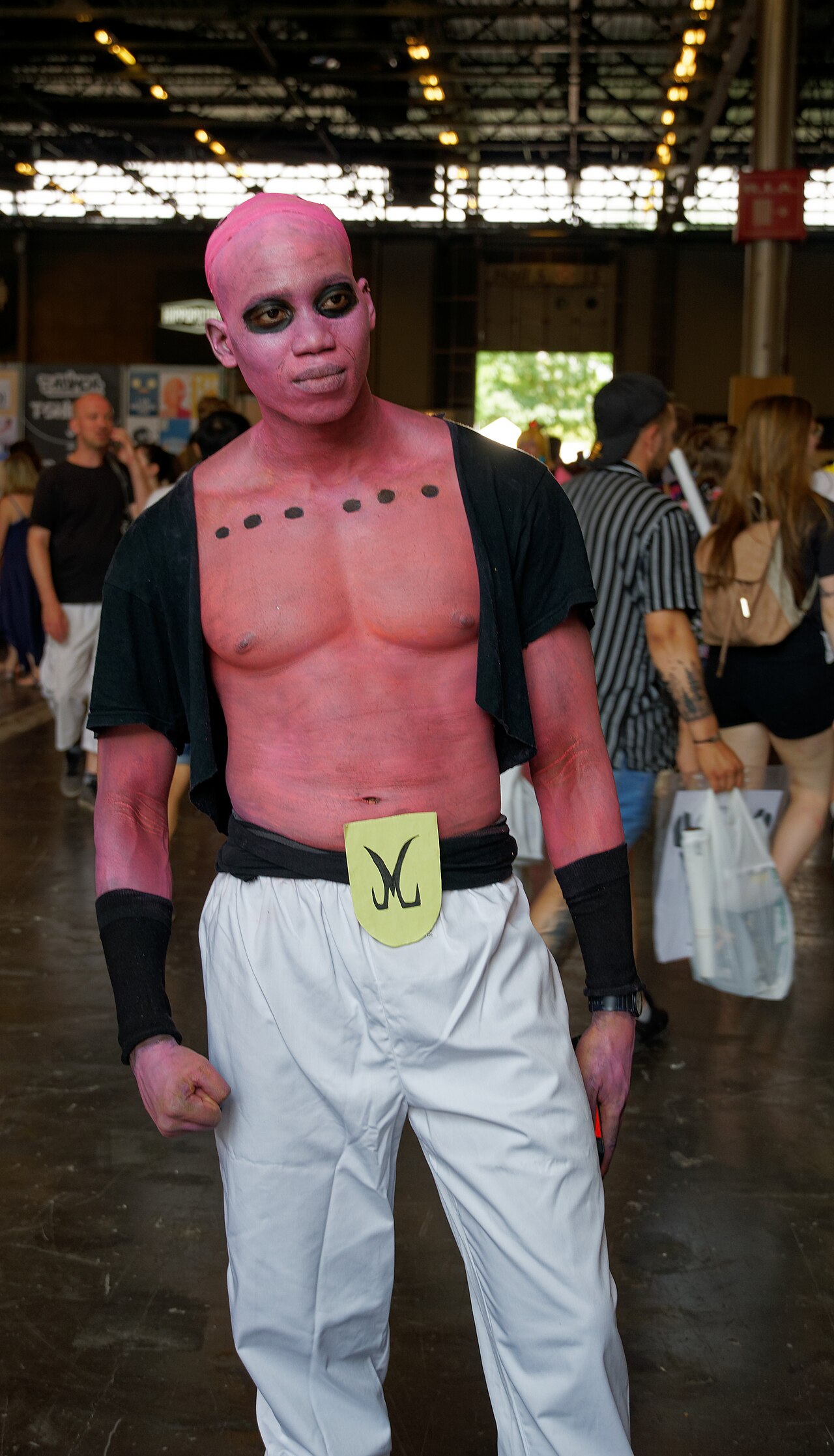
A cosplayer dressed as Majin Buu at Japan Expo, Paris, 2019 — representative of the franchise's global convention culture, not official artwork. Photo: Miguel Discart, CC BY-SA 2.0, via Wikimedia Commons.
Meaning
ドラゴンボール (doragon bōru, "Dragon Ball") is the 漫画 series created by 鳥山明 (Toriyama Akira), serialized in 週刊少年ジャンプ (Weekly Shōnen Jump) from 1984 to 1995, and the sprawling anime, film, and merchandise franchise it spawned. The title refers to the seven magical crystal orbs (dragon balls) at the heart of the story: when gathered together, they summon the 竜 (dragon) Shenron, who grants the summoner one wish.
The story follows Son Goku (孫悟空, Son Gokū), a monkey-tailed boy raised in the mountains who turns out to be a member of a fictional warrior race, the Saiyans (サイヤ人, Saiya-jin). Across the original Dragon Ball (treasure-hunting adventure comedy) and its sequel Dragon Ball Z (ドラゴンボールZ, martial-arts tournament and alien-invasion action), Goku and his friends train, fight increasingly powerful enemies, and repeatedly save the Earth — and eventually the universe.
Usage
Dragon Ball's vocabulary is so embedded in Japanese pop culture that its catchphrases and character names function as everyday shorthand, especially among people who grew up with the series.
「かめはめ波!」 "Kamehame-ha!" — the signature energy-blast attack move, shouted (often while striking the pose) as a joke among friends, at karaoke, or by kids on a playground.
天下一武道会で優勝するのが夢だ。 Tenka-ichi Budōkai de yūshō suru no ga yume da. "My dream is to win the World Martial Arts Tournament." (Referencing the recurring fictional tournament — used loosely to mean any big competitive showdown.)
Referring to someone as サイヤ人 ("a Saiyan") is a common compliment for extraordinary strength, stamina, or resilience — much like calling someone "a machine" in English. Saying something is 界王拳 level, or that a person just "went 超サイヤ人" (turned Super Saiyan), jokingly describes a sudden burst of power, anger, or effort (e.g., a coworker suddenly working at ten times their normal speed before a deadline).
Cultural Context
Toriyama began Dragon Ball in 1984 as a loose riff on the classical Chinese novel Journey to the West (西遊記), casting Goku as a version of the Monkey King, Sun Wukong. The manga ran for 42 単行本 volumes and sold over 260 million copies worldwide, making it one of the best-selling manga series of all time. The 1989–1996 anime adaptation Dragon Ball Z became the series' biggest cultural export: it was among the first anime to achieve mainstream popularity across the Americas, Europe, and the Middle East in the 1990s and 2000s, well before "anime" was a familiar word outside Japan.
Within Japan, Dragon Ball helped define the modern shōnen (少年, boys') manga formula: a determined underdog hero, escalating rival battles, training arcs, and a found-family cast — a template later followed by hits such as NARUTO and ONE PIECE. Toriyama's clean, dynamic art style and his sense of comedic timing (honed on his earlier hit Dr. Slump) also shaped how a generation of manga artists drew action and expression.
The franchise never really stopped growing. Dragon Ball GT (1996–97) and years of movies kept it visible through the 2000s; Dragon Ball Kai (2009) re-edited Z for a new audience; and Dragon Ball Super (2015–2018, manga ongoing) returned Toriyama to an active creative role until his death in March 2024. The 2024 film Dragon Ball Daima and continued Super manga chapters (now written by Toyotarō with Toriyama's outline material) show the series is still an active, evolving property rather than a nostalgia act.
Dragon Ball's imagery is now part of Japan's visual shorthand for anime itself: the orange gi, the spiky hair, the Kamehameha pose, and Shenron's dragon silhouette appear constantly in advertising, product tie-ins (everything from instant noodles to credit cards), and public art. Toriyama's hometown of Kiyosu, Aichi Prefecture, and Nagi, Okayama Prefecture (birthplace of the manga's setting inspiration) both host Dragon Ball-themed public monuments and tourism campaigns.
Key Terms and Names
Many character and technique names are Japanese puns, a Toriyama trademark that Japanese readers catch immediately but that gets lost in translation:
| Term | Reading | Literal meaning / joke |
|---|---|---|
| 孫悟空 (Son Gokū) | そんごくう | The Monkey King's name from Journey to the West |
| かめはめ波 | かめはめは | Named after Master Roshi's dojo nickname, "Kame House" (亀, 亀 = turtle) |
| ベジータ (Vegeta) | べじーた | From vegetable — the Saiyans are largely named after vegetables and produce |
| フリーザ (Frieza) | ふりーざ | From "freezer" — his allies are named for refrigeration appliances |
| サイヤ人 (Saiyan) | さいやじん | Anagram of yasai (野菜, 野菜 "vegetable") |
| 界王拳 (Kaiō-ken) | かいおうけん | "Fist/technique of the King of Worlds," a power-up taught by King Kai |
The core narrative engine — 修行 (rigorous training) followed by a tournament or 敵 (enemy) fight that pushes the hero past his previous limit — became such a recognizable structure that Japanese fans and critics use the phrase インフレバトル (infure batoru, "battle inflation") to describe any shōnen series, Dragon Ball included, where power levels escalate faster than the story can meaningfully justify.
Legacy
Dragon Ball's influence is hard to overstate: it helped establish 集英社's Weekly Shōnen Jump as the dominant force in manga publishing, inspired the power-scaling and tournament arcs used across the shōnen genre, and — through Dragon Ball Z's syndicated dub — introduced millions of non-Japanese viewers to anime as a medium in the 1990s. Video games (the Dokkan Battle and Xenoverse series), a long-running toy and card-game business, and a 2009 Hollywood 実写映画 adaptation (Dragonball Evolution, widely panned) all extended the brand far beyond the original manga's 1995 打ち切り... though in Dragon Ball's case, ending was never really "the end" — Goku and friends kept coming back for one more fight.
Related Dictionary Words
cartoon; comic; comic strip; manga
Shōnen Jump (weekly magazine)
dragon (esp. a Chinese dragon)
training; practice; discipline; study
opponent; rival; adversary
tortoise; turtle
vegetable
standalone book (i.e. not part of an anthology, series, etc.); (book published as a) single volume
serialization; serialisation; serial story
end; close; finish; truncation; discontinuance; closure; cancellation; breaking off; aborting
live-action film
Shueisha (publisher)