NARUTO
narutoNARUTO is Masashi Kishimoto's mega-hit ninja manga and anime, one of the best-selling manga series ever and, alongside One Piece and Bleach, part of anime's iconic "Big Three" that introduced a generation of fans worldwide to shonen anime.
Meaning
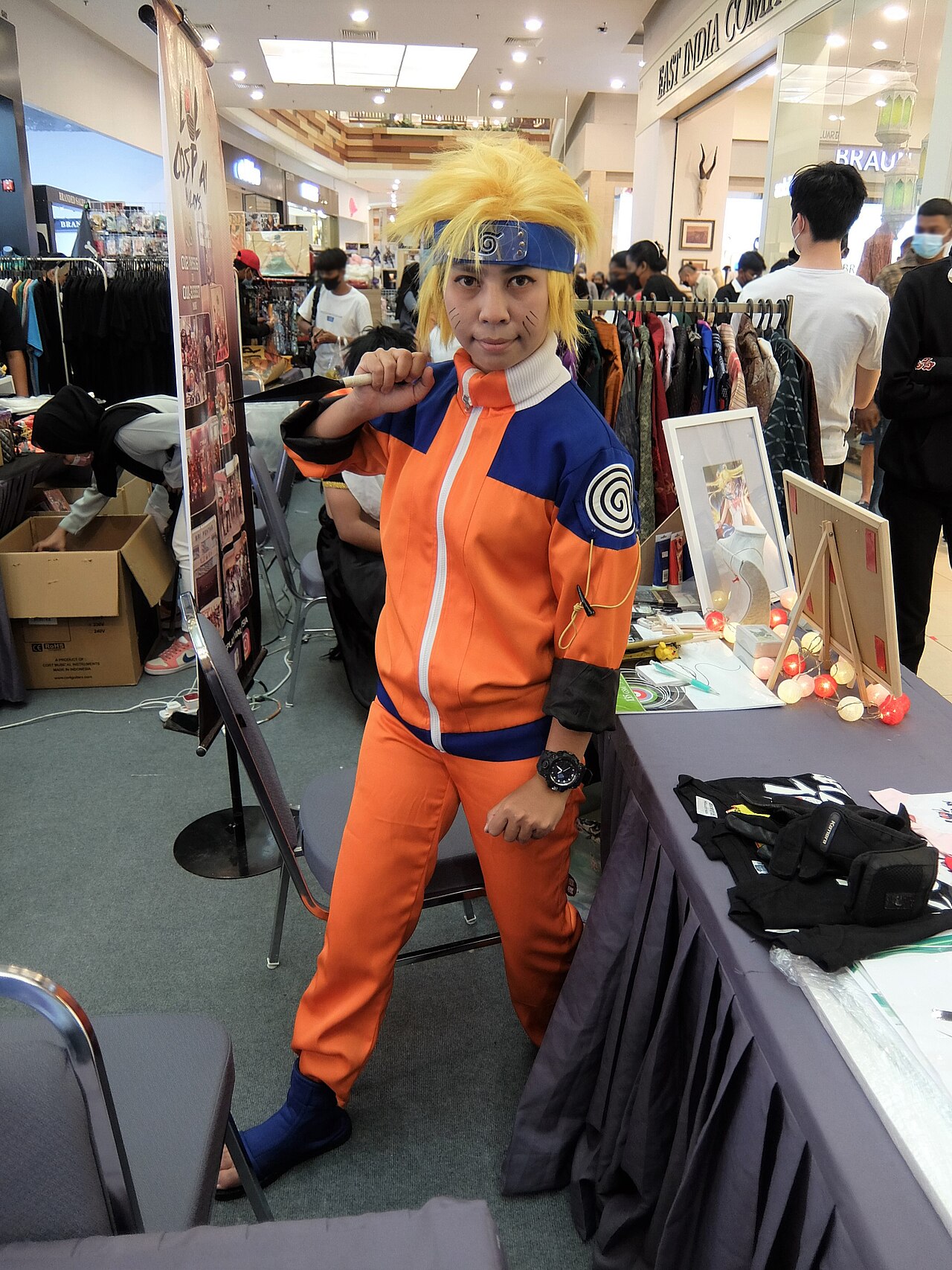
A cosplayer as Naruto Uzumaki at Cosplay Expo 2022, wearing the character's signature orange jumpsuit and Hidden Leaf forehead protector. Photo: Chongkian, CC BY-SA 4.0, via Wikimedia Commons.
NARUTO (ナルト) is a Japanese 忍者 (ninja) manga written and illustrated by Masashi Kishimoto, serialized in Weekly Shōnen Jump from 1999 to 2014. Its anime adaptation — split into the original Naruto (2002–2007) and its continuation Naruto: Shippūden (2007–2017) — ran for a combined 720 episodes and helped introduce an entire generation of viewers outside Japan to anime as a mainstream form of entertainment. The manga sold more than 250 million copies worldwide, making it one of the best-selling manga series of all time, alongside One Piece and Dragon Ball.
The story follows Naruto Uzumaki, an orphaned, loudmouthed 少年 (shōnen, "boy") who has a powerful fox spirit sealed inside him at birth, making him an outcast in his own village. Naruto's stated 夢 (yume, "dream") is to become Hokage — the leader and strongest ninja of his village — so that everyone who once shunned him will finally acknowledge him. That premise, of an unwanted kid earning recognition through sheer stubbornness, is the emotional engine that drives the entire 700-chapter, 15-year story.
The World of Shinobi
Naruto takes place in a world where 忍術 (ninjutsu, "ninja techniques") function as a magic system: ninja channel internal energy called chakra (チャクラ) through hand seals to walk on water, breathe fire, summon giant animals, or copy an opponent's moves. Shinobi are organized into hidden villages — Konohagakure ("Village Hidden in the Leaves"), Sunagakure ("Hidden Sand"), Kirigakure ("Hidden Mist"), and others — each led by a 影 (kage, "shadow"), the strongest ninja of that village and its de facto ruler. Konoha's leader carries the title Hokage (火影, literally "fire shadow"), the position Naruto spends the whole series trying to earn.
| Term | Reading | Meaning |
|---|---|---|
| 忍者 | にんじゃ | Ninja; a shinobi operative |
| 忍術 | にんじゅつ | Ninjutsu, the techniques ninja use, powered by chakra |
| 火影 | ほかげ | "Hokage," the leader of the Hidden Leaf Village |
| チャクラ | ちゃくら | Chakra, the internal energy source behind every ninjutsu |
| 里 | さと | "Village," specifically a hidden ninja village |
| 尾獣 | びじゅう | "Tailed Beasts," nine world-ending spirits (including the fox sealed in Naruto) |
Each of the nine Tailed Beasts is sealed inside a human host, called a jinchūriki (人柱力, literally built on the older word 人柱, "human pillar," a historical term for a human sacrifice buried to protect a structure). This names the story's central tension: characters who carry unimaginable destructive power inside them, feared or exploited for it rather than seen as people. Naruto himself hosts the Nine-Tailed Fox, and much of the story is about him refusing to let that power define him.
Team 7 and the Cast
Naruto's core team, Team 7, pairs him with Sasuke Uchiha — a genius from a nearly annihilated ninja clan bent on 復讐 (fukushū, "revenge") against his own older brother — and Sakura Haruno, who grows from a lovestruck bystander into one of the story's strongest medical ninja. Their teacher, the aloof and famously tardy Kakashi Hatake, rounds out a dynamic built on rivalry as much as 友情 (yūjō, "friendship"). The push and pull between Naruto and Sasuke — one chasing recognition, the other consumed by 憎しみ (nikushimi, "hatred") — anchors the series from its earliest arcs through its finale, more so than any single villain.
諦めたらそこで試合終了ですよ? (Akirametara soko de shiai shūryō desu yo?) "The moment you give up, that's when the game is over."
This line, spoken by Kakashi but repeated throughout fan culture as one of Naruto's defining quotes, captures the series' central ethic: 努力 (doryoku, "effort") and refusal to quit matter more than raw talent.
Structure and the Shippūden Timeskip
The manga is split into two halves. Part I follows Naruto as a young genin (novice ninja) navigating village politics and the Chūnin Exams. After a story-changing time skip, Part II — adapted as Naruto: Shippūden — resumes with Naruto as a young adult, drawing the whole world into a war against the criminal organization Akatsuki and, eventually, an apocalyptic Fourth Great Ninja War. The manga's 連載 (rensai, "serialization") ran for fifteen years and concluded in November 2014, collected into 72 巻 (kan, "volumes").
Cultural Impact: Part of the "Big Three"
Naruto is routinely grouped with One Piece and Bleach as anime and manga's so-called "Big Three" (ビッグ3) — the trio of Weekly Shōnen Jump series that defined mainstream shōnen anime for Western audiences in the 2000s, largely through Cartoon Network's Toonami block and, later, Crunchyroll and Netflix streaming. For many non-Japanese fans who grew up in that era, Naruto was a first, formative exposure to anime as a medium, not just a single show — a role often compared to what Dragon Ball Z played for the generation before it.
Its cultural footprint in Japan and abroad includes:
- Merchandising and tourism: Naruto-themed ramen shops, a permanent "Naruto & Boruto: Uzumaki and Uchiha Museum" experience, and heavy collaboration merchandise (from headbands to instant ramen tie-ins) keep the franchise commercially active more than a decade after the manga ended.
- Internet culture: The image of characters sprinting with their arms held stiffly backward — the "Naruto run" — became one of anime's most widely recognized visual memes, performed unironically and ironically at conventions, in flash mobs, and across social media worldwide.
- Games and events: The Naruto: Ultimate Ninja Storm and Naruto to Boruto fighting game series, along with real-world attractions like Naruto & Boruto theme areas at Universal Studios Japan, keep the IP active as an interactive brand, not just a finished story.
- Vocabulary: Terms coined or popularized by the series — "believe it!" (the English dub's rendering of Naruto's verbal tic だってばよ, dattebayo), "dattebayo" itself, and "Naruto run" — circulate as recognizable shorthand even among people who have never watched the show.
Boruto and the Sequel Era
Kishimoto handed the story's continuation to protégé writer/artists, producing Boruto: Naruto Next Generations (ボルト -NARUTO NEXT GENERATIONS-), which follows Naruto's son Boruto Uzumaki as a ninja in the next generation of Konoha. The sequel launched as an anime and manga in 2016–2017; in 2023 the manga relaunched as Boruto: Two Blue Vortex with Kishimoto himself returning to plot and Mikio Ikemoto illustrating, signaling the franchise's continued commercial importance to Shueisha even after the original story's conclusion. Naruto himself, now Hokage, appears as a supporting figure — completing the character's arc from unwanted outcast to the leader he always dreamed of becoming.
Related Works
Naruto belongs to the same Weekly Shōnen Jump tradition as One Piece, Jujutsu Kaisen, and Kimetsu no Yaiba — long-running, arc-based shōnen manga built around the magazine's editorial mantra of friendship, effort, and victory (友情・努力・勝利). Kishimoto has cited Dragon Ball as a defining influence on his approach to action storytelling and character growth, a lineage Naruto passed on in turn to the next wave of Shōnen Jump hits that followed it.
See Also
Related Dictionary Words
ninja; person trained in ninjutsu and employed for covert purposes in feudal Japan
ninjutsu; combat and stealth techniques used by ninja for espionage, sabotage, assassination, etc.
dream
boy
shadow; silhouette; figure; shape
person who died for a cause
revenge
friendship; fellowship; camaraderie
hatred
effort; exertion; endeavour; endeavor; hard work; striving
serialization; serialisation; serial story
roll (e.g. of cloth)