腐女子
fujoshiA self-deprecating term for female fans of Boys Love (BL) manga and anime who enjoy romantic stories between male characters.
Meaning
腐女子 (ふじょし) literally translates as "rotten girl" — a playful, self-deprecating label that female fans of ボーイズラブ (Boys Love, or BL) media embraced rather than rejected. The "rotten" (腐) part alludes to the idea that these fans have minds "corrupted" by their love of romantic and often explicitly sexual stories between male characters — but the term is used with pride and humor by the community itself.
The male equivalent is 腐男子 (ふだんし, fudanshi) — male fans who enjoy BL. Together they form a broad subculture within Japanese fan communities.
Cultural Context
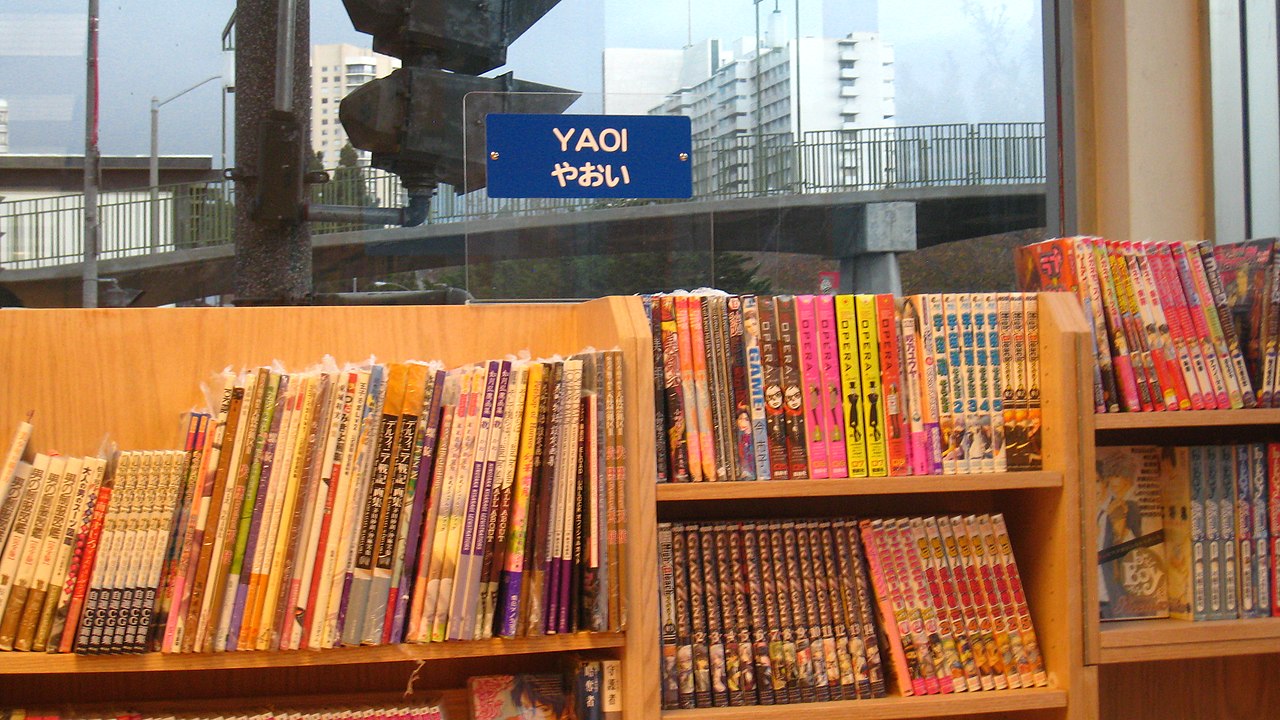
Boys Love manga volumes on display. Photo: miyagawa, CC BY-SA 2.0, via Wikimedia Commons.
The term 腐女子 emerged in the early 2000s on Japanese internet communities — particularly 2channel (now 5channel) — where 女性 fans of yaoi and BL fiction coined it themselves as a tongue-in-cheek badge of identity. It spread rapidly through otaku circles and became the standard label by the mid-2000s.
Before 腐女子 entered common usage, these fans were often referred to simply as "やおいファン" or grouped under the broader 同人誌 (doujinshi) community. The self-coined term gave the subgroup a distinct, cohesive identity.
Today the word is widely recognized beyond Japan. International fans use "fujoshi" in English-language anime discussions, and the term has been covered in mainstream Japanese media, academic papers on fan culture, and pop-culture documentaries.
Usage
腐女子 culture centers on several key practices:
カップリング (Coupling / Shipping)
One of the defining activities of a 腐女子 is カップリング — imagining romantic pairings between male characters in anime, 漫画, games, and even real-world entertainment (such as idol groups or sports teams). These pairings are often written as "A×B" or "A/B", where A is the 攻め (seme, the dominant partner) and B is the 受け (uke, the receptive partner).
腐女子の友達にそのアニメを見せたら、即カップリングを考え始めた。 (When I showed that anime to my fujoshi friend, she immediately started thinking up pairings.)
受け・攻め (Uke / Seme) Dynamics
A key vocabulary pair in BL fiction: 攻め (seme) refers to the dominant character in a romantic or sexual relationship, while 受け (uke) is the submissive one. Fans debate pairings passionately, and "どっちが攻め?" ("Which one is the seme?") is a common point of discussion.
同人誌 and Comiket
The 腐女子 community has a massive presence in 同人誌 (self-published fan works) culture. At コミックマーケット (Comiket), the world's largest fan convention, the "yaoi" and "BL" sections draw some of the event's largest crowds. Many fujoshi both consume and create fan works — fan fiction, fan art, and doujinshi.
彼女はコミケのたびに、推しのカップリングの同人誌を山ほど買ってくる。 (Every Comiket, she comes back with piles of doujinshi featuring her favorite pairing.)
The Real vs. Fictional Distinction
An important nuance in 腐女子 culture is the distinction between 二次元 (fiction / 2D) and 現実 (reality). Most fujoshi are careful to separate their enjoyment of BL stories from real-life relationships or expectations of actual gay men. The fan community refers to this as the "二次元と現実の区別" (distinction between fiction and reality).
This boundary is taken seriously within the community: shipping fictional characters or even real celebrities in fan fiction is seen as 創作 (creative expression) within an understood fictional frame, not a statement about real people or real relationships.
Terminology and Variations
| Term | Reading | Meaning |
|---|---|---|
| 腐女子 | ふじょし | Female BL fan ("rotten girl") |
| 腐男子 | ふだんし | Male BL fan ("rotten boy") |
| 攻め | せめ | Dominant partner in BL |
| 受け | うけ | Receptive partner in BL |
| カップリング | かっぷりんぐ | Romantic pairing / ship |
| ボーイズラブ | ぼーいずらぶ | Boys Love genre (BL) |
| 同人誌 | どうじんし | Self-published fan works |
| 推しカプ | おしかぷ | Favorite pairing |
Social Perception and Identity
Historically, 腐女子 identity carried a stigma — the idea of a 女子 who obsessively reads "rotten" content was sometimes mocked. But much like "otaku," the term has been reclaimed and is now worn as a badge of pride by those inside the community.
The rise of streaming platforms, global anime fanbases, and officially published BL manga (which now has its own mainstream shelf space in Japanese bookshops) has further normalized the term. Shows like Given, Yuri on Ice, and Banana Fish attracted mainstream audiences including many new self-identified 腐女子 fans internationally.
腐女子 also appears in Japanese pop culture itself: manga and anime such as Genshiken Nidaime and the drama Fujoshi, Ukkari Gei ni Kokuru depict fujoshi characters navigating fandom, friendships, and relationships — contributing to broader public familiarity with the term.
Related Dictionary Words
woman who likes comics depicting male homosexual love
male who likes comics depicting male homosexual love (usually targeted to women)
comics or novels about male homosexuality, targeted at young women
dōjinshi; magazine published by like-minded people; fanzine; zine
coupling
popularity; favour; favor; reception
attack; offence; offense; assault
two dimensions