コミケット
comiketThe world's largest self-published manga and doujinshi fair, held twice a year at Tokyo Big Sight and drawing over 750,000 attendees.
Meaning
コミケット (Comiket), short for コミックマーケット (Comic Market), is the world's largest gathering for self-published creative works — primarily 同人誌 (doujinshi), the hand-crafted, independently printed magazines and comics that form the backbone of Japanese fan culture. The name blends "comic" with the English word "market," reflecting its origins as a place where ordinary ファン could both buy and sell their own 創作 works outside the commercial publishing industry.
The full official name is コミックマーケット (Komikku Māketto), but コミケ — the casual two-mora abbreviation — is how most Japanese speakers refer to it in everyday conversation.
History
Comiket was born on December 21, 1975, in a small gymnasium at Tokai University in Tokyo. Harada Teruko and her circle 迷宮 (Meikyū, "Labyrinth") organized the founding event after feeling excluded from an existing convention. Just 32 サークル (creator circles) participated, and roughly 700 people showed up — a far cry from today's scale, but revolutionary for the era. There were no social media, no online fan communities; Comiket offered the only physical space where manga lovers could connect and trade self-made works.
Through the late 1970s and 1980s, Comiket expanded steadily as the doujinshi boom took hold. The explosion of Captain Tsubasa and other anime-inspired fan works brought massive new audiences. By the early 1990s attendance was in the hundreds of thousands, and the event had outgrown every venue it occupied — from Tokai University to the Tokyo International Trade Fair at Harumi.
In 1996, Comiket moved to its current home: 東京ビッグサイト (Tokyo Big Sight), the vast convention complex on Odaiba's reclaimed waterfront. The move gave the event the floor space it needed to keep growing. Today, Comiket is held twice annually:
- 夏コミ (Natsukomi, Summer Comiket) — late July or August
- 冬コミ (Fuyukomi, Winter Comiket) — late December
Each edition runs over two or three days, with approximately 35,000 circles exhibiting and a peak turnstile attendance of over 750,000 across the event (as of 2019). The COVID-19 pandemic forced cancellations and scale reductions in 2020–2021, but Comiket returned to full capacity by 2023.
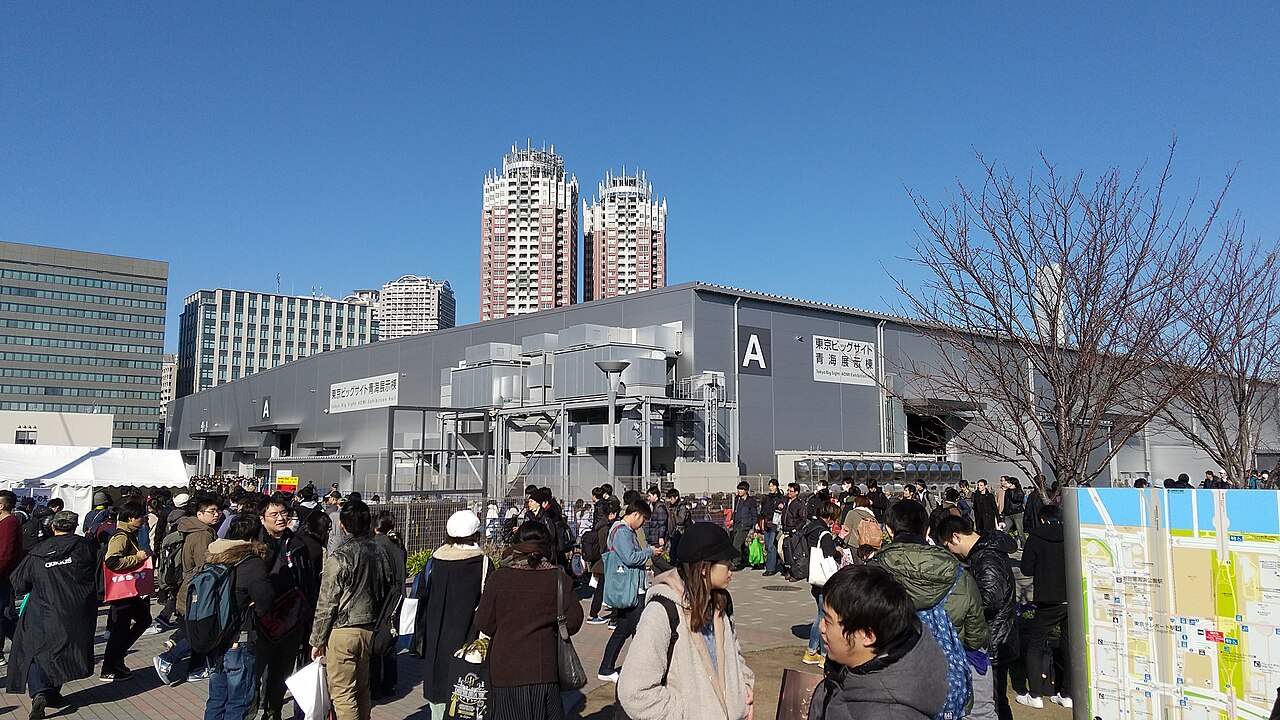
The corporate exhibition area at Comic Market 97 (December 2019). Photo: 高木あゆみ, CC BY-SA 4.0, via Wikimedia Commons.
The Event Experience
Arriving at Comiket for the first time is sensory overload. Lines (行列, gyōretsu) begin forming outside 東京 Big Sight hours before the gates open, sometimes stretching for kilometers. The event is organized into two main zones:
サークルスペース (Circle Space) — The heart of Comiket. Thousands of tables crammed into massive exhibition halls, each occupied by one or two creators selling their own work. Prices are low — often ¥200–¥1,000 per book — because the goal is sharing, not profit.
企業ブース (Corporate Booths) — A separate area where anime studios, game companies, and publishers sell limited-edition merchandise. Lines for popular corporate booths can exceed several hours.
Attendees carry large tote bags and clutch hand-drawn maps (catalog pages) marked with priority stops. The Comiket catalog itself — a thick, phone-book-sized volume published before each event — is an institution, containing circle listings, maps, and commentary. Many fans spend hours studying it in advance.
参加 in Comiket culture comes in two forms: 一般参加者 (ippan sankasha, general attendees) who browse and buy, and サークル参加者 (sākuru sankasha, circle participants) who apply months in advance for table space to sell their work.
Doujinshi Culture
同人誌 — self-published works sold at Comiket — range from derivative fan fiction (二次創作, nijisōsaku) based on popular anime, games, and manga, to wholly original (オリジナル) creative works. The sheer breadth is staggering:
| Category | Examples |
|---|---|
| Manga parody | Fan comics based on popular anime/games |
| Novels | Written fan fiction and original stories |
| Illustrations | Art books and character studies |
| Music (同人音楽) | Original compositions and arrangements |
| Games (同人ゲーム) | Indie visual novels and RPGs |
| Goods | Prints, keychains, pins, stickers |
Japanese law treats most derivative doujinshi as a legal gray area, and major publishers have historically tolerated — even quietly encouraged — the fan creativity it represents, viewing it as free publicity. Comiket's organizers maintain this balance carefully, refusing commercial sponsorship and policing explicit content classifications.
The 即売会 (direct-sales meet) format is fundamental: creators sell directly to readers, no middlemen, no publisher gatekeepers. A first-time creator can debut their 20-page manga at Comiket for the same application fee as a circle with decades of history.
Cosplay at Comiket
Comiket is also one of Japan's premier cosplay stages. A dedicated cosplay area (コスプレ広場) outside the main halls allows コスプレ participants to change into elaborate costumes and pose for photographs. Tens of thousands of cosplayers attend each event, representing characters from the season's most popular games, anime, and franchises.
The cosplay culture at Comiket operates on its own etiquette: photographing cosplayers requires asking permission (「写真を撮ってもいいですか?」), costumes must not block emergency exits, and certain prop weapons are regulated. Despite these rules — or perhaps because of them — the cosplay community at Comiket has a reputation for organized, respectful self-governance.
Cultural Significance
Comiket is more than a market. It is a twice-yearly affirmation of 文化 — a declaration that fan creativity has inherent value, independent of commercial viability. The event is run entirely by volunteers under the Comic Market Preparatory Committee (コミックマーケット準備会), a non-profit organization that has stubbornly resisted corporatization for fifty years.
For many Japanese 同人 creators, Comiket serves as a professional launchpad. Several major manga artists, game studios, and music producers cut their teeth selling self-published works at Comiket before breaking into mainstream industry. The visual novel studio Type-Moon (Fate/stay night), the doujin music circle IOSYS, and the game developer Key all have roots in the Comiket ecosystem.
For attendees, Comiket is a seasonal ritual. Many オタク have attended every summer and winter for decades, treating the event as a pilgrimage — a time to reconnect with the community, discover new creators, and carry home a stack of works unavailable anywhere else in the world.
The international fan community has taken notice. Foreign visitors now represent a visible and growing portion of attendance, and Comiket has inspired similar events worldwide — though none approach its scale.
Key Terms
| Japanese | Reading | Meaning |
|---|---|---|
| コミックマーケット | こみっくまーけっと | Comic Market (full name) |
| コミケ | こみけ | Short form of Comiket |
| 夏コミ | なつこみ | Summer Comiket |
| 冬コミ | ふゆこみ | Winter Comiket |
| サークル | さーくる | Creator circle (group or individual) |
| 一般参加 | いっぱんさんか | General attendance |
| 即売会 | そくばいかい | Direct-sales event format |
| カタログ | かたろぐ | Official program / event catalog |
Related Dictionary Words
dōjinshi; magazine published by like-minded people; fanzine; zine
Comic Market (semiannual self-published comic book convention); comiket
cartoon; comic; comic strip; manga
group with a common interest (e.g. students); club (e.g. company sports club); circle
display and sale of new products
same person
creation; production; creative work (novel, film, etc.); original work; (creative) writing
cosplay (dressing up as a character from an anime, manga, video game, etc.)