風鈴
fuurinThe traditional Japanese glass, metal, or ceramic wind chime hung outdoors in summer, whose bright, cool-sounding ring is believed to help people feel cooler in the humid heat.
What is a Furin?
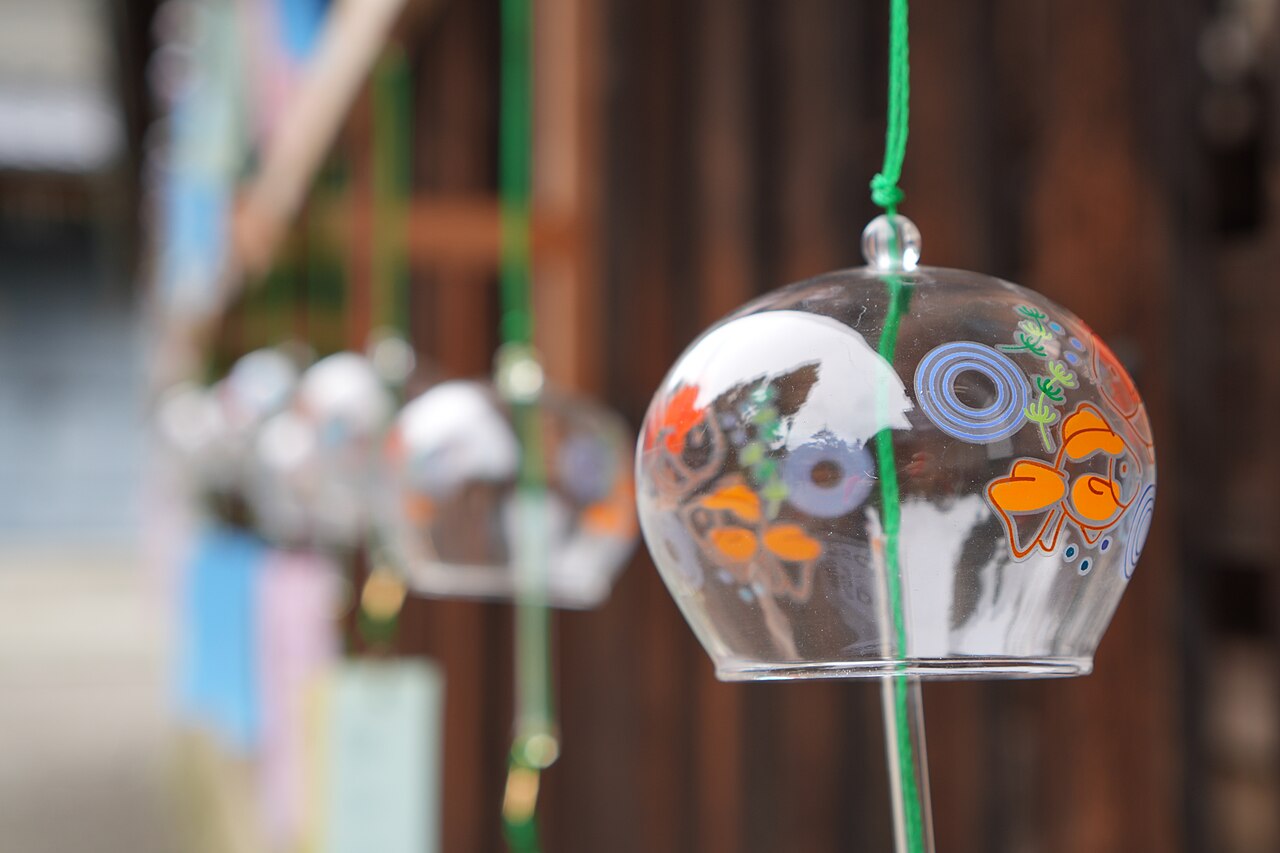
A hand-painted glass furin at a shrine, with its paper tanzaku strip visible behind. Photo: Sago350, CC0, via Wikimedia Commons.
風鈴 (furin) is a small 風-catching bell hung outside a window, on a porch, or under the eaves of a house during Japan's hot, humid summer. It has three parts working together:
- The dome or bell — a rounded cap, traditionally hand-blown glass, cast iron, or fired ceramic, that produces the ring.
- The clapper (舌, shita, literally "tongue") — a small piece hanging inside the dome that strikes it when it swings.
- The tanzaku (短冊) — a narrow strip of paper hanging below the clapper. It has no acoustic function; its only job is to catch even the faintest puff of air and set the clapper swinging. Many tanzaku are printed with a poem, a seasonal picture, or simply the maker's name.
A breeze that would otherwise go unnoticed makes the tanzaku flutter, which taps the clapper against the bell, producing the furin's clear, glassy chime — a small mechanical translation of moving air into sound.
The Sound of Summer
Japan's summers are famously hot and humid, and long before electric fans and air conditioning were common, the furin's ring was one of the few reliable cues that a breath of wind was passing through. Hearing it is said to have a genuine psychological cooling effect: the mind associates the high, tinkling pitch with moving air and 涼 (ryō, coolness), so people report feeling cooler on hearing it even when the temperature hasn't changed. Furin are sold and displayed as natsu no oto (夏の音), literally "the sound of summer" — an object valued as much for what it evokes as for what it does.
This belief has old roots. Furin descend from Chinese bronze wind bells (風鐸, fūtaku) that arrived in Japan during the 平安時代 hung from temple eaves, where their ringing was thought to ward off evil spirits and disease — a kind of audible 魔除け (protective charm) marking the boundary the wind crossed to reach the building. Only later, especially from the Edo period onward, did the furin move from temple architecture into ordinary homes and become associated purely with summer comfort rather than protection.
風鈴の音を聞くと、少し涼しく感じる。 Hearing the sound of a furin makes you feel a little cooler.
Edo Furin and Nanbu Furin
Two regional styles are the best known today, and they could hardly sound more different from each other.
| Edo furin (江戸風鈴) | Nanbu furin (南部風鈴) | |
|---|---|---|
| Material | Hand-blown glass | Cast iron |
| Origin | 東京 (old Edo) | 岩手 Prefecture (Nanbu domain) |
| Sound | High, delicate, glassy tinkle | Deep, clear, bell-like ring that carries |
| Decoration | Painted by hand from the inside of the glass, often with 金魚, morning glories, or fireworks motifs | Usually unpainted; relies on the cast shape and iron's natural tone |
| Craft lineage | Edo-period glassblowers, descended from techniques for glass vessels and lamps | Nanbu ironware (南部鉄器) casting tradition, also used for the region's famous cast-iron kettles |
Edo furin are blown by hand into thin, irregular glass domes; the mouth of each bell is deliberately left unground and slightly rough, because a perfectly smooth rim rings less brightly than an uneven one. Painting is done from the inside so brushstrokes never wear off. Nanbu furin, made in Iwate using the same iron-casting techniques as Nanbu tea kettles (南部鉄瓶), produce a lower, more resonant tone that some describe as closer to a temple bell than a chime. Ceramic furin, made in pottery towns like Mashiko and Kutani, are a quieter third tradition, often glazed in seasonal designs.
Where Furin Are Seen
Furin are still hung outside ordinary homes each summer, often near a 縁側 (engawa, a porch-like veranda) where they catch the breeze and can be heard from inside. Beyond private homes, they show up at:
- Summer festivals (夏祭り) and department store summer fairs, where stalls sell dozens of styles at once.
- Furin festivals, the best known being the wind chime market held every summer at Kawagoe's Hikawa Shrine, where thousands of Edo furin are hung across the shrine grounds and visitors choose one to take home, each tagged with its own paper fortune.
- Temples and shrines more broadly, continuing the older fūtaku tradition of hanging bells from the eaves.
- Souvenir shops and gift sets, since a furin is a compact, inexpensive, unmistakably Japanese gift tied to a specific season.
In Poetry, Art, and Seasonal Aesthetics
The furin is a kigo (季語) — a season word used in haiku to fix a poem in summer — and it appears throughout classical and modern Japanese poetry as shorthand for the particular stillness of a hot afternoon broken by a single, sudden chime. In anime and manga, a furin shot — the camera lingering on a glass bell swaying gently on a veranda, tanzaku fluttering — is one of the most common visual signals directors use to establish a summer setting, alongside cicada song, shaved ice, and fireworks. It carries the same instant seasonal recognition as cherry blossoms do for spring, functioning as a small, quiet emblem of natsuyasumi (summer vacation) nostalgia in coming-of-age stories.
Related Words
Related Dictionary Words
wind chime; wind bell
wind; breeze; draught; draft
summer
cool breeze; cool air; refreshing coolness
tanzaku; long, narrow strip of paper on which Japanese poems are written (vertically)
charm against evil spirits; talisman; amulet
engawa; external corridor on the outer side of traditional Japanese houses
summer festival; summer matsuri
goldfish (Carassius auratus)
Iwate (prefecture)
Tokyo
Heian period (794-1185)