七夕
tanabataJapan's Star Festival celebrated on July 7th, honoring the legend of two celestial lovers—Orihime and Hikoboshi—separated by the Milky Way and reunited just once a year.
The Legend
七夕 (tanabata) is built around one of Japan's most beloved romantic legends. 織姫 (Orihime, the Weaver Princess) was the daughter of Tentei (天帝), the Sky King. She sat by the banks of the 天の川 (Amanogawa, the Milky Way) weaving cloth day after day—beautiful fabric that pleased her father greatly. Yet her endless labor left her no time to meet anyone, and she grew lonely.
Sympathetic to his daughter's sadness, Tentei introduced her to 彦星 (Hikoboshi, the Cowherd Star), who lived on the opposite bank of the Milky Way. The two fell instantly in love and married. But happiness made them neglectful: Orihime stopped weaving, and Hikoboshi's cattle wandered freely across the heavens. Furious, Tentei separated the lovers once more, placing the vast river of stars between them.
Orihime wept so bitterly that Tentei relented. He decreed that if Orihime worked diligently at her loom, the two could meet once a year—on the seventh day of the seventh month. On that night, a bridge of magpies forms across the 天の川, allowing the lovers to cross and embrace. If rain falls and the river rises, the magpies cannot come and the reunion must wait another year.
In astronomy, Orihime corresponds to the star Vega (織女星, Shokujosei) and Hikoboshi to Altair (牽牛星, Kengyusei), two of the brightest stars in the summer sky.
Origin
Tanabata traces its roots to the Chinese festival of Qixi (七夕, literally "seventh evening"), also called Kikkōden (乞巧奠, "Festival to Plead for Skills") in the Japanese reading. The Chinese festival, celebrating the same legend of the Weaver Girl and the Cowherd, was introduced to the Japanese imperial court during the Nara period (710–794).
This Chinese star festival blended with an ancient Japanese Shinto weaving ritual called Tanabata-tsume (棚機), in which a village maiden would weave sacred cloth on a riverside loom as an offering to the gods, praying for a bountiful harvest and protection from impurity. The mingling of the romantic Chinese legend with indigenous Japanese ritual gave birth to the Tanabata celebrated today.
The Empress Kōken is recorded as having introduced formal Tanabata observances at the imperial court in 755 CE. From the Heian period onward, courtiers celebrated by writing poems on paper mulberry leaves and practicing calligraphy, praying for improved skills in music, writing, and weaving.
How It's Celebrated
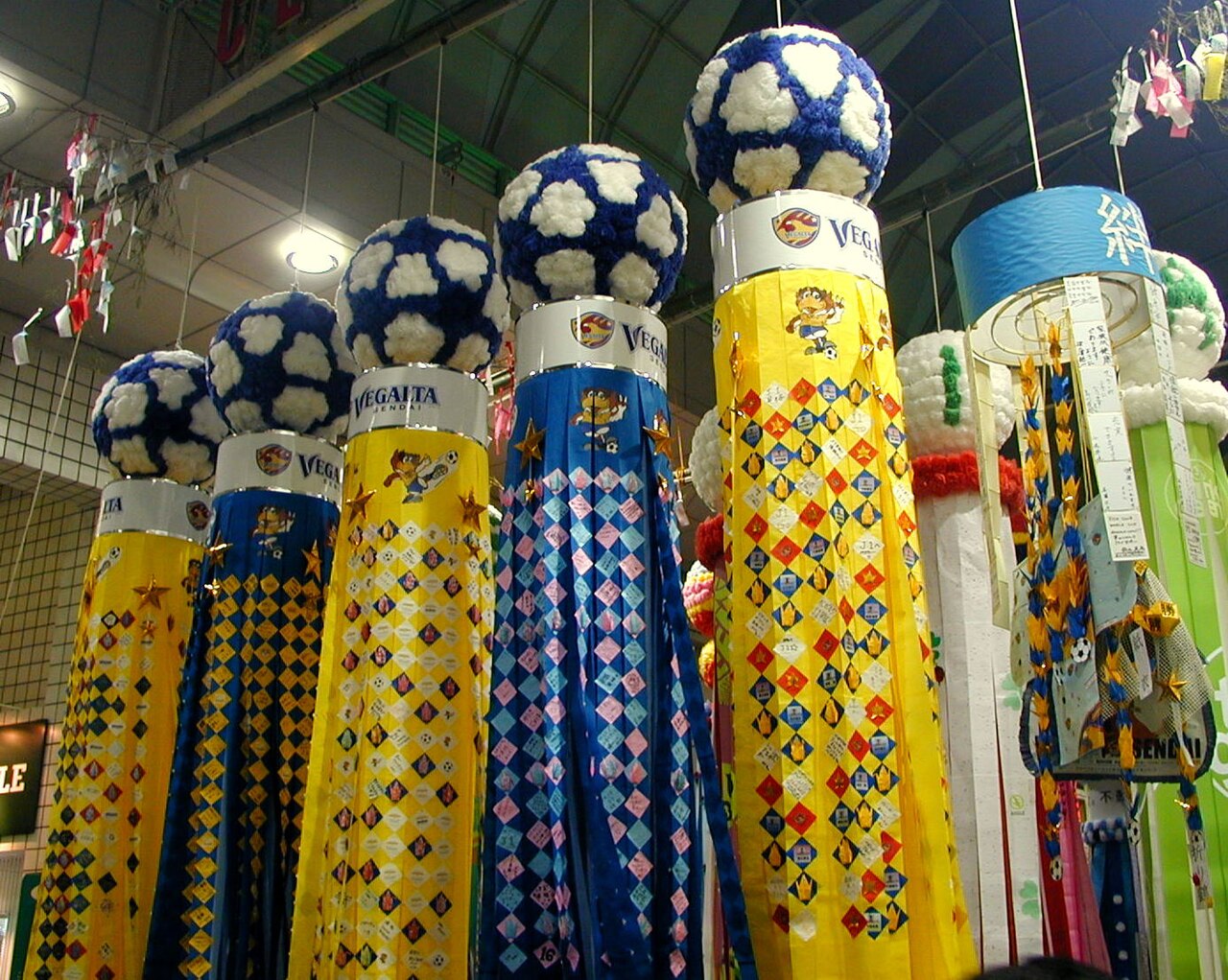
Elaborate handmade streamers at the Sendai Tanabata Festival. Public domain, via Wikimedia Commons.
The most iconic Tanabata custom is writing wishes on 短冊 (tanzaku)—long, narrow strips of colorful paper. Each person writes a personal wish or dream on their tanzaku and hangs it from a branch of 笹 (sasa, bamboo grass) or a 竹 (take, bamboo) stalk, ideally placed outside or near a window so the wish can rise toward the 星 (hoshi, stars) with the breeze.
願いが叶いますように。 May my wish come true.
Traditional tanzaku colors each carry meaning:
| Color | Represents | Traditional wish |
|---|---|---|
| Red | Gratitude | Thanks to ancestors and parents |
| Black/Purple | Learning | Academic and intellectual improvement |
| Yellow | Friendship | Harmonious human relationships |
| White | Duty | Fulfilling obligations and virtue |
| Blue/Green | Growth | Personal development and health |
Bamboo is central to Tanabata because it grows rapidly straight toward the sky—a fitting vessel for wishes bound for heaven. Decorated bamboo poles are placed outside homes, schools, and shopping arcades, then ceremonially burned or floated down rivers after the festival, carrying the wishes away.
Other traditional decorations include:
- Fukinagashi (吹き流し) — long, streaming paper tassels in five colors that flutter in the breeze, representing Orihime's weaving threads
- Origami cranes (折り鶴) — symbolizing health and longevity
- Paper nets (投網) — expressing hopes for a good harvest or catch
- Treasure bags (巾着) — wishing for wealth and prosperity
The traditional food of Tanabata is sōmen (素麺), thin white noodles. Their long, delicate strands are said to resemble both the weaving threads of Orihime and the flow of the Milky Way itself.
Regional Festivals
Japan celebrates Tanabata with festivals across the country, but a handful stand out as unmissable.
Sendai Tanabata Matsuri (仙台七夕まつり) is the largest and most famous, held August 6–8 in Sendai City, Miyagi Prefecture. It draws approximately two million visitors each year. The festival's signature feature is its enormous handmade fukinagashi streamers—some weighing up to five kilograms—that cascade from bamboo arches spanning the shopping arcades of Ichibancho and Clis Road. Merchants and organizations spend months crafting these spectacular decorations. The festival's Tanabata tradition dates to the era of the feudal lord Date Masamune (1567–1636).
Hiratsuka Tanabata Festival (平塚七夕まつり) in Hiratsuka, Kanagawa, is one of the largest in the Kanto region, taking place in early July and drawing close to a million visitors. Known for its colorful, whimsical decorations in the city center around Shonan Star Mall.
Asagaya Tanabata Festival (阿佐ヶ谷七夕まつり) in Tokyo's Suginami Ward runs in early August along the Pearl Center shopping arcade. It has a distinctly modern creative flavor: giant papier-mâché figures of popular anime and manga characters bob above visitors' heads alongside more traditional streamers, making it a favorite for fans of pop culture.
Date Confusion: July or August?
One of the most common sources of confusion about Tanabata is why different regions celebrate it at different times.
| Calendar | Date | Used by |
|---|---|---|
| Gregorian (New Calendar) | July 7 | Most of Japan; schools, shopping centers |
| Old Lunar Calendar equivalent | August 7 (approx.) | Sendai, Hiratsuka, and many regional festivals |
The original Chinese Qixi festival was set on the seventh day of the seventh month of the traditional lunisolar calendar. When Japan adopted the Gregorian calendar in 1873, the date was converted directly to July 7—but astronomically, the lunar date typically falls about a month later, closer to early August. This is why the sky is clearer and summer is more fully underway for August festivals, which many argue better captures the spirit of the warm summer evening the legend describes. The Milky Way is also far more visible in August than July, when rainy season (梅雨, tsuyu) still lingers in many parts of Japan.
In Popular Culture
Tanabata permeates Japanese art, literature, music, and anime. Its themes of longing, distance, and a once-a-year reunion resonate deeply in a culture that prizes bittersweet emotion (mono no aware).
The legend appears in the Man'yoshu (万葉集), Japan's oldest poetry anthology (compiled in the late 8th century), which contains over 130 poems about Orihime and Hikoboshi—more than almost any other topic.
In modern anime and manga, Tanabata scenes are a staple: characters write wishes on tanzaku, attend summer festivals in yukata, and gaze at the night sky. The holiday features prominently in series such as Ano Hi Mita Hana and countless romance stories where Tanabata's theme of separated lovers mirrors the characters' own situations.
The phrase
七夕に願いをかける to pin one's wish on Tanabata
is a common metaphor in Japanese for hoping against hope.
Pop songs celebrate the festival regularly, and the classic children's song Tanabata-sama (たなばたさま) is taught in schools across Japan:
ささの葉さらさら、のきばに揺れる The bamboo leaves rustle, swaying under the eaves
Tanabata imagery—the 天の川, the 星, the 竹 hung with wishes—appears in everything from department store displays to regional train station decorations every July, making it one of the most visually recognizable seasonal events in the Japanese calendar.
Related Dictionary Words
star (usu. excluding the Sun); planet (usu. excluding Earth); heavenly body
desire; wish; hope
bamboo (any grass of subfamily Bambusoideae)
Milky Way; luminous band corresponding to the plane of the galaxy
tanzaku; long, narrow strip of paper on which Japanese poems are written (vertically)
woman textile worker
Altair (star in the constellation Aquila); Alpha Aquilae
bamboo grass; generally smaller species of running bamboo that do not shed their sheaths (e.g. Sasa spp.)
festival; feast; matsuri
summer