芸者
geishaA traditional female entertainer trained in classical Japanese music, dance, and conversation, historically and still active today in districts like Kyoto's Gion and Tokyo's Asakusa.
Meaning
芸者 (geisha), literally "person of art" (芸 gei, "art/performance" + 者 sha, "person"), is a professional female entertainer trained for years in traditional Japanese arts: 三味線 (shamisen) playing, 踊り (classical dance), singing, and witty conversation. Geisha host 座敷 (private banquet rooms) at exclusive teahouses, entertaining guests — historically merchants and politicians, today often tourists and companies — with performance and refined hospitality rather than the companionship implied by Western pop-culture stereotypes.
In Kyoto's hanamachi (花街, "flower towns") the word geisha itself is rarely used; a fully qualified performer there is called a geiko (芸妓), while an apprentice in training is a 舞妓 (maiko, "dancing girl"). Tokyo and most of the rest of Japan use geisha for the qualified performer and hangyoku or simply "apprentice" for a trainee. All three words describe stages or regional names for the same profession.
Usage
Geisha and maiko are usually discussed in the context of the teahouse, the district, or a specific performance:
祇園には今も現役の芸者さんがいます。 Gion ni wa ima mo genʼeki no geisha-san ga imasu. "There are still active geisha working in Gion today."
舞妓さんは芸者になるまで数年間修業します。 Maiko-san wa geisha ni naru made sūnenkan shugyō shimasu. "A maiko trains for several years before becoming a full geisha."
The polite suffix さん (-san) is almost always attached — "geisha-san," "maiko-san" — reflecting the respect the profession commands in Japan.
Cultural Context
Origin and history
The geisha profession emerged in 京都 and Edo (old Tokyo) in the mid-18th century. The very first geisha were actually men — taikomochi, jesters and drum-players who entertained at parties in the pleasure quarters. By the 1750s–1770s women began taking the role, and by the end of the century female geisha outnumbered their male counterparts and the word came to mean exclusively a female performer. Geisha arose specifically as artists, distinct from and originally regulated separately from courtesans (oiran) who worked in the same pleasure districts; a geisha's role was performance and conversation, and strict rules in the licensed quarters forbade geisha from selling sex, precisely to preserve this distinction.
The Western "geisha girl" misconception
Outside Japan, the word "geisha" is frequently and mistakenly conflated with sex work — a stereotype amplified by Japan's WWII-era and post-war history, when the term "geisha girl" was loosely applied by occupying troops to any woman working in the entertainment trade, including sex workers who had nothing to do with the actual profession. This conflation has persisted in Western film and fiction ever since. In reality, becoming a geisha requires years of formal training in classical music, dance, tea ceremony, and etiquette, comparable to conservatory-level arts education, and the profession is built on artistry, not intimacy. Genuine geisha are highly respected culture-bearers, and the maiko/geiko community itself has pushed back publicly (including a 2023 code of conduct in Kyoto restricting tourist access) against harassment and misrepresentation by visitors who buy into the stereotype.
Training and the hanamachi
A maiko traditionally begins her apprenticeship as a teenager (today usually after completing compulsory education, around 15–16), living communally in an 置屋 (okiya, geisha house) run by an "onee-san" (elder-sister mentor) and a house mother (okaa-san). Training covers shamisen, drums, classical dance (in Kyoto, the Inoue school of Kyomai), tea ceremony (茶道), calligraphy, and the art of conversation. A maiko's appearance is distinctive: elaborate wax-set hairstyles decorated with seasonal hairpins (kanzashi), 白塗り white-lead-era (now non-toxic) makeup, and a long trailing kimono with an obi tied in a dangling darari knot. On graduating to full geiko/geisha status — a ceremony called erikae ("turning of the collar") — she switches to a more subdued wig, shorter kimono sleeves, and a simpler obi knot, signaling mastery rather than youth.
Kyoto's five geisha districts (五花街, gokagai) are the best-known hanamachi: Gion Kōbu, Pontochō, Miyagawachō, Kamishichiken, and Gion Higashi. Each holds its own annual public dance recital (odori), the most famous being Gion Kōbu's Miyako Odori ("Cherry Dance") every spring. Tokyo's own geisha districts, such as Asakusa, Shimbashi, and Kagurazaka, follow a similar but distinct tradition, without the maiko apprentice stage in most cases — Tokyo's hangyoku system largely died out, so training there is compressed and less formalized than in Kyoto.
Decline and survival today
At the profession's peak in the 1920s there were an estimated 80,000 geisha across Japan; today there are only a few hundred, concentrated mostly in Kyoto's hanamachi, with the rising costs of training, the decline of the traditional teahouse-introduction (ichigen-san okotowari, "first-timers refused") economy, and competing entertainment options all contributing to the decline. Despite this, geisha and maiko remain a living, working tradition rather than a museum piece — they can still be booked (typically through an established connection or a ryokan/hotel concierge) for private banquets, and their public dance performances are one of the most sought-after cultural experiences for visitors to Kyoto.
Related Traditional Arts
| Art | Japanese | Role in geisha training |
|---|---|---|
| Shamisen | 三味線 | Core instrumental accompaniment for dance and song |
| Classical dance | 日本舞踊 (nihon buyō) | Central performance art, school-specific choreography |
| Tea ceremony | 茶道 | Etiquette, hospitality, seasonal awareness |
| White-face makeup | 白塗り | Stage makeup shared with kabuki, distinct maiko vs. geiko styles |
| Kimono | 着物 | Formal attire, indicates rank via sleeve length and obi knot |
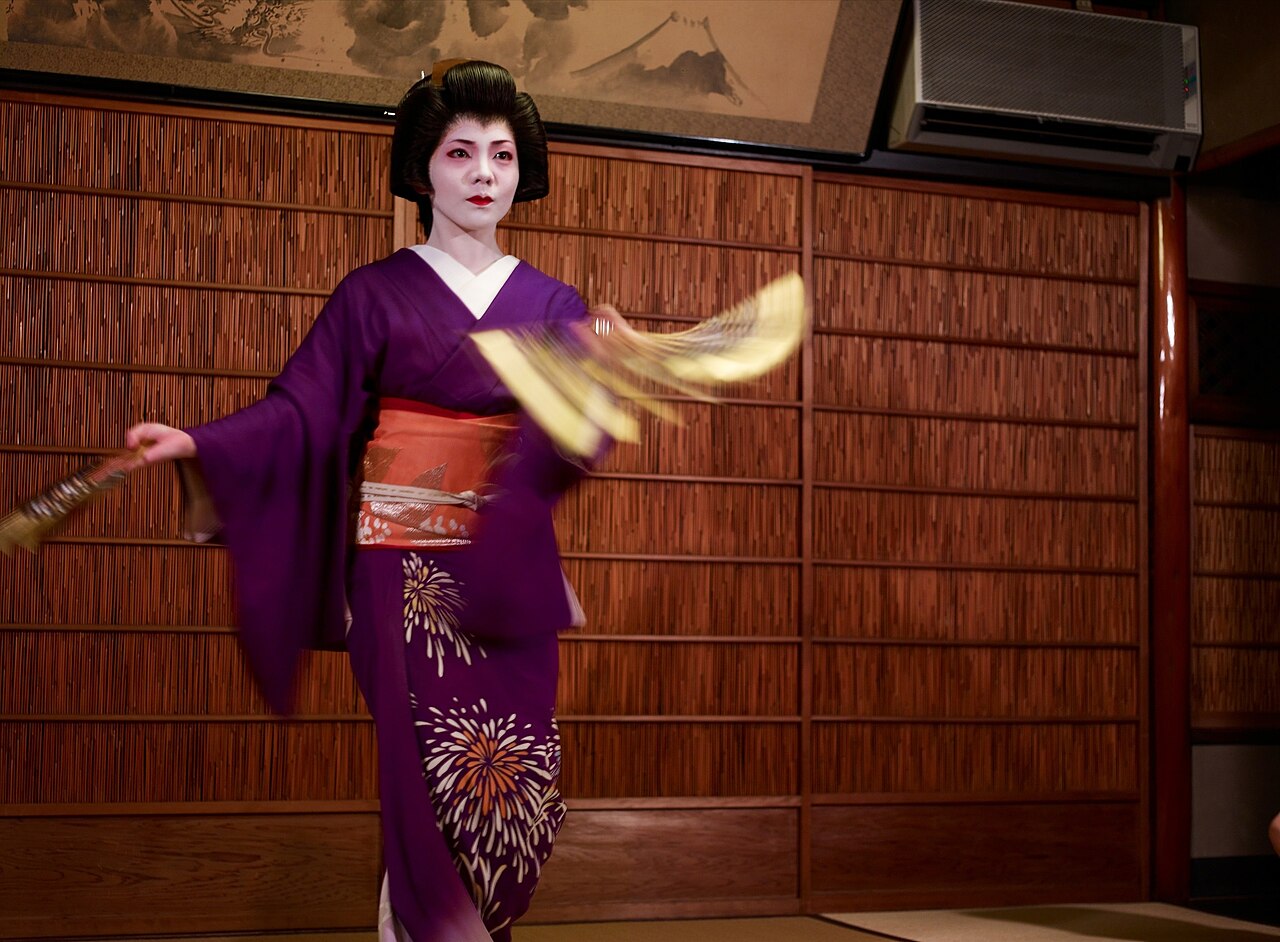
A geisha performing a traditional dance with a folding fan at a teahouse in Gion, Kyoto, wearing shironuri makeup and a formal kimono. Photo: Joi Ito, CC BY 2.0, via Wikimedia Commons.
Related Dictionary Words
geisha; professional female entertainer, usu. at traditional banquets
maiko; apprentice geisha (in Kyoto)
geisha
red-light district; prostitution quarter; geisha quarter
geisha house; establishment with geisha on its books for whom it acts as an agency
(geisha) teahouse; establishment where patrons are entertained by geisha
shamisen; samisen; three-stringed Japanese lute
kimono; Japanese traditional clothing (esp. full-length)
something painted white; white makeup (for an actor)
dance
tea ceremony; Way of Tea; sadō
red-light district; pleasure quarters; world of the geisha; demimonde
tatami room; tatami mat room; formal Japanese room