白塗り
shironuriA Harajuku fashion subculture built around fully white-painted faces paired with dark, avant-garde outfits, drawing on the white makeup traditions of kabuki, geisha, and butoh.
Meaning
白塗り (shironuri) literally means "painted white" or "white painting" — from 白 (white) and 塗る (to paint, to coat). As a fashion term, it refers to a Harajuku-born style built around covering the entire face (and often neck and hands) in thick white 化粧 (makeup), paired with dark, dramatic, often gothic or eclectic avant-garde clothing, elaborate wigs, and striking eye makeup.
Unlike everyday cosmetics, shironuri makeup isn't meant to look "natural" — the goal is closer to living sculpture or performance art than beauty in the conventional sense. Practitioners describe the white base as a blank canvas: a way to erase the ordinary 顔 (face) underneath and build a new, otherworldly identity on top of it.
Visual Characteristics
A typical shironuri look combines:
- Full white face — a dense, opaque white base covering the whole face, sometimes extending down the neck and onto the hands, applied far thicker than everyday foundation
- Dark or dramatic eye makeup — heavy black or colored eyeliner, exaggerated lash lines, and sometimes painted-on tears, cracks, or symbolic motifs
- Contrasting hair — wigs or dyed hair in vivid colors or stark black, frequently styled tall or voluminous to stand out against the white skin
- Eclectic, 独特 (unique) outfits — anything from Victorian-style lace gowns and 歌舞伎-inspired kimono to cyberpunk or horror-themed pieces; there is no single required silhouette
- Symbolic or nature-based themes — many shironuri artists build entire looks around a concept (a flower, a season, a spirit) rather than just an outfit
Because the makeup itself is the unifying element rather than a specific clothing silhouette, shironuri is sometimes better described as a technique or art practice that different wearers apply to very different aesthetics — from delicate and floral to unsettling and macabre.
Cultural Context
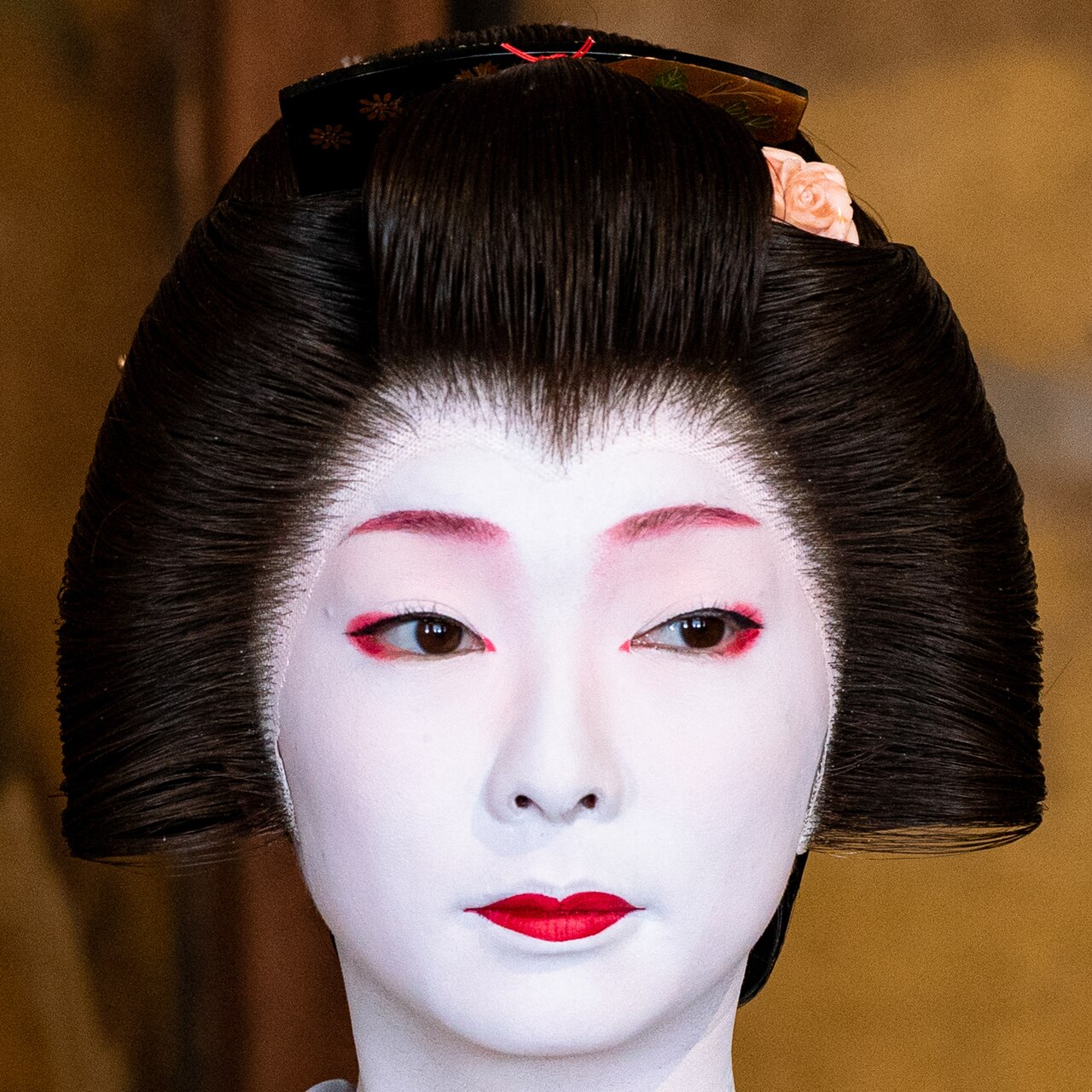
A geiko (geisha) in Kyoto wearing traditional 白粉 (oshiroi) white face makeup — a representative image of the historical performing-arts tradition shironuri draws on, not a photograph of shironuri fashion itself. Photo: Sawai Susao, CC BY-SA 2.0, via Wikimedia Commons.
Shironuri's white face has deep roots in Japanese performing arts. Since the Edo period, 歌舞伎 actors have used a thick white foundation called oshiroi to make their features read clearly under stage lighting and to erase the individual actor's face beneath a role's stylized mask-like expression. 芸者 (geisha) and 舞妓 (maiko, apprentice geisha) in 京都 and elsewhere adopted a related oshiroi technique as part of formal 舞台-ready presentation, historically useful for visibility by candlelight. The avant-garde dance form butoh, which emerged in the late 1950s, pushed the white body/face paint in a starker, more unsettling direction — using it to suggest liminal, ghostlike, or non-human states rather than beauty.
Modern shironuri as a street style crystallized much later, in Harajuku's alternative fashion scene, and its visual vocabulary borrows loosely from all of these sources without being identical to any of them. Some accounts trace an early precursor to face-painting subcultures of the 1960s–70s that were tied to nationalist youth groups, but that political association faded, and by the 2000s the white face had been decoupled from any ideology and re-adopted purely as a canvas for individual 芸術 (art) and rebellion against conventional beauty standards.
The style's biggest international ambassador is Minori, a Tokyo-based artist who began fully painting her face white around 2008–2009 after discovering that ordinary makeup felt out of place against the bold, gothic-and-lolita-adjacent fashion she loved — a friend pointed her toward the visual-kei band Malice Mizer, whose members also wore heavy white stage makeup. Minori began building elaborate themed looks (flowers, seasons, decay) as complete art pieces rather than simple outfits, and after being photographed on the street-snap site Tokyo Fashion, her work spread internationally through blogs, magazines like Metropolis Japan, and eventually the BBC — turning shironuri from a Harajuku curiosity into a recognized global fashion export.
Usage
The word is mostly used descriptively, either for the technique or for someone who practices it (a "shironuri artist" or "shironuri girl").
彼女は毎日顔を白塗りにして原宿を歩いている。 Kanojo wa mainichi kao o shironuri ni shite Harajuku o aruite iru. "She walks around Harajuku with her face painted white every day."
白塗りメイクは歌舞伎の白粉が元になっていると言われている。 "Shironuri makeup is said to have its roots in kabuki's oshiroi (white face powder)."
Shironuri vs. Other Harajuku Styles
Shironuri is often mentioned in the same breath as other well-known Harajuku subcultures, but the makeup is what sets it apart — the others are defined primarily by clothing silhouette, not face paint.
| Style | Defining feature | Typical mood |
|---|---|---|
| Shironuri | Full white face makeup as the centerpiece | Eerie, artistic, avant-garde, or ethereal |
| Lolita (ロリータファッション) | Victorian/Rococo-inspired dresses, petticoats | Elegant, doll-like, modest |
| Decora (デコラ) | Maximalist layering of colorful accessories | Loud, childlike, joyful |
| Mori Girl (森ガール) | Soft, natural, earth-toned layered clothing | Quiet, woodland, understated |
In practice the categories can overlap — a shironuri look might be built on top of a lolita silhouette, for instance — but shironuri is unique in that its core identifying feature is a makeup technique rather than a garment style.
Place in the Harajuku Scene
Shironuri belongs to the same lineage of self-expressive, rule-breaking 原宿 street fashion that produced lolita, decora, visual-kei-adjacent looks, and other alternative subcultures from the late 20th century onward. Because it demands significant time, skill, and social confidence — walking around with a fully painted white face draws stares even by Harajuku standards — shironuri has always remained a smaller, more dedicated scene than mass-market kawaii trends, closer to performance art or cosplay culture than to everyday fashion. It nonetheless holds a distinct place in the popular image of Harajuku as the epicenter of Japan's most experimental youth fashion, and continues to circulate online through tutorials, photo collections, and the ongoing work of artists like Minori.
Related Dictionary Words
something painted white; white makeup (for an actor)
white
to paint; to spread; to plaster; to apply (cream, lotion); to smear; to lacquer; to varnish; to put up (wallpaper)
make-up; makeup; cosmetics
face; visage
kabuki; traditional form of drama and music performed by male actors wearing makeup mainly in white and red
dancing; dance
stage (of a theatre, concert hall, etc.)
geisha; professional female entertainer, usu. at traditional banquets
maiko; apprentice geisha (in Kyoto)
Kyoto (city, prefecture)
peculiarity; uniqueness; characteristic
avant-garde
art; the arts
white makeup powder; (face) powder