ホロライブ
hororaibuHololive Production is the Tokyo-listed VTuber talent agency behind Japan's most commercially successful virtual idols, whose live-streamed "talents" fill arenas, top superchat rankings, and drive a global VTuber boom.
Meaning
ホロライブ (hololive, formally hololive production) is a VTuber talent agency owned by the Tokyo-based company COVER Corporation (カバー株式会社). Where the term "VTuber" describes the format — a performer streaming through an animated avatar — hololive is a specific brand: a roster of individually designed characters, each performed by a contracted talent, who stream under a shared agency identity, cross-promote one another, and appear together at branded concerts and events. It is the industry's largest and most profitable VTuber agency, with rival Nijisanji as its closest competitor.
Each hololive talent has a stage name, a fixed character design (illustrated, then rigged as a 2D Live2D or 3D model), and an original backstory, but performs live and largely unscripted — gaming 配信 (streams), variety content, singing, and chatting with viewers in real time. The performer behind the character is called the 「中の人」 (naka no hito, "the person inside"), whose real identity is contractually kept separate from the character.
History
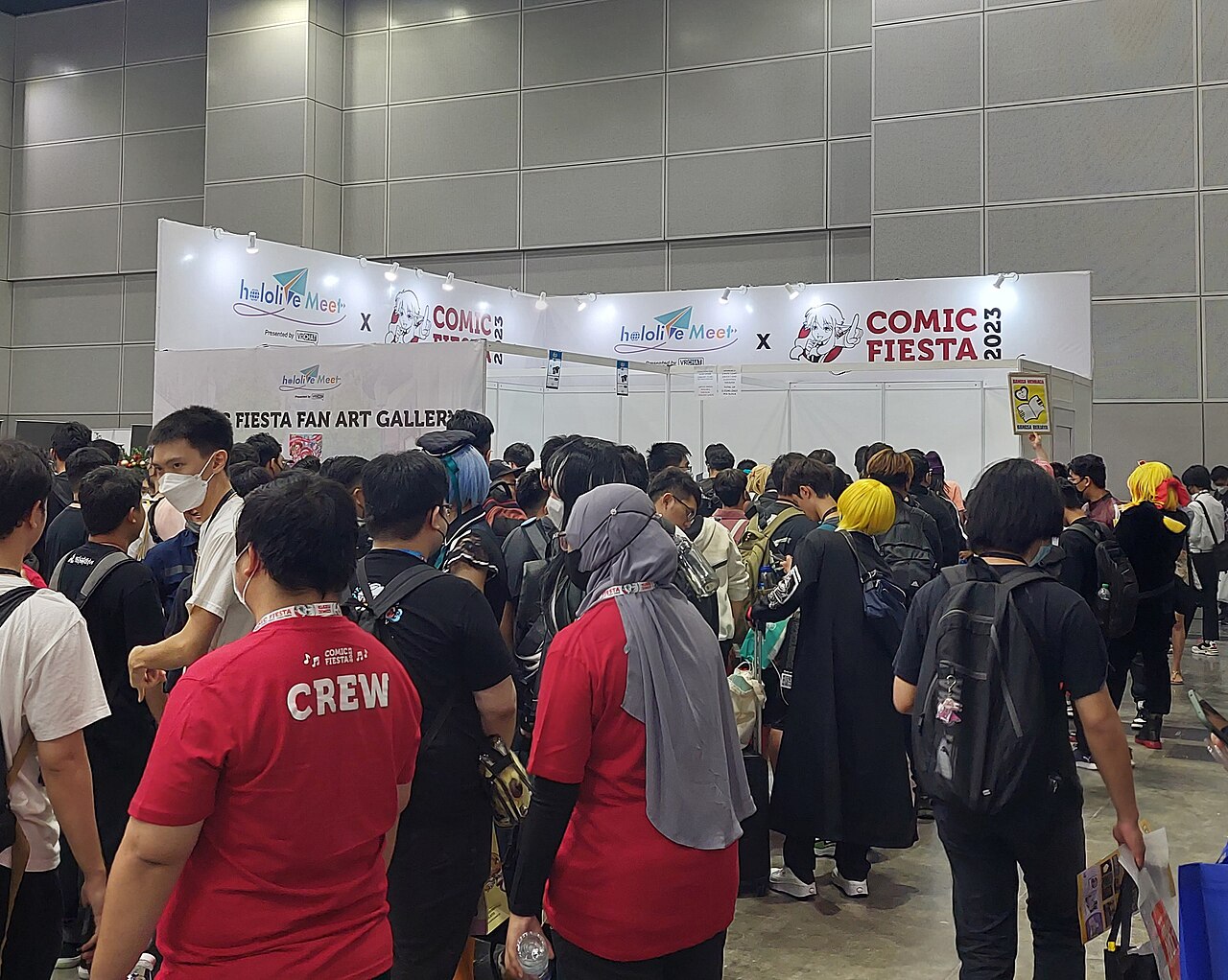
Fans queue at the "hololive Meet x Comic Fiesta 2023" booth in Kuala Lumpur, Malaysia — evidence of hololive's reach well beyond Japan. Photo: PeaceSeekers, CC BY 4.0, via Wikimedia Commons.
COVER Corporation originally used the name "hololive" for a 3D live-streaming distribution app launched in December 2017. The agency side of the brand began the same year when Tokino Sora (ときのそら) debuted as its first official talent, followed shortly by Roboco-san, Sakura Miko, Hoshimachi Suisei, and AZKi — retroactively grouped as "Gen 0." Hololive's first formally numbered generation launched in mid-2018, right as the broader VTuber boom was taking off across Japan.
Growth accelerated through 2019–2020 as hololive added further Japanese generations, a gaming-focused hololive GAMERS sub-unit, and opened its first overseas branch, hololive Indonesia, in 2019. The turning point for global recognition came in September 2020, when hololive launched hololive English, starting with the "Myth" generation (Mori Calliope, Takanashi Kiara, Ninomae Ina'nis, Gawr Gura, Watson Amelia). Debuting during COVID-19 lockdowns, hololive EN found a huge Western audience almost overnight; Gawr Gura became the fastest VTuber in history to reach one million subscribers, and later four million.
Hololive English expanded with Council (2021, alongside soloist IRyS), Advent (2023, including the twin duo FUWAMOCO), and Justice (2024), while hololive Japan added a sixth generation branded holoX and an original-song production unit, DEV_IS. In March 2023, COVER Corporation listed on the Tokyo Stock Exchange Growth Market under ticker 5253 — the world's first IPO by a company built primarily around virtual talent. By the mid-2020s the company was posting record annual revenue in the tens of billions of yen, driven by streaming グッズ (merchandise) sales, concerts, and licensing deals such as the hololive Official Card Game, launched in 2024.
Structure: Generations, Branches, and Units
Hololive organizes its roster into generations (期生, kisei) — talents who debut together, train together, and are marketed as a cohort with a shared design theme. This mirrors the generational "class" system familiar from Japanese idol groups such as AKB48, adapted to a virtual, streaming-first format.
| Branch | Notable generations / units |
|---|---|
| hololive (Japan) | Gen 0, Gen 1–5, hololive GAMERS, holoX, DEV_IS |
| hololive English | Myth, Council (+IRyS), Advent (+FUWAMOCO), Justice |
| hololive Indonesia | Gen 1 "Area 15," Gen 2 "Holoro," Gen 3 |
| hololive DEV_IS | ReGLOSS, FLOW GLOW (original-song focused units) |
| holostars | The male-talent counterpart agency, launched 2019 |
A talent's growth is tracked publicly through subscriber and 「同接」 (douseki, simultaneous/concurrent viewer count) milestones, and through 原点回帰 debuts, milestone celebrations, and full-scale 3D concerts (hololive's annual hololive SUPER EXPO and stadium shows such as hololive Alternative productions draw tens of thousands of live and streamed viewers).
Oshi and Superchat Culture
Hololive fandom runs on the same 推し (oshi, "favorite you support") logic that powers idol fandom generally, intensified by the platform tools of live streaming:
- スーパーチャット (superchat / "スパチャ," supacha) — paid messages fans send during a live stream, highlighted on-screen in proportion to the amount paid. Hololive talents have repeatedly topped YouTube's global superchat rankings; several individual streams have generated well over ¥10 million in a single session.
- 箱推し (箱推し, hako-oshi, "supporting the whole box") — fans who support the entire hololive roster or branch rather than a single talent, versus supporting one specific member.
- 卒業 (卒業, sotsugyou, "graduation") — hololive's term for a talent's permanent departure, typically marked with a final stream and message rather than an announced reason, following idol-industry convention.
- 転生 (tensei, "reincarnation") — when a performer's prior or subsequent VTuber identity becomes publicly linked, a sensitive topic given hololive's strict separation between talent and 中の人.
- 記念グッズ and 生誕祭 (seitansai, "birthday festival") — fan-funded merchandise drops and community celebrations timed to a talent's set birthday, complete with fan art, trending hashtags, and donation drives (often for real-world charities the talent selects).
Because talents interact with fans directly and continuously — unlike a traditional idol's tightly managed public appearances — the parasocial bond in hololive fandom tends to be unusually strong, and viewers often describe watching a stream as being unusually 尊い (toutoi, "precious," a common Japanese fan-culture expression of overwhelmed affection).
Notable Talents
| Talent | Branch / Generation | Known for |
|---|---|---|
| Tokino Sora | hololive JP, Gen 0 | hololive's very first debuted talent |
| Sakura Miko | hololive JP, Gen 1 | Comedic energy; one of hololive's most senior talents |
| Usada Pekora | hololive JP, Gen 3 | Top viewership; catchphrase-driven comedy streams |
| Houshou Marine | hololive JP, Gen 3 | Singing, variety, and merchandise sales |
| Inugami Korone | hololive JP, Gen 4 | Marathon retro-game streams |
| Gawr Gura | hololive EN, Myth | First VTuber to reach 4 million YouTube subscribers |
| Mori Calliope | hololive EN, Myth | Rapper/idol persona; original music releases |
| Hoshimachi Suisei | hololive JP, Gen 0 | Dual idol/VTuber career; major-label music releases |
Cultural Impact and Business Model
Hololive's business model blends three revenue streams that map closely onto idol-industry economics: live-streaming income (superchats, YouTube ad revenue, and channel memberships), merchandise and licensing (acrylic stands, apparel, the hololive TCG, and brand collaborations with companies like Kura Sushi and PUMA), and live events (3D concerts, expos, and pop-up stores in Japan and abroad). Individual talents also release commercial music, several charting on Japan's Oricon and Billboard Japan rankings.
Internationally, hololive functions as one of Japan's most effective contemporary cultural exports. hololive English and hololive Indonesia deliberately built multilingual rosters to reach audiences outside Japan directly, rather than relying on official translation or licensing after the fact — a departure from how earlier anime and idol franchises typically expanded overseas. Pop-up stores, con booths (as pictured above), and collaboration campaigns now run regularly across Asia, North America, and Europe.
The agency has also weighed contested territory: talent departures are sometimes abrupt and unexplained, drawing fan speculation; COVER Corporation received formal guidance from Japan's Fair Trade Commission in 2024 over merchandising practices; and debates persist within VTuber fandom over labor conditions, avatar ownership, and how much creative freedom individual talents retain versus the agency's corporate character IP. These tensions are part of ongoing conversations about how a streaming-native entertainment format scales into a publicly traded, IP-driven company.
Hololive vs. the Generic "VTuber" Concept
| VTuber (general) | hololive (specific) | |
|---|---|---|
| Scope | Any avatar-based streamer, indie or agency | One specific agency's roster and brand |
| Ownership | Varies — independent or many competing agencies | COVER Corporation (Tokyo Stock Exchange: 5253) |
| Structure | No fixed structure | Talents grouped into named generations and branches |
| Origin | Kizuna AI, 2016 | Tokino Sora / COVER Corp, 2017–2018 |
See the VTuber article for the broader phenomenon, its history, and its wider fan vocabulary (切り抜き, コラボ, 個人勢, and more), most of which applies equally to hololive talents.
Related Dictionary Words
being a fan of; being a supporter of; pushing for
distribution (of information, news, etc.); broadcast; delivery; transmission; streaming (over the Internet)
graduation; completion (of a course)
person inside a cartoon body suit
(being a) fan of an entire music group (esp. idol group); not having a favorite member of a group
concurrent connections; simultaneous connections
voice actor or actress (radio, animation, etc.)
listing (on the stock exchange, etc.); taking (a company) public
precious; valuable; priceless