百円ショップ
hyakuen shoppuThe Japanese "100 yen shop" retail format — chains like Daiso and Seria where most items cost just ¥100 plus tax.
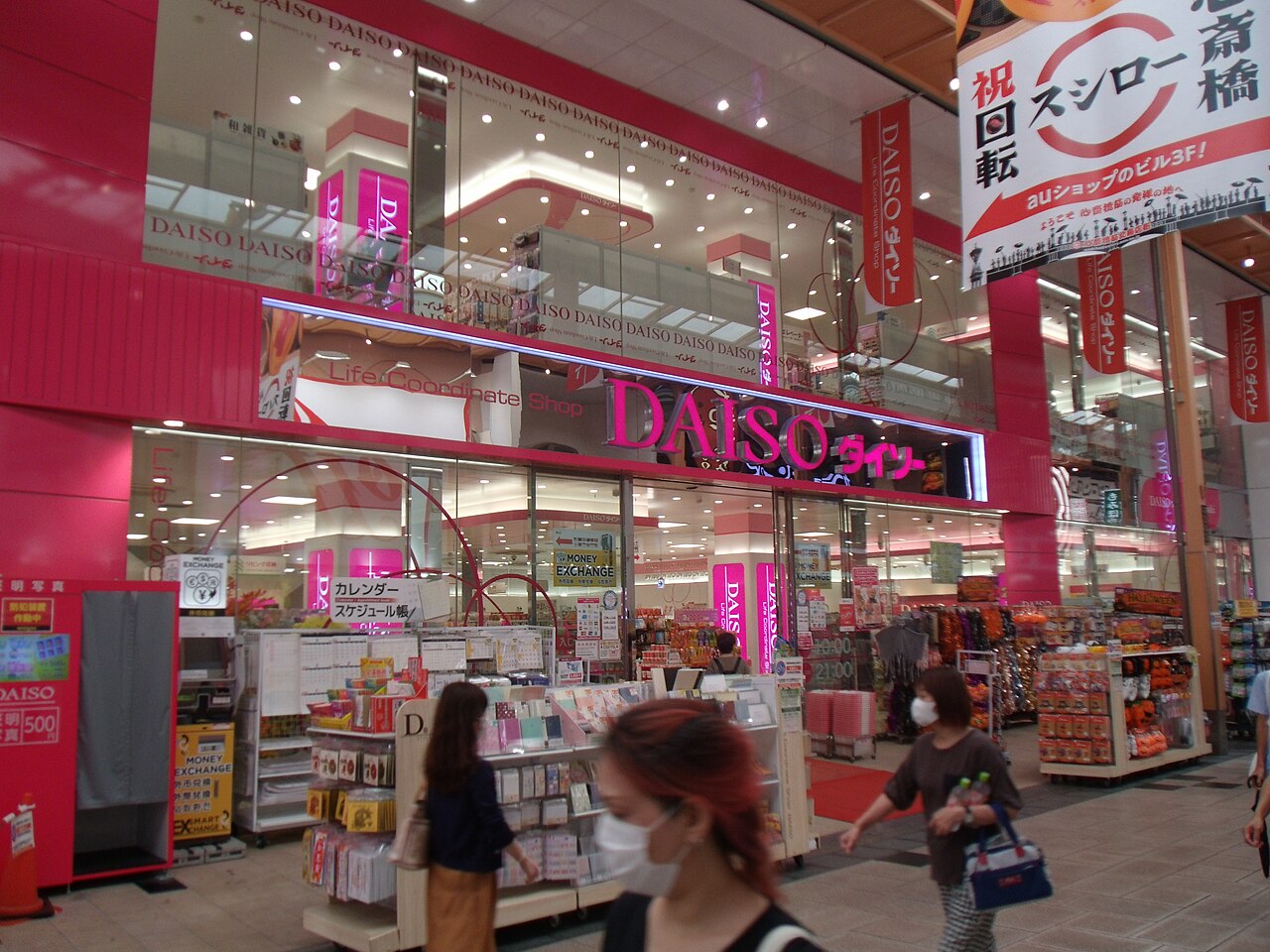
A Daiso storefront on the Shinsaibashi shopping street in Osaka, a typical urban 100-yen shop location. Photo: Mr.ちゅらさん, CC BY-SA 4.0, via Wikimedia Commons.
Meaning
百円ショップ (hyakuen shoppu), universally shortened in speech to 百均 (hyakkin, literally "hundred [yen] uniform [price]"), refers to Japan's chain of variety stores where the overwhelming majority of products are priced at a single flat rate — historically ¥100 before 消費税, now typically ¥110 with Japan's 10% consumption tax included (some larger or specialty items run ¥200, ¥300, or more, but the ¥100 base price is the format's defining feature).
These stores are the Japanese equivalent of a dollar store, pound shop, or discount variety store, but occupy a much larger, more design-conscious niche in everyday Japanese life. A single 店 might stock several thousand distinct 商品 — kitchenware, 文房具, cleaning supplies, seasonal decorations, 化粧品, snacks, phone accessories, and craft supplies — all at the same uniform price point, refreshed constantly with new items.
Usage
In conversation, people almost always use the abbreviation 百均 (hyakkin) rather than the full 百円ショップ. It functions as both a noun for the store type and a shorthand for "cheap but surprisingly good."
文房具は百均で十分だよ。 Bunbōgu wa hyakkin de jūbun da yo. "Stationery is plenty good enough from the 100-yen shop."
これ百均で買ったんだけど、意外と品質いいよね。 Kore hyakkin de katta n da kedo, igai to hinshitsu ii yo ne. "I bought this at the 100-yen shop, but the quality is surprisingly good, right?"
週末は百均で季節の飾りを見るのが楽しみ。 Shūmatsu wa hyakkin de kisetsu no kazari o miru no ga tanoshimi. "On weekends I look forward to browsing the seasonal decorations at the 100-yen shop."
The phrase 百均で十分 ("the 100-yen shop is enough/good enough") is a common expression of practical, unpretentious consumer values — using it signals you don't think an item is worth spending more on, without any embarrassment attached.
Major Chains
Four chains dominate the market, together running close to 9,000 stores and generating over ¥1 trillion in annual sales.
| Chain | Market Position | Character |
|---|---|---|
| DAISO (ダイソー) | No. 1, ~4,600+ stores in Japan | The largest and most famous; huge, eclectic selection; the name most non-Japanese associate with "100 yen shop" |
| Seria (セリア) | No. 2 | Stylish, minimalist, "Made in Japan"-focused design; strict about staying at ¥100; popular for home decor and crafting |
| Can Do (キャンドゥ) | No. 3 | Character collaborations and trend-driven items; launched an online shop for individual purchases in 2022 |
| Watts (ワッツ) | No. 4 | Practical, consumable-focused; often tucked inside supermarkets and drugstores in smaller towns |
Daiso alone has grown into a global operation, with roughly 2,300 stores outside Japan across some 25 countries and regions — including the United States, Australia, Southeast Asia, and the Middle East — making it one of Japan's most visible retail exports.
Cultural Context
The format traces back to traveling market vendors of the 1970s who sold miscellaneous goods from trucks at a flat ¥100, since pricing every item individually was too time-consuming. Hirotake Yano, who had been running exactly this kind of mobile stall business since 1972, formally founded Daiso Industries in 1977 and adopted the uniform ¥100 price permanently for the same reason — it let him and his small staff skip individual price-tagging altogether. Daiso opened its first fixed-location, directly managed store in 1991 in Takamatsu, Kagawa Prefecture, and expanded aggressively through the 1990s as Japan's post-bubble economy pushed shoppers toward value retail. Seria, Can Do, and Watts followed with their own takes on the format over the following decades.
What makes 100-yen shops a genuine cultural institution rather than just a discount chain is the combination of extremely tight cost engineering with surprisingly serious product design. Japanese consumers have high baseline expectations for build quality and thoughtful functionality even in inexpensive goods, and hyakkin chains compete hard to meet that bar — a phenomenon often described as 100円とは思えない (hyakuen to wa omoenai, "you wouldn't believe it's only ¥100"). Seria in particular built its identity around this, sourcing Japan-made items with the kind of considered design normally associated with pricier boutique brands.
The stores are also a barometer of Japanese seasonal culture. Aisles rotate constantly with tie-in and seasonal merchandise — sakura-themed goods in spring, 七夕 decorations in summer, Halloween costumes and Christmas ornaments later in the year — turning a routine errand into a small ritual of noticing the calendar. For crafters and hobbyists, hyakkin chains are a primary supply source: resin, washi tape, beads, and DIY materials for everything from scrapbooking to cosplay prop-making.
For international visitors, 100-yen shops (Daiso especially) have become a staple tourist stop in their own right, offering an affordable, dense sample of Japanese design sensibility, character goods, and practical gadgets to bring home as お土産 — often name-checked in travel guides alongside コンビニ and ドン・キホーテ as essential Japan shopping stops, though it sits at the opposite end of the retail spectrum from the curated luxury of a デパ地下.
Tips for Shoppers
- Check the price tag anyway. Most items are ¥110 (tax included), but larger or imported goods can be ¥220, ¥330, or more — always marked clearly, but easy to miss when everything looks uniform.
- Daiso for breadth, Seria for design. If you want the widest possible selection, go to Daiso; if you want fewer but more aesthetically considered items, Seria tends to edge it out.
- Inventory turns over fast. Seasonal and limited items sell out and aren't restocked — hyakkin regulars check in often rather than assuming an item will still be there next visit.
- Great for travelers. Compact toiletries, adapters, umbrellas, and snack gifts make 100-yen shops a practical stop for restocking mid-trip, not just a souvenir errand.
Related Dictionary Words
yen (currency of Japan)
store; shop; establishment; restaurant
to buy; to purchase
cheap; inexpensive
quality (of a product or a service)
uniformity; equality
commodity; article of commerce; goods; stock; merchandise
season; time of year
stationery
cosmetics; beauty products; toiletries; makeup
miscellaneous goods; general goods; sundries
tourist