怪獣
kaijuA genre of giant monster stories originating in Japan, most famously represented by Godzilla, born from post-WWII nuclear anxieties and now a global cultural phenomenon.
Meaning
怪獣 (kaiju) literally combines two characters: 怪, meaning "strange" or "mysterious," and 獣, meaning "beast" or "creature." Together they describe a monstrous, supernatural creature of enormous scale — something far beyond an ordinary 怪物 (monster). In contemporary usage the word refers specifically to the giant creatures of Japanese film, television, and media, though internationally "kaiju" has come to mean any creature in that tradition, regardless of origin.
The creatures are defined not merely by size but by their relationship to human 文明: they emerge from nature, from the sea, or from the effects of modern science, and they reduce human cities and ambitions to rubble. That collision between unstoppable force and fragile society is at the heart of the genre.
Origins: Godzilla and the Shadow of the Bomb
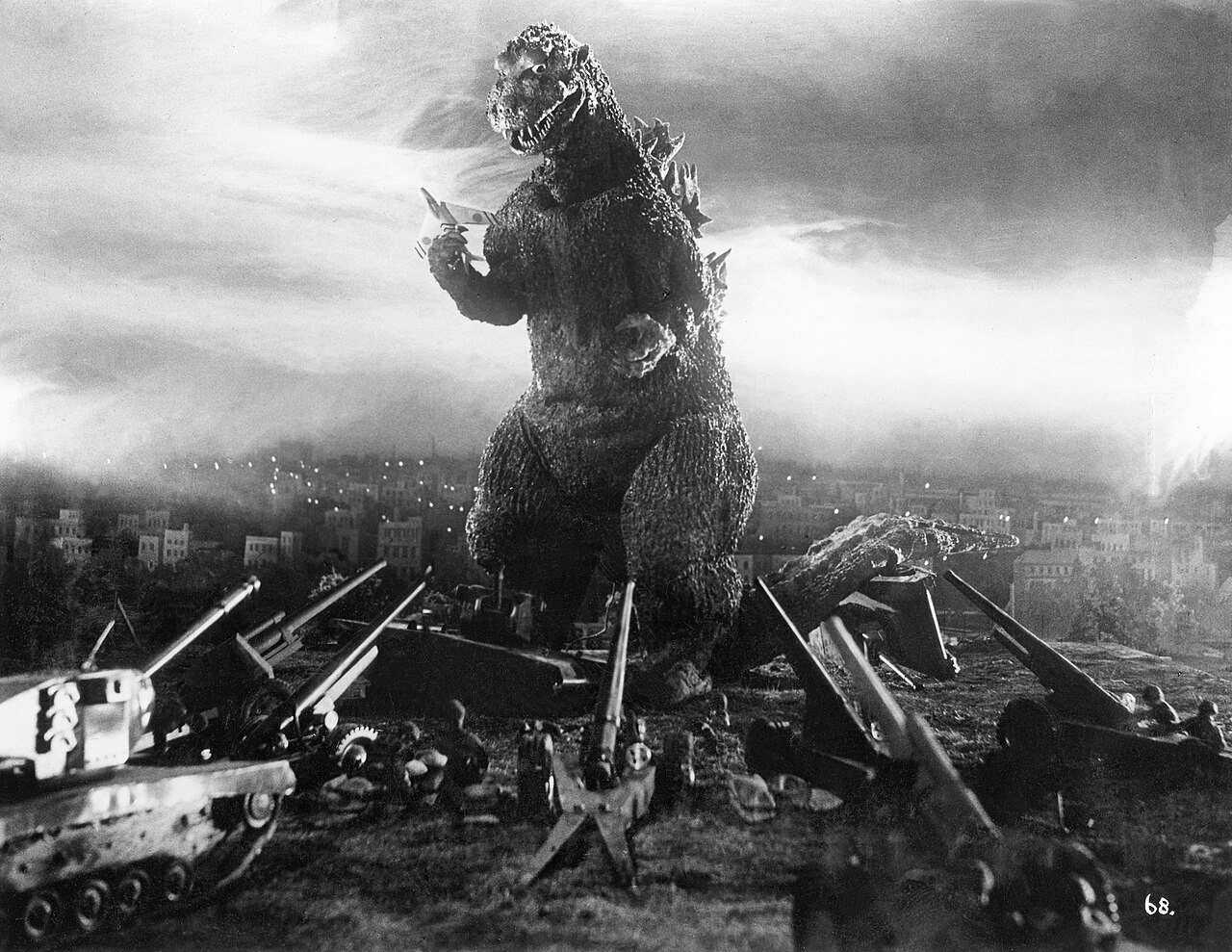
A still from the original 1954 Toho film ゴジラ (Godzilla). Public domain, Toho Company Ltd., via Wikimedia Commons.
The kaiju genre was born on November 3, 1954, when Toho Studios released ゴジラ (Gojira, known internationally as Godzilla). Director Ishiro Honda and special effects maestro Eiji Tsuburaya created a creature that was unmistakably shaped by recent history. Japan had surrendered to Allied forces just nine years earlier; the atomic bombings of Hiroshima and Nagasaki were vivid national trauma, and in March 1954 — just months before the film's release — the Lucky Dragon No. 5 fishing vessel was irradiated by American hydrogen bomb tests at Bikini Atoll, reigniting public 恐怖 over 放射線 and 核兵器.
Godzilla emerged from that fear made flesh. The creature was mutated by nuclear testing, covered in keloid-like skin that evoked radiation burns, and it breathed 熱線 (heat ray) that leveled 東京 in scenes that consciously echoed wartime destruction. The original film is a dark, melancholic work of science fiction as much as a monster 映画. Its tagline asked whether mankind had finally created something it could not stop.
The name ゴジラ is itself a portmanteau of gorira (ゴリラ, gorilla) and kujira (クジラ, whale), coined by Toho staff to suggest a creature that combined the power of a great land animal with the mystery of the 海.
The Kaiju Genre Expands
The commercial success of the original film launched a franchise and a genre. Toho followed with a roster of iconic creatures:
| Creature | Japanese | First appearance | Notes |
|---|---|---|---|
| ゴジラ (Godzilla) | 怪獣王 | 1954 | "King of the Monsters" |
| モスラ (Mothra) | 守護神 | 1961 | Divine moth, protector deity |
| ラドン (Rodan) | 翼竜 | 1956 | Giant pterosaur |
| キングギドラ (King Ghidorah) | 宇宙超怪獣 | 1964 | Three-headed alien dragon |
| ガメラ (Gamera) | 友好的怪獣 | 1965 | Daiei Studios rival; giant turtle |
Mothra (モスラ) deserves special attention: rooted in Japanese 神話 and 伝説, she is worshipped by a small island people and fights not out of destructive rage but as a guardian. She represents a gentler, more spiritual dimension of the kaiju concept.
Tokusatsu: Kaiju Comes to Television
In 1966 producer Eiji Tsuburaya — the same man who built Godzilla's miniature Tokyo — launched Ultraman (ウルトラマン) for TBS television. The show introduced a new format: a giant alien hero who grows to enormous size to battle kaiju threatening Earth. This is 特撮 (tokusatsu), literally "special filming" — the live-action genre defined by elaborate practical effects, miniatures, and rubber suits.
Ultraman spawned a multi-decade franchise and made kaiju a staple of children's entertainment. The 怪獣 here shifted from object of dread to weekly spectacle: each episode a new monster, each monster an opportunity for intricate suit design and miniature destruction. The franchise continues to produce new series today.
Nuclear Metaphor and Cultural 象徴
Scholars of Japanese 文化 have long read kaiju as displaced expressions of national anxiety. In the 1950s and 1960s, 戦争 guilt, atomic trauma, and rapid industrial 破壊 of the natural environment all found expression in giant monsters that punished human hubris. Godzilla in particular shifted in meaning across decades:
- 1954: Horror — a warning against nuclear weapons and unchecked science
- 1960s–70s: Family entertainment — Godzilla battles other monsters to protect Japan
- 1984–95 (Heisei era): Return to darkness — rebooted as a genuine threat, explicitly nuclear
- 2016 (Shin Godzilla): Political satire — a blistering critique of government bureaucracy and Japan's post-Fukushima disaster response
Shin Godzilla (シン・ゴジラ), directed by Hideaki Anno (creator of Evangelion) and Shinji Higuchi, is arguably the most important kaiju film since 1954. Its creature is grotesque and unknowable; its true monster is institutional paralysis in the face of catastrophe.
アニメ and 漫画: Kaiju Beyond the Screen
The kaiju concept permeated 漫画 and アニメ in ways that sometimes departed radically from the original form.
Neon Genesis Evangelion (新世紀エヴァンゲリオン, 1995) reimagined kaiju as "Angels" (使徒, shito) — beings of incomprehensible shape and purpose that humanity barely survives. The teenage pilots of giant mechs fight these creatures not in triumphant battles but in desperate, traumatic struggles. Creator Hideaki Anno stripped away the spectacle of kaiju to expose the psychological horror underneath.
Attack on Titan (進撃の巨人, 2009–2021) reconfigured the kaiju template again: the Titans are humanoid, mindless, and relentless, and the story focuses entirely on the human survivors behind the walls they have built to keep the creatures out. The series became a global phenomenon, and many international critics drew explicit lines from its Titans back to Godzilla and the kaiju tradition.
Kaiju No. 8 (怪獣8号, 2020–) returns directly to the classic formula — kaiju as real-world disaster — but through the lens of the people whose job it is to clean up after attacks.
International Influence
The kaiju genre crossed the Pacific long before Pacific Rim. American drive-in cinema of the 1950s and 1960s ran dubbed Godzilla films and imitated the formula with its own giant insects, dinosaurs, and sea creatures. But the modern international kaiju boom is more direct:
- Pacific Rim (2013, dir. Guillermo del Toro) was an explicit love letter to kaiju and mecha (giant robot) anime, using the Japanese vocabulary of giant monsters versus giant machines. Del Toro has spoken at length about his childhood fascination with Godzilla.
- The MonsterVerse (2014–present, Legendary/Warner Bros.) is a shared cinematic universe built around Godzilla and Kong, drawing on Toho's mythology while reworking it for global audiences. The 2014 Godzilla and 2021 Godzilla vs. Kong both performed strongly worldwide.
- Korean cinema has produced its own kaiju entries, most notably The Host (2006, dir. Bong Joon-ho), which uses a Han River monster as a vehicle for social criticism in a way that consciously echoes Honda's 1954 film.
Kaiju and 妖怪
The kaiju tradition did not emerge in a vacuum. Japan already possessed a rich tradition of 妖怪 — supernatural creatures of folklore — that had populated art, literature, and legend for centuries. Artists like Toriyama Sekien catalogued hundreds of these beings in the 18th century. Kaiju drew on this existing cultural vocabulary of dangerous, mysterious natural forces taking monstrous form, while updating it for the age of cinema and nuclear science.
Merchandise and Pop Culture Today
Toho has licensed Godzilla continuously since 1954, making the character one of the most merchandised fictional beings in history. 恐竜-like figure kits, vinyl toys (ソフビ, sofubi), and elaborate collector statues span every price point. The sofubi tradition — hand-painted vinyl figures of kaiju, originally made as children's toys — has become a serious collector's hobby with boutique producers making limited runs priced in the hundreds of dollars.
Kaiju aesthetics are deeply embedded in Japanese 都市 life: Godzilla has an official residence in the Shinjuku Toho Building in Tokyo, with a giant head emerging from the rooftop. The character has appeared in tourism campaigns, municipal mascots, and luxury brand collaborations.
The international fandom for kaiju merchandise is substantial. American and European toy collectors prize original vintage Toho-licensed sofubi; specialty stores in Akihabara stock figures that sell to buyers from around the world.
Why Kaiju Endures
The staying power of the genre lies in its flexibility. At its simplest, kaiju is spectacle: big things breaking other big things. But the form has proven capable of carrying almost any emotional or political weight its creators bring to it. A creature that can represent nuclear anxiety in 1954, bureaucratic failure in 2016, and adolescent psychological collapse in 1995 is not just a monster — it is a mirror.
The word 怪獣 has entered global vocabulary largely unchanged, a rare case of a Japanese genre term being adopted internationally not as a translation but as the original. When filmmakers and critics around the world say "kaiju," they mean exactly what Toho meant in 1954: a mysterious beast of overwhelming power, and the very human stories of those who must face it.
Related Dictionary Words
monster
monster
huge; gigantic; enormous
fear; dread; dismay; terror; horror; scare; panic
movie; film; motion picture
special effects; SFX
radiation
nuclear weapon
destruction; disruption
Tokyo
legend; folklore; tradition
symbol (of something abstract); emblem; (symbolic) representation