狐
kitsuneThe fox spirit of Japanese Shinto belief and folklore — sacred messenger of the rice god Inari, legendary shapeshifter, and one of the most enduring trickster figures in Japanese culture.
Meaning
狐 (きつね, kitsune) is the Japanese word for "fox," but in Japanese folklore and religion the term reaches far beyond the animal itself. Kitsune are among the most important 妖怪 (supernatural beings) in Japanese tradition — shapeshifters, tricksters, and, in their most exalted form, divine messengers of the Shinto deity of rice and prosperity. Where the 狸 (tanuki) is Japan's bumbling, slapstick trickster of the eastern Kantō imagination, the kitsune is its sharper, more elegant, and often more dangerous counterpart — a fox whose cunning can be either a blessing or a curse depending on how it is treated.
Kitsune folklore divides broadly into two categories: zenko (善狐, "good foxes"), who serve the gods and protect people, and yako or nogitsune (野狐, "field foxes"), wild and mischievous spirits with no divine allegiance who are blamed for hauntings, illness, and deception. This duality — sacred messenger on one hand, wily trickster on the other — runs through nearly every kitsune story.
Kitsune and Inari
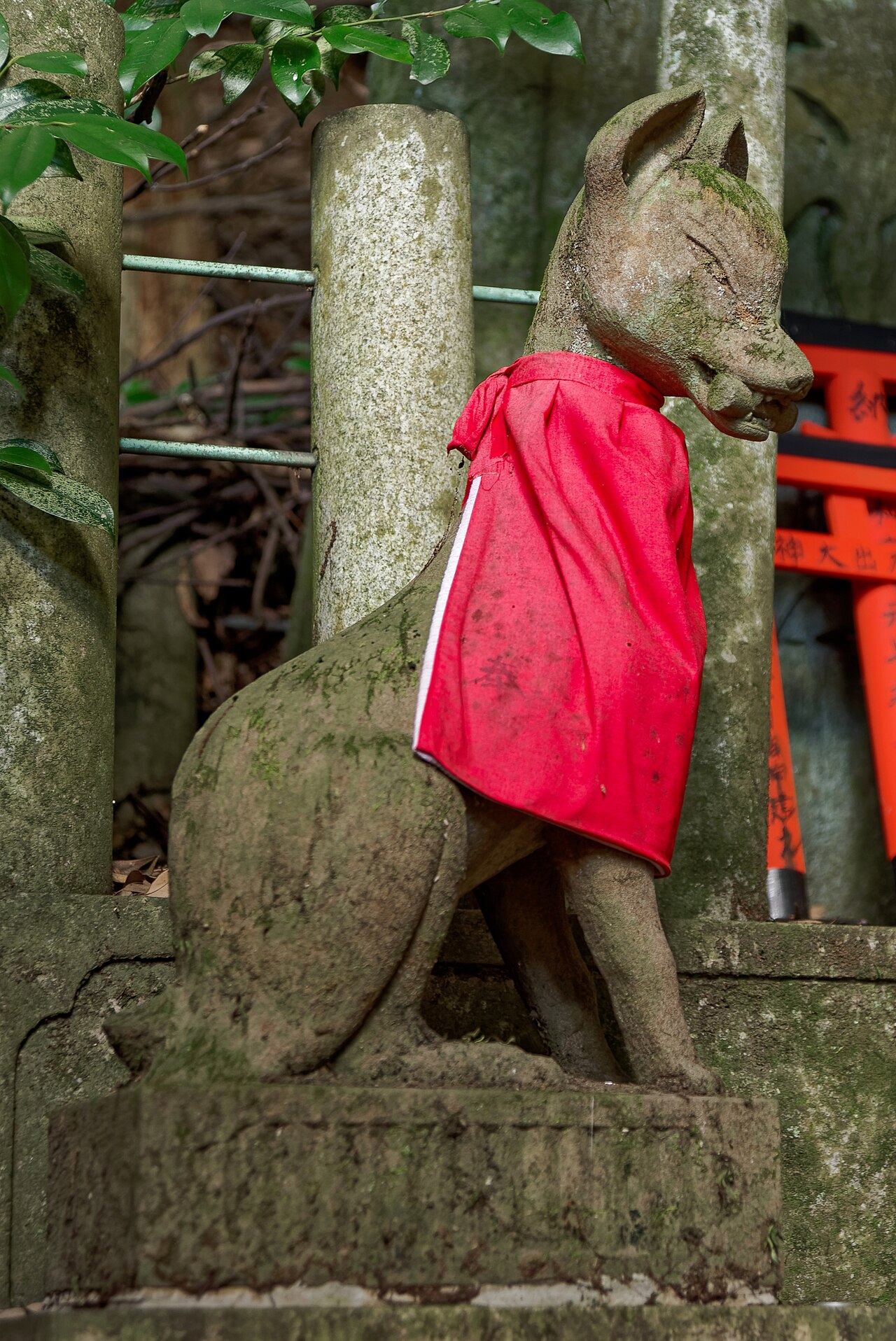
A fox statue guarding the approach to Fushimi Inari Taisha in Kyoto, head shrine of Japan's Inari worship. Photo: Jakub Hałun, CC BY 4.0, via Wikimedia Commons.
The kitsune's most enduring religious role is as the 使い (messenger) and 眷属 (retainer/familiar) of 稲荷神社 (Inari shrines), dedicated to Inari, the Shinto deity of rice, agriculture, fertility, and business prosperity. Statues of foxes — often carved from stone, sometimes holding a key, a jewel (tama, 玉), or a sheaf of rice (俵) in their mouths — flank the approach (参道) of virtually every Inari shrine in Japan, standing in the same guardian role that lion-dog 狛犬 play at other Shinto shrines.
The largest and most famous example is Fushimi Inari Taisha in Kyoto, head shrine of some 30,000 Inari shrines nationwide, where thousands of vermilion 鳥居 gates wind up the mountain past countless fox statues. Contrary to a common misconception among foreign visitors, the fox is not itself worshipped as a god — it is Inari's servant and intermediary, sometimes so closely identified with the deity that shrine-goers colloquially call Inari "the fox god." Farmers historically honored kitsune each spring at the hatsuuma (初午) festival, the first Day of the Horse in February, praying for a good harvest (豊作) and success in agriculture (農業).
Shapeshifting and the Nine Tails
Kitsune are legendary 変化 (shapeshifters), most famously able to 化ける into human form — frequently a beautiful woman, sometimes a monk or an old man, in order to test, seduce, reward, or trick the humans they encounter. Countless folktales describe a kitsune-wife who marries a human man and bears his children, only to be discovered — often when a dog frightens her, or her tail slips from beneath her kimono — and forced to flee back to the wild. The idiom 尻尾を出す ("to show one's tail," meaning to reveal one's true nature or get caught) preserves this image directly in everyday Japanese.
A kitsune's power is said to grow with age, marked physically by the number of tails (尾) it grows — up to a legendary maximum of nine. A fully matured nine-tailed fox, or kyūbi no kitsune, gains near-omniscience and can take any form at will; its fur often turns white or gold. The most famous kyūbi in East Asian legend, Tamamo-no-Mae, disguises herself as a courtesan in the imperial court before being exposed as a malevolent nine-tailed fox and hunted down — a story retold in noh, kabuki, and countless modern adaptations. A related mark of supernatural rank is 狐火 (kitsune-bi, "fox fire"), the eerie floating lights foxes are said to conjure at night, sometimes explained today as swamp gas or bioluminescence.
Kitsune-tsuki: Possession Folklore
Where the tanuki's magic tends toward comedy, the kitsune's has a darker edge, most vividly expressed in 狐憑き (kitsune-tsuki), the folk belief that a fox spirit can 憑く (possess) a human being. Historically, sudden illness, erratic behavior, or symptoms resembling mental illness were sometimes attributed to possession by a nogitsune, and families in some regions — particularly parts of the Shikoku and Chūgoku regions — were even stigmatized for generations as belonging to a "fox-owning household" (kitsune-mochi) believed to command spirit foxes for its own gain. Exorcism was traditionally sought through prayer at a temple or shrine rather than medicine. While the belief has faded from mainstream life, it remains a well-studied case in the history of Japanese folk psychiatry and is echoed in the broader vocabulary of spirit possession (憑依, 精霊) found across Japanese folklore.
Kitsune no Yomeiri: The Fox's Wedding
One of the gentler pieces of kitsune folklore is 狐の嫁入り (kitsune no yomeiri, "the fox's wedding"), the traditional name for 天気雨 — a sun shower, rain falling from a clear, sunlit sky. Old stories held that this eerie weather was a sign of a fox wedding procession passing invisibly nearby, its lantern-lit parade glimpsed only as strange lights flickering on distant mountainsides at night. Several towns across Japan, including Kudamatsu in Yamaguchi Prefecture, host modern kitsune no yomeiri festivals in which villagers dress as fox brides and grooms and parade through town, deliberately reviving the folk image as local tourism and cultural heritage.
Inari-zushi and Kitsune Noodles
Kitsune folklore even shapes the Japanese menu. Deep-fried tofu pouches (油揚げ, abura-age) are said to be a fox's favorite food, so rice-stuffed tofu pouches are called inari-zushi in Inari's honor, and any noodle dish topped with a sheet of sweetened fried tofu is called kitsune udon or kitsune soba — the tofu standing in, by culinary shorthand, for an offering to the fox. (By contrast, a noodle dish topped with tempura scraps is nicknamed tanuki udon or soba, extending the fox-and-raccoon-dog rivalry onto the dinner table.)
Masks, Kagura, and Noh
The fox's face is one of the most recognizable in Japanese performing arts and festival culture. White fox masks with pointed ears and painted whiskers are sold at Inari shrines and worn by visitors at festivals, and stylized fox masks appear throughout 神楽 (kagura, ritual Shinto dance-theater) and 能 (noh) drama, most famously in the noh play Kokaji and in kyōgen comic interludes where an actor in fox costume mimes vulpine movements — crouched gait, twitching ears, a swishing tail. These performances keep the kitsune's dual sacred/trickster identity alive as a living stage tradition rather than only a literary one.
Kitsune in Modern Pop Culture
Kitsune remain one of the most productive character archetypes in contemporary anime, manga, and games. The "kitsune-mimi" character — a human-animal hybrid with fox ears and a tail — is a recurring 萌え-adjacent design across harem, fantasy, and slice-of-life series, drawing directly on the shapeshifting fox-wife tradition. Nine-tailed and spirit-fox characters appear as powerful, morally ambiguous figures in franchises from Naruto (the tailed beast sealed inside its protagonist) to Ōkami, Inari Kon Kon, and Spice and Wolf — most trading on the same age-equals-power logic (more tails, more wisdom, more danger) that defined the folklore centuries earlier. The trope has also spread well beyond Japan through global fandom, making the kitsune, alongside the tanuki, one of Japan's most internationally recognized folkloric exports.
Kitsune vs. Tanuki at a Glance
| Kitsune (狐) | Tanuki (狸) | |
|---|---|---|
| Animal | Fox | Raccoon dog |
| Tone of trickery | Cunning, seductive, sometimes sinister | Comic, bumbling, self-defeating |
| Divine association | Messenger of Inari, worshipped at shrines | Folk deity of commerce in some regions |
| Stronghold region | Kantō (eastern Japan) | Kansai (western Japan) |
| Signature food | Inari-zushi, kitsune udon/soba | Tanuki udon/soba |
Related Dictionary Words
fox (esp. the red fox, Vulpes vulpes)
ghost; apparition; phantom; spectre; specter; demon; monster; goblin; yōkai
errand; mission; going on an errand
Inari shrine; shrine dedicated to Inari
change; variation; alteration; mutation; transition; transformation
to take the form of (esp. in ref. to a spirit, fox, raccoon dog, etc.); to assume the shape of; to turn oneself into; to transform oneself into
to show one's true colors (colours); to expose one's faults; to give oneself away
tail (of an animal); cauda
pale fiery light seen in fields and mountains at night; will-o'-the-wisp; ignis fatuus; elf-fire; fen-fire
possession by a fox spirit; person possessed by a fox spirit
rain shower while the sun shines; sun shower
sun shower; sudden rain from a blue sky
abura-age; thin deep-fried slices of tofu
kagura; traditional Shinto music and dancing
sprouting; budding
old, white fox (trad. said to have supernatural powers)
celestial fox; fox with supernatural powers (sometimes said to live in the heavens)
(one's) family; dependents; household
to possess; to haunt
God; god; deity; divinity; spirit; kami