七福神
shichifukujinThe Seven Lucky Gods of Japanese folk religion — a syncretic band of Shinto, Buddhist, Hindu, and Taoist deities, each bringing a different form of fortune, who sail together on a treasure ship at New Year.
Meaning
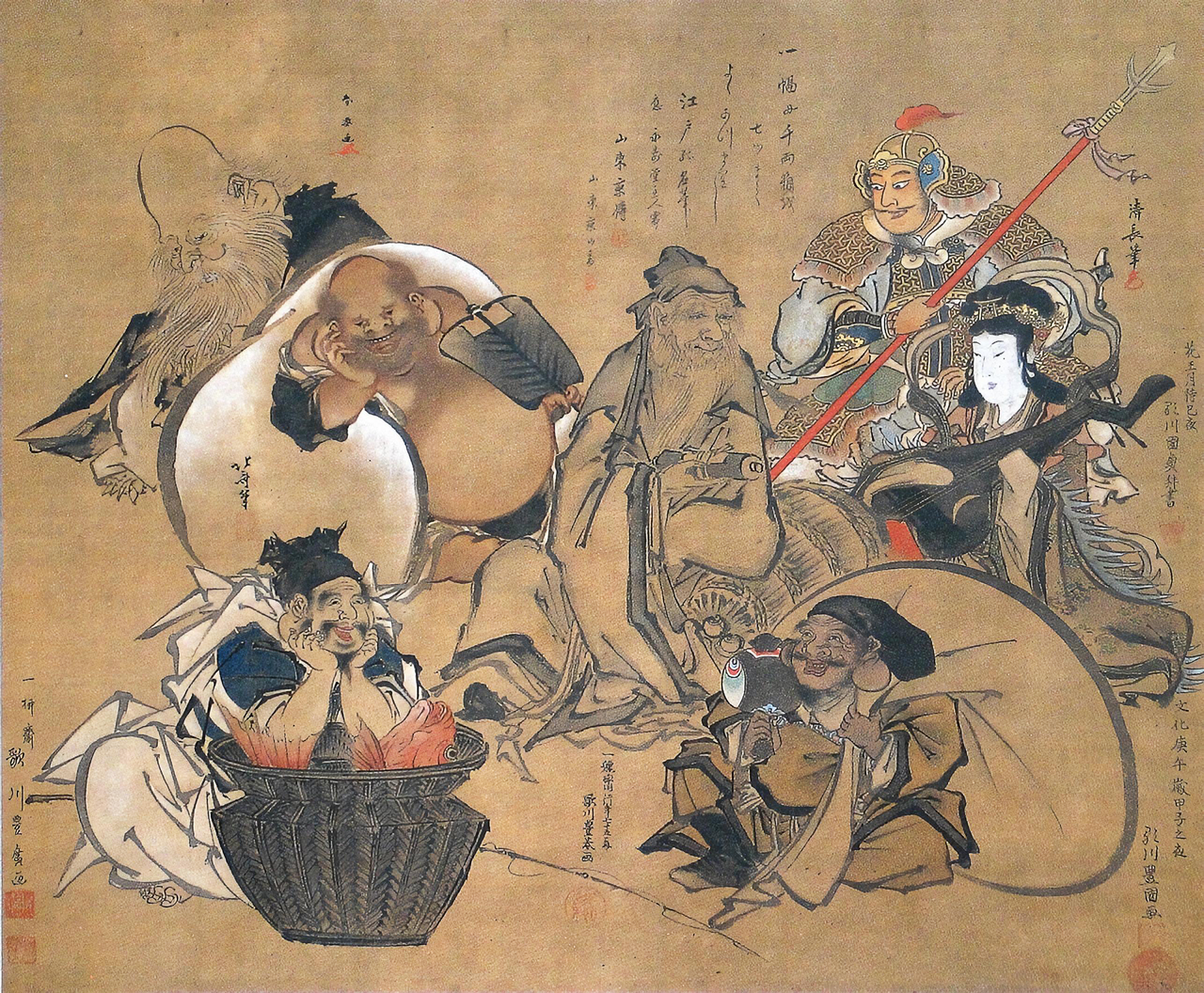
The Seven Lucky Gods, a collaborative painting attributed to Katsushika Hokusai and other Edo-period artists, circa 1810s. Public domain, via Wikimedia Commons.
七福神 (しちふくじん, shichifukujin, "Seven Gods of Fortune") is a band of seven deities worshipped together in Japanese folk religion as bringers of good luck. What makes the group unusual is its pedigree: it isn't a single tradition's pantheon but a deliberate mash-up assembled from Shinto, Buddhist, Hindu, and Chinese Taoist sources. A native Japanese god of fishing and commerce sails alongside an Indian god of war reimagined as a temple guardian, a Chinese god of longevity, and a Hindu river goddess — all repackaged as a single, harmonious set of good-luck symbols.
Each god presides over a different flavor of fortune: wealth, business success, happiness, longevity, wisdom, and the arts. Collectively they are believed to travel each New Year's Eve on a takarabune (宝船, "treasure ship") loaded with gold coins, rice bales, and other symbols of abundance, sailing into harbor to deliver prosperity for the coming year.
The Seven Gods
| God | Reading | Origin | Brings |
|---|---|---|---|
| 恵比寿 | Ebisu | Native Japanese (Shinto) | Fishing, prosperous business, honest trade |
| 大黒天 | Daikokuten | Hindu (Mahakala) via Buddhism | Wealth, agriculture, household fortune |
| 毘沙門天 | Bishamonten | Hindu (Vaishravana) via Buddhism | Warriors, protection, victory |
| 弁財天 | Benzaiten | Hindu (Sarasvati) via Buddhism | Music, eloquence, water, the arts |
| 福禄寿 | Fukurokuju | Chinese Taoism | Wisdom, longevity, good fortune |
| 寿老人 | Jurōjin | Chinese Taoism | Longevity, health, contentment in old age |
| 布袋 | Hotei | Chinese Buddhism (based on a historical monk) | Happiness, abundance, generosity |
Ebisu (恵比寿)
The only member of the group who is native to Japan rather than imported, Ebisu is usually shown as a plump, smiling fisherman holding a large sea bream (tai) under one arm and a fishing rod in the other. He is the patron of fishermen and, by extension, of honest commerce — his beaming face is a fixture on the signs of restaurants, breweries, and shops nationwide (the Yebisu beer brand takes its name directly from him).
Daikokuten (大黒天)
Daikokuten stands on bales of rice, carries a mallet said to grant wishes with a tap, and is flanked by a rat, his messenger. He descends from Mahakala, a fierce Hindu-Buddhist protector deity, but was softened in Japan into a rotund, cheerful god of wealth and the household — often paired visually with Ebisu as the two most popular of the seven.
Bishamonten (毘沙門天)
Depicted in full armor with a spear and a small pagoda in hand, Bishamonten derives from Vaishravana, guardian of the north in Buddhist cosmology and one of the Four Heavenly Kings. In Japan he became a protector of warriors and of those who follow the rules, admired for dignity and authority as much as martial strength.
Benzaiten (弁財天)
The only female member of the group, Benzaiten evolved from the Hindu river goddess Sarasvati and is portrayed playing a biwa (Japanese lute). She governs music, eloquence, knowledge, and flowing water — many of her shrines sit on islands or beside ponds, most famously at Enoshima and Chikubushima.
Fukurokuju (福禄寿)
A Chinese Taoist hermit-sage with an extremely elongated bald head, a long white beard, and a walking staff, often accompanied by a crane or turtle. His name is itself a compressed blessing: 福 (happiness), 禄 (wealth/status), 寿 (longevity).
Jurōjin (寿老人)
Easily confused with Fukurokuju, Jurōjin is another Taoist star-god of longevity, usually shown as an elderly man with a staff, a fan, and a companion deer said to live a thousand years. Some regional traditions treat him and Fukurokuju as two aspects of the same star.
Hotei (布袋)
The rotund, laughing "Fat Buddha" familiar in Chinese and Japanese art, Hotei carries a huge cloth sack over his shoulder, said to hold endless gifts for children and the poor. He is loosely based on a wandering Chinese Zen monk of the 10th century and represents contentment, generosity, and abundance.
Cultural Context
The treasure ship and hatsuyume
At 正月 (New Year), images of the seven gods riding their treasure ship were traditionally slipped under a pillow on the night of January 1st or 2nd, in the hope of inducing a lucky first dream of the year (hatsuyume, 初夢). A famous saying ranks the luckiest possible dream contents: 一富士二鷹三茄子 ("first Fuji, second hawk, third eggplant") — and a glimpse of the treasure ship, or of the seven gods themselves, was considered luckier still. Woodblock prints of the takarabune were sold cheaply at temple gates every December specifically for this purpose.
Shichifukujin meguri pilgrimages
A popular New Year custom is the shichifukujin meguri (七福神巡り), a walking 巡礼 that visits seven temples or shrines — each enshrining one of the seven gods — typically completed over the first days of January. Tokyo alone has dozens of established circuits (Yanaka, Nihonbashi, Sumida, and more), each just a few kilometers long and dotted with stalls selling stamped scrolls or small figurines that pilgrims collect at every stop, assembling their own miniature set of seven by the end of the walk. The custom turns an abstract wish for the year's good fortune into a concrete, sociable outing for families and friends.
Art, netsuke, and everyday objects
The seven gods have been a favorite subject of Japanese artists for centuries. Ukiyo-e masters including Hokusai, Kuniyoshi, and Yoshitoshi produced full-cast group portraits like the one above, and individual gods appear constantly in painting, sculpture, and lacquerware. In miniature form they were carved as 根付 — the toggles used to fasten a hanging container to a kimono sash — with each god's attribute (Daikokuten's mallet, Benzaiten's biwa, Hotei's sack) instantly recognizable even at a few centimeters tall. Ceramic and wooden figurine sets of the seven gods remain common household and shop decorations, especially displayed together at New Year alongside other 縁起物 (auspicious lucky charms) such as the 招き猫 beckoning cat and the 達磨 doll.
Usage
The full set is typically invoked together, as a symbol of all-around good fortune:
七福神にあやかって、今年もいい年になりますように。 Shichifukujin ni ayakatte, kotoshi mo ii toshi ni narimasu yō ni. "May this year be a good one too, blessed like the Seven Lucky Gods."
Individual gods are also invoked for their specific specialty — Ebisu and Daikokuten especially remain everyday shorthand for business success:
商売繁盛を願って、恵比寿様と大黒様の像を店に飾っています。 Shōbai hanjō o negatte, Ebisu-sama to Daikoku-sama no zō o mise ni kazatte imasu. "Wishing for prosperous business, we display statues of Ebisu and Daikoku in the shop."
Related Folk Icons
The seven gods sit within a much larger family of Japanese lucky charms and folk figures, including the 招き猫 beckoning cat, the 達磨 wishing doll, 地蔵 roadside guardian statues, 絵馬 wish-writing plaques, and お守り amulets. Unlike those single-purpose charms, the shichifukujin function as an entire ensemble — each god covering one slice of a good life, together adding up to complete fortune.
Related Dictionary Words
Ebisu; god of fishing and commerce
Mahakala (incarnation of Mahesvara)
Vaisravana (guardian god of Buddhism)
Benzaiten; Saraswati; goddess of music, eloquence, art, wealth and water
Fukurokuju; god of happiness, prosperity and long life
god of longevity
cloth bag
treasure ship
New Year (esp. first three days)
talisman; lucky charm
pilgrimage; pilgrim
netsuke; carved toggle used to tether a small container to the sash of a robe