狸
tanukiThe Japanese raccoon dog, a beloved folkloric trickster spirit whose ceramic statues stand guard outside shops and restaurants across Japan as symbols of good luck and prosperity.
Meaning
The 狸 (たぬき) is the Japanese raccoon dog (Nyctereutes procyonoides viverrinus), a real canid species native to Japan. Unlike its name might suggest, it is not a raccoon — it belongs to the dog family (Canidae) and is more closely related to foxes and wolves. In Japanese culture, however, the word tanuki carries far more weight than a simple animal name. It refers equally to the living animal and to 化け狸 (bake-danuki), a supernatural trickster figure central to Japanese 民話 (folktales) and 妖怪 (supernatural beings) lore.
The tanuki's plump silhouette — round belly, wide-brimmed straw hat, sake bottle in hand, and a cheerful grin — is one of the most recognizable images in all of Japanese folk art.
Folklore and Mythology
In traditional 昔話, the tanuki is one of Japan's preeminent shape-shifters, capable of 化ける (transforming) into almost any form: a human, a monk, a rock, a teapot, or even a pile of gold coins. Unlike the cunning 狐 (kitsune, the fox), whose transformations are often sinister or seductive, the tanuki's tricks tend toward slapstick comedy. It transforms not to deceive for gain but for mischief and amusement, and it frequently gets caught out.
Among the most famous tanuki tales is Bunbuku Chagama (分福茶釜), in which a tanuki transforms into a teapot, is sold to a temple, and then struggles comically to maintain the disguise while being placed over a fire. Another well-known story pairs the trickster tanuki against the cunning fox, with the tanuki invariably coming off worse despite its magic.
The tanuki's supernatural belly — both enormous and drum-like — is a defining feature of the mythology. Tanuki are said to beat their bellies like 太鼓 (drums) to produce magical sounds and to communicate with one another across the 森. The famous children's song Tan Tan Tanuki (たんたんたぬきの) celebrates this image.
Beyond comedy, the tanuki carries a cosmic dimension. In some regional traditions it is venerated as a 神 (deity) of 商売 (commerce) and good fortune, and tanuki shrines can be found across rural Japan. The animal's association with 幸運 and prosperity made it a natural mascot for merchants.
Tanuki Statues (信楽焼き)
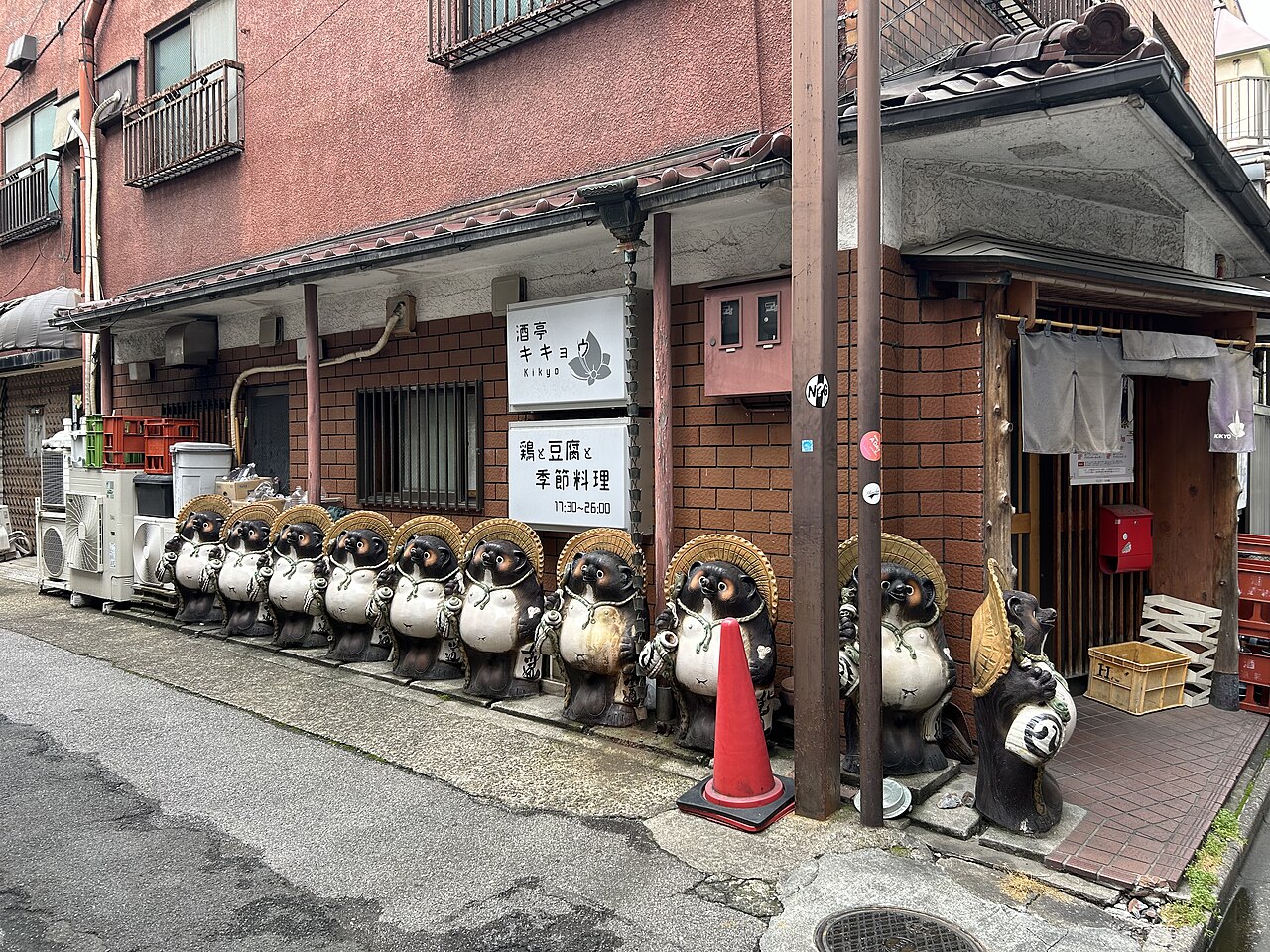
Shigaraki ware tanuki statues outside a shop in Tokyo. Photo: Sahaib, CC BY 4.0, via Wikimedia Commons.
The ceramic tanuki statue that greets visitors outside restaurants, izakaya, and shops across Japan is almost universally made in 信楽 (Shigaraki), a small town in Shiga Prefecture renowned for its 陶器 (pottery). Shigaraki is one of Japan's six ancient kilns and has been producing ceramics since the Nara period (710–794 CE).
The iconic modern Shigaraki tanuki was popularized in the Meiji era (1868–1912) by potter Tetsuzō Fujiwara. The design became a national sensation in 1951 when Emperor Shōwa (Hirohito) passed through Shigaraki by train and the townspeople lined the tracks with tanuki statues to welcome him. A poem the Emperor composed in response made national news, and demand for Shigaraki tanuki exploded overnight.
Today, Shigaraki tanuki statues come in every size imaginable — from palm-sized lucky charms to towering roadside monuments several meters tall.
The Eight Lucky Traits (八相縁起)
Each element of the classic Shigaraki tanuki figure carries a symbolic meaning in what is known as hassō engi (八相縁起, "eight auspicious aspects"). These were formalized during the Meiji era as a mnemonic for the tanuki's good-luck attributes:
| Feature | Japanese | Meaning |
|---|---|---|
| Straw 笠 (hat) | 笠 | Protection from misfortune and bad weather |
| Large eyes | 目 | Clear judgment and the ability to see opportunity |
| Friendly face | 顔 | Warm relationships with others |
| 徳利 (sake bottle) | 徳利 | Virtue and a generous spirit |
| Account book | 通い帳 | Trust and reliability in business |
| Large 腹 (belly) | 腹 | Bold decisiveness and calm confidence |
| 金 pouch | 金袋 | Financial luck and wealth |
| Thick 尾 (tail) | 尻尾 | Stability and strength in achieving goals |
These eight traits make the tanuki an ideal talisman for businesses, which is why the statues are so commonly displayed at the entrances of shops, restaurants, and banks.
Tanuki in Modern Culture
Studio Ghibli: Pom Poko (1994)
The most artistically serious engagement with tanuki mythology is Isao Takahata's animated film Heisei Tanuki Gassen Pompoko (平成狸合戦ぽんぽこ), released by Studio Ghibli in 1994. The film follows a community of tanuki in the hills outside Tokyo whose 森 is being demolished to build the Tama New Town housing development. The tanuki attempt to resist by mastering their ancestral 変身 (shape-shifting) powers, staging elaborate illusions to frighten off the developers.
The film is bittersweet ecological allegory — the tanuki's magic ultimately cannot stop urbanization — wrapped in the full richness of tanuki folklore, including frank depictions of the creatures' mythological anatomy that Western audiences found startling.
Super Mario Bros.
Nintendo introduced the Tanooki Suit in Super Mario Bros. 3 (1988), giving Mario the power to fly and briefly 変化 into an invincible stone statue — a direct reference to the tanuki's legendary shape-shifting. The suit's raccoon-dog ears and striped tail made the power-up instantly recognizable. The Tanooki Suit has returned in Super Mario 3D Land (2011) and multiple subsequent Mario titles.
Animal Crossing: Tom Nook
Tom Nook, the ubiquitous shopkeeper and real-estate broker of Nintendo's Animal Crossing series, is explicitly a tanuki in the original Japanese releases (though localized as a "raccoon" for Western markets). His name in Japanese, Tanukichi (タヌキチ), makes the reference unambiguous. The games even include Nook's nephews Timmy and Tommy, whose names in Japanese (Mame-kichi and Tsubu-kichi) continue the tanuki theme.
The Animal Crossing series has introduced tanuki as a cultural concept to millions of players worldwide who might never have encountered the folklore directly.
Regional Variations
Tanuki mythology varies significantly by region:
- Shikoku and western Japan: The tanuki is far more powerful and sinister, capable of possessing humans and causing madness (tanuki-tsuki).
- Eastern Japan (Kantō): The tanuki is more comic and harmless, a bumbling creature whose tricks backfire.
- Tokushima Prefecture: The legendary Yashima Danuki (屋島の狸) is revered as a great tanuki spirit and has a dedicated shrine.
- Miyagi Prefecture: The Bunbuku Chagama tanuki of Mōtsūji temple is venerated and given offerings.
This east-west divide mirrors the broader cultural geography of Japan, where the 狐 (fox) holds supernatural dominance in the Kantō east while the tanuki reigns in the Kansai west.
Related Dictionary Words
tanuki (Nyctereutes procyonoides); raccoon dog
supernatural tanuki (Japanese folklore)
ghost; apparition; phantom; spectre; specter; demon; monster; goblin; yōkai
folk tale; folktale; folk story; folklore
old tale; folk tale; legend
pottery; earthenware; ceramics; (soft-paste) porcelain; china
omen; sign of luck
metamorphosis; disguise; transformation; shapeshifting; morphing