鯉のぼり
koinoboriCarp-shaped wind streamers flown outside Japanese homes every spring for Kodomo no Hi (Children's Day), symbolizing strength and success drawn from a legend of a carp swimming upstream to become a dragon.
Koinobori strung across a river at Chizu, Tottori prefecture — a well-known spring display where hundreds of carp streamers "swim" together over the water. Photo: 663highland, CC BY 2.5, via Wikimedia Commons.
Meaning
鯉のぼり (こいのぼり, koinobori) are windsock-style streamers shaped and painted like 鯉 (koi, carp) that are flown from tall poles outside Japanese homes in the weeks leading up to こどもの日 (Kodomo no Hi, Children's Day) on May 5th. The name combines koi (carp) with nobori (幟, a narrow banner flown from a pole) — literally, "carp banner."
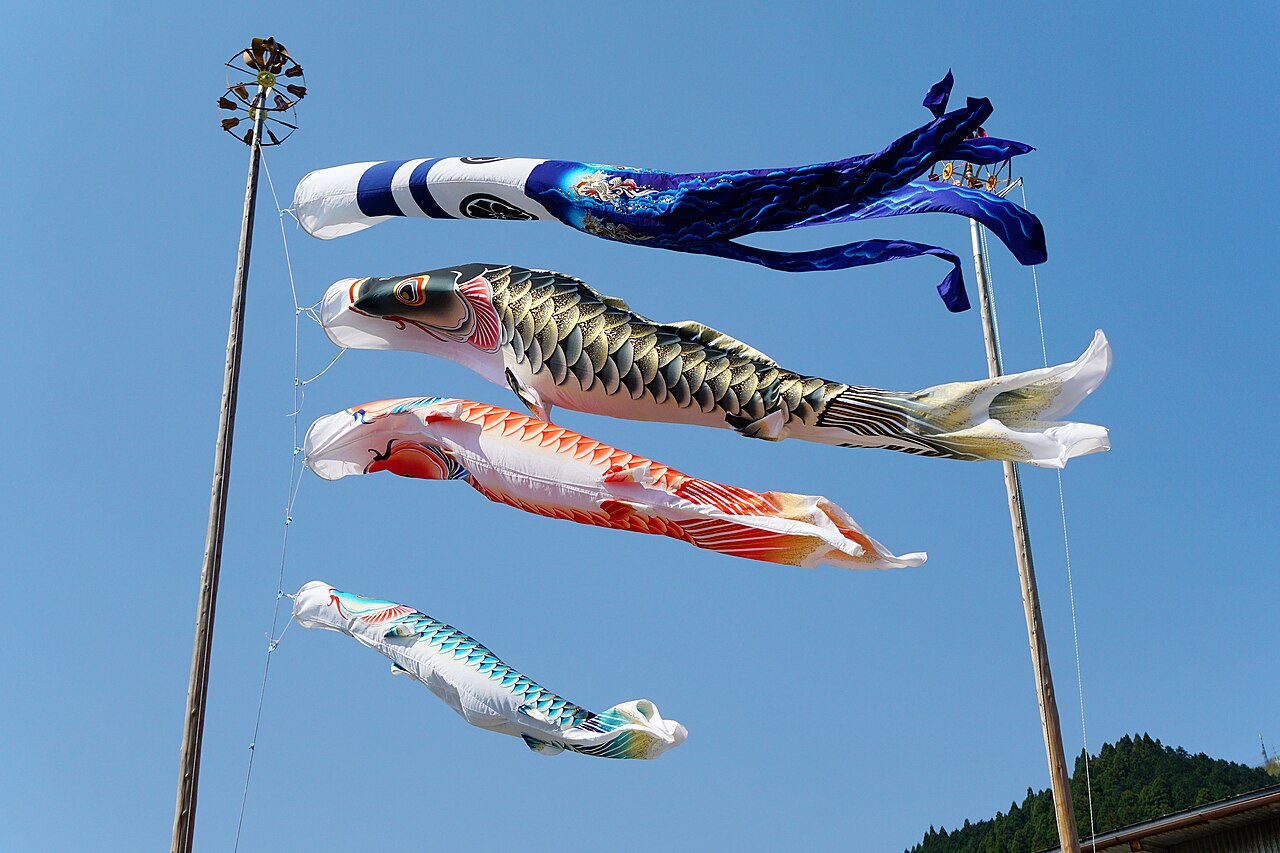
A full koinobori set represents an entire family, traditionally arranged from top to bottom of the pole:
| Element | What it represents |
|---|---|
| 矢車 (yaguruma, arrow-wheel spinner) | Tops the pole; catches the wind and rattles to call the gods' attention |
| 吹き流し (fukinagashi, five-colored streamer) | Sits just below the spinner; its five colors are meant to ward off evil, echoing the five elements of Chinese cosmology |
| 真鯉 (magoi, black carp) | The largest streamer, traditionally representing the father |
| 緋鯉 (higoi, red carp) | The next-largest, traditionally representing the mother |
| Smaller blue, green, and other colored carp | Added one per child, in birth order, growing the set as a family grows |
Flown from a tall bamboo or metal pole in a yard, on a balcony, or strung in bundles across rivers and valleys, the carp fill with wind and appear to swim through the air — a display meant to be seen from a distance and enjoyed communally, not just by the family that raises it.
The Legend Behind the Symbol
Koinobori draw their meaning from an old East Asian legend about a carp swimming up the 黄河 (Yellow River) against a punishing current, past a waterfall called 登竜門 ("Dragon Gate," toryumon) that no other fish could climb. The carp that succeeded in leaping the falls was transformed into a dragon. Because the carp is a hardy fish that can survive in ponds, slow rivers, and even relatively stagnant water, and because it swims upstream against obstacles rather than avoiding them, it became a symbol of perseverance, strength, and the potential for 出世 (shusse, worldly success or advancement) — the same legend gave Japanese the everyday idiom 登竜門, still used today to mean a difficult gateway or test that leads to success (e.g., a prestigious competition described as the toryumon for young novelists).
Flying carp banners for a 男の子 (male child) was a way of wishing that a boy would grow up with the resilience to overcome life's obstacles and rise to success, much like the legendary carp becoming a dragon.
Usage
Families traditionally begin displaying koinobori in early April and take them down shortly after May 5th, though some households leave smaller decorative sets up throughout the spring.
ゴールデンウィークが近づくと、あちこちの家で鯉のぼりが泳ぎ始めます。 Gōruden wīku ga chikazuku to, achikochi no ie de koinobori ga oyogi hajimemasu. "As Golden Week approaches, koinobori start 'swimming' outside houses everywhere."
息子が生まれたので、今年から鯉のぼりを飾ることにしました。 Musuko ga umareta node, kotoshi kara koinobori o kazaru koto ni shimashita. "Since our son was born, we've decided to start displaying koinobori this year."
Beyond private homes, koinobori appear in large public displays every spring: dozens or even hundreds of donated carp streamers are strung on cables over rivers, valleys, and parks in towns across Japan, turning the custom into a shared community event rather than a purely private one. The Chizu, Tottori display shown above is one well-known example, and similar mass displays are held annually in many other prefectures, drawing local families and tourists to watch the carp "swim" together in the wind.
Cultural Context
Koinobori grew out of 端午の節句 (Tango no Sekku), one of Japan's five seasonal festivals (節句) imported from China, originally held to ward off evil and disease at the start of summer using irises and mugwort believed to have purifying properties. Because the word shōbu (菖蒲, iris/sweet flag) is a homophone of shōbu (尚武, "military spirit" or "martial valor"), the festival gradually took on associations with samurai virtues and became linked specifically to boys during the Edo period (江戸時代), when it merged with the aspirational carp-and-dragon legend of Chinese origin.
Samurai families of the Edo period displayed cloth or paper banners (nobori) bearing family crests (家紋) and warrior imagery outside their homes to celebrate a son's birth and pray for his future success and protection. Merchant families, who were not permitted to display samurai crests, adapted the custom by flying carp-shaped banners instead — inexpensive to produce and free of class restrictions — which is generally regarded as the origin of the koinobori as we know it today. The custom spread from the merchant class of Edo (present-day Tokyo) outward and, by the 20th century, had become a nationwide tradition regardless of social class.
Indoors, families raising boys traditionally complement the outdoor koinobori with a 五月人形 (Gogatsu ningyō, "May dolls") display — a miniature suit of samurai armor and a 兜 (kabuto helmet) set on a stand — echoing the same wish for a child's strength and protection from harm. Seasonal foods such as 柏餅 (kashiwa mochi, a mochi filled with sweet bean paste and wrapped in an oak leaf that famously doesn't fall until a new bud grows, symbolizing unbroken family lineage) and 粽 (chimaki, a rice dumpling wrapped in bamboo leaves) are also eaten around the holiday.
In 1948, the postwar Japanese government renamed May 5th こどもの日 (Kodomo no Hi, Children's Day) and made it a national holiday celebrating the happiness and well-being of all children, not only boys, as part of a broader set of reforms toward gender equality. Even so, koinobori and the shōbu-linked warrior imagery of Tango no Sekku remain most closely associated with boys in everyday practice, existing alongside Hinamatsuri (Girls' Day, March 3rd) as a parallel, separate celebration for daughters in many households — together the two festivals bookend spring on the modern Japanese calendar as complementary wishes for 家族 (family) and children's growth.
Modern Variations
Contemporary koinobori range from traditional hand-painted washi-paper and cotton sets to lightweight, machine-printed nylon versions designed for small balconies and apartment living, reflecting the reality that fewer households today have a yard large enough for a full-size pole. Novelty and character versions — koinobori printed with popular cartoon or corporate mascots — are also common, sold seasonally at department stores and toy shops alongside the classic black-red-blue color scheme. Some municipalities and tourism boards now organize massive koinobori "matsuri" featuring thousands of donated streamers, turning what began as a private family wish into one of the most recognizable seasonal images of the Japanese spring, alongside cherry blossoms and Golden Week travel.
Related Dictionary Words
koinobori; carp streamer; carp-shaped windsock traditionally flown to celebrate the Children's Day in May
common carp (Cyprinus carpio); koi carp
Children's Day (national holiday; May 5)
Boys' Day celebration (May 5)
black carp; black koi
red carp; golden carp
arrow wheel (decorative windmill on the pole on which carp streamers are raised)
streamer consisting of multiple long strips of material attached to a circular frame
Boys' May Festival dolls
rice cake wrapped in oak leaves
rice cake wrapped in bamboo leaves
gateway to success
success in life; getting ahead; successful career; promotion; climbing the corporate ladder; eminence
family crest
seasonal festival