門松
kadomatsuA traditional pine-and-bamboo decoration placed in pairs at entrances during Japanese New Year to welcome the harvest deity into the home.
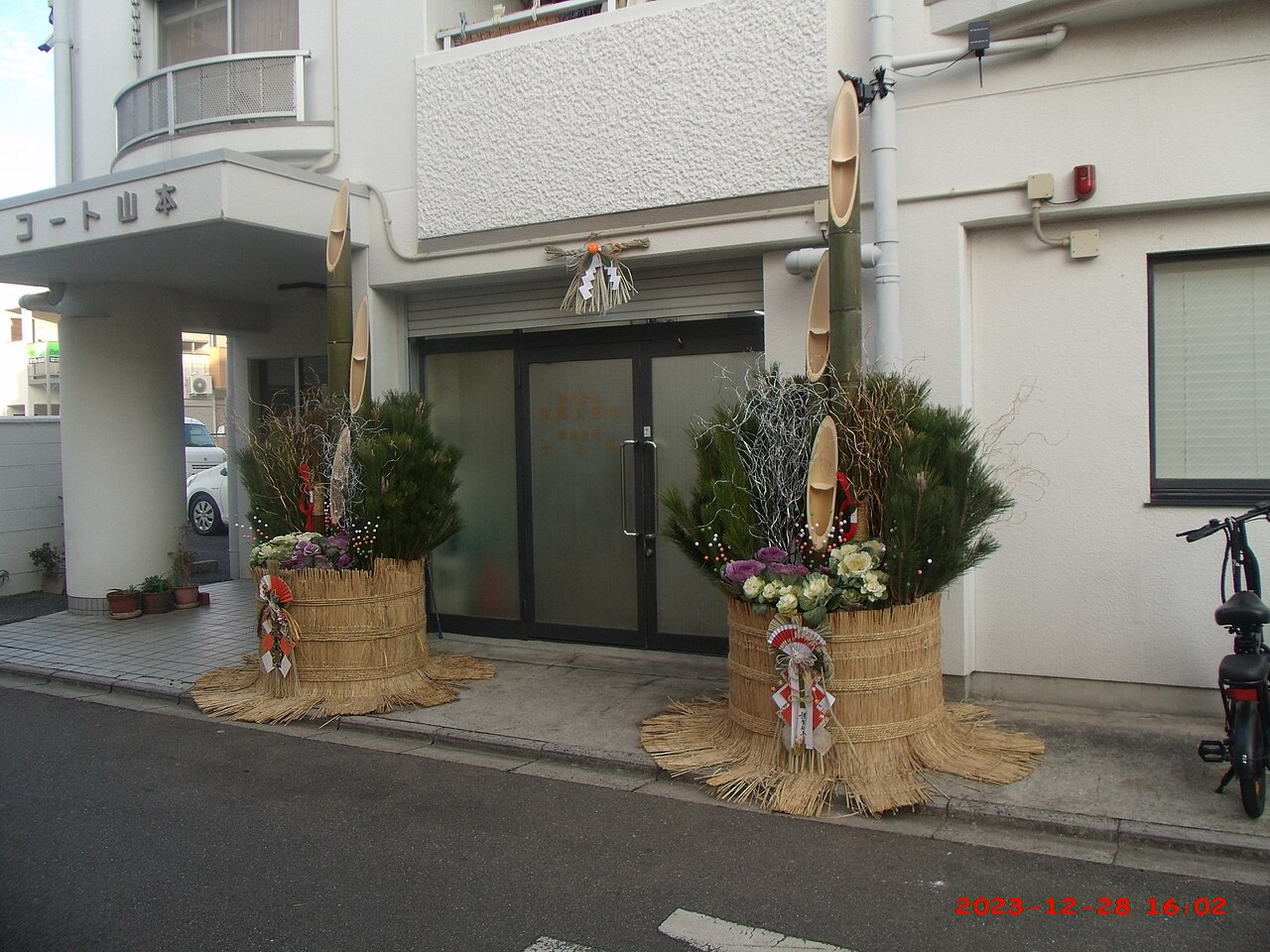
A pair of 門松 outside a building entrance, with a 注連縄 (shimenawa) hung above the doorway. Photo: Mr.ちゅらさん, CC0, via Wikimedia Commons.
Meaning
門松 (かどまつ, kadomatsu) is a traditional New Year decoration made of pine branches and cut bamboo stalks, set up in matched pairs on either side of a gate, doorway, or entrance. The name literally combines 門 (kado, "gate") and 松 (matsu, "pine"), describing exactly what it is: a pine tree at the gate.
Kadomatsu are not simply festive ornaments. In Shinto belief, they function as a 依り代 (yorishiro) — a physical object that a deity can temporarily inhabit or use as a landmark. Specifically, kadomatsu are placed to welcome 年神 (Toshigami, also written 歳神), the New Year deity who is said to descend from the mountains at 正月 (Shōgatsu, New Year) to bring a good harvest, health, and prosperity for the year ahead. Because ancient Japanese people believed that evergreen trees like pine housed the spirits of the gods, standing a pine tree at the entrance was a way of giving Toshigami a visible "sign post" to find the house and a place to rest during the visit.
A standard kadomatsu consists of three main elements:
| Element | Symbolism |
|---|---|
| 松 (matsu, pine) | Longevity and steadfastness — pine stays green through winter, symbolizing enduring life |
| 竹 (take, bamboo) | Strength, flexibility, and prosperity — bamboo grows straight and fast, bending in storms without breaking |
| 梅 (ume, plum) | Renewal and perseverance — plum blossoms bloom in the cold before spring, often added as a third accent |
Together, pine, bamboo, and plum form a set known as shōchikubai (松竹梅), a recurring trio of auspicious plants in Japanese art and design that also appears in wedding motifs and formal gift-ranking systems (where "pine," "bamboo," and "plum" grades roughly correspond to "top," "middle," and "basic").
Construction and Regional Styles
A typical kadomatsu bundles three (or sometimes five) 竹 stalks of different heights, cut on a diagonal, standing upright in the center, surrounded by pine branches, and bound at the base with woven straw (a technique related to the rope-braiding used for shimenawa). Decorative accents such as red-and-white ornamental cabbage, plum sprigs, or paper 縁起 (engi, "good luck") ornaments are often added.
The angle of the bamboo cut carries its own story. A diagonal cut is called sogi, while a flat, horizontal cut is called zundō. Popular legend credits the diagonal sogi cut to the warlord Tokugawa Ieyasu, who supposedly ordered bamboo sliced at an angle after his defeat at the Battle of Mikatagahara in 1573 as a symbolic vow to "cut down" his rival Takeda Shingen next time — the diagonal cut resembles a broad smiling mouth, which is why it is considered auspicious and is now by far the more common style.
Regional taste also varies. In the Kantō region (around Tokyo), kadomatsu tend to emphasize tall, straight bamboo stalks, sometimes with fairly minimal pine. In the Kansai region (around Osaka and Kyoto), the pine branches themselves are more prominent and lush, and a set of three bamboo stalks is often placed centrally with red-and-white ornamental cabbage at the front. Sizes range enormously — from small tabletop versions barely 25cm tall for apartment entrances, to towering multi-meter kadomatsu erected in pairs outside department stores, hotels, and shrine gates.
Usage
Kadomatsu are almost always displayed as a matched 対 (pair, ittsui), one on each side of an entrance, echoing the way shimenawa rope and 鏡餅 rice-cake offerings also frame or mark sacred or celebratory space during the New Year season.
玄関の両側に門松を飾りました。 Genkan no ryōgawa ni kadomatsu o kazarimashita. "We decorated both sides of the entrance with kadomatsu."
そろそろ門松を出す時期ですね。 Sorosoro kadomatsu o dasu jiki desu ne. "It's about time to put out the kadomatsu."
Businesses, hotels, government buildings, and shrines commonly display large, elaborate kadomatsu as a sign of hospitality and good fortune for visitors and customers in the coming year, while households may use modest tabletop versions or printed paper substitutes.
When Kadomatsu Go Up and Come Down
Kadomatsu are traditionally set up around December 13th, the day New Year preparations (正月事始め, shōgatsu kotohajime) traditionally began in the Edo period, though most households and businesses today put theirs up in the last week of December. Two dates are avoided out of superstition: December 29th, because the number nine (九, ku) sounds like "suffering" (苦, ku), and December 31st, because putting up a decoration the night before New Year's Day is considered ichiya-kazari ("one-night decoration") — rushed and disrespectful, resembling funeral preparations made in haste.
The display period is called 松の内 (Matsu no Uchi, literally "within the pine"), which historically ran until January 15th nationwide but today ends January 7th in the Kantō region and much of Japan, while Kansai and some other areas still observe it through January 15th. At the end of Matsu no Uchi, kadomatsu (along with shimenawa and other New Year decorations) are taken down and often brought to a shrine for a ritual bonfire called dondo-yaki (どんど焼き) or sagichō, usually held in mid-January. Burning the decorations is believed to send Toshigami back to the mountains and to bring good health to anyone who warms themselves at the fire or eats mochi roasted over it.
Cultural Context
The custom is thought to have roots in Heian-period (794–1185) court practices of decorating with pine at the New Year, with the paired bamboo-and-pine format most researchers associate with taking shape by the Muromachi period (14th–16th century). Some accounts trace an early precedent to Chinese New Year customs of the 7th century that reached Japan and were gradually adapted into a distinctly Japanese form centered on Shinto beliefs about trees as dwelling places for kami, rather than the Chinese originals.
Kadomatsu sits within a broader set of Shōgatsu customs that welcome the New Year and its deity: shimenawa ropes purify and mark off sacred space at entrances and shrines, 鏡餅 (kagami mochi) rice cakes serve as an offering and resting place for the deity indoors, and osechi-ryōri feasts are eaten to celebrate once the deity has been properly welcomed. Where shimenawa purifies and kagami mochi feeds and houses the kami indoors, kadomatsu's specific role is to act as a beacon at the threshold, guiding Toshigami in from outside. Many households today use simplified or artificial kadomatsu, and mass-produced designs are sold seasonally at supermarkets, garden centers, and flower shops, but the traditional handmade version — cut fresh from real bamboo and pine — remains prized, especially in front of shrines, hotels, and traditional restaurants, where elaborate kadomatsu are treated as both decoration and a display of the host's respect and hospitality for the year ahead.
Related Dictionary Words
New Year's pine decoration
pine tree (Pinus spp.)
bamboo (any grass of subfamily Bambusoideae)
Japanese apricot (Prunus mume); Japanese plum; ume; Chinese plum
New Year (esp. first three days)
kagami mochi; New Year offering consisting of two mochi stacked on each other with a bitter orange on top, cut and eaten on January 11
god; deity; divinity; spirit; kami
kami celebrated at the beginning of New Year (usu. to pray for a good harvest)
New Year's Eve
New Year's Week (festivities)
first shrine visit of the New Year
omen; sign of luck
evergreen tree; (an) evergreen
turning point; critical juncture
to go out to meet; to receive; to welcome; to greet; to salute; to hail
entrance; front door; entryway; entranceway; entry hall; vestibule; porch; foyer; mud room
versus; against; vs.; v.
decoration; ornament; trimmings