こたつ
kotatsuA traditional Japanese heated table with a heavy blanket draped over it — the ultimate symbol of cozy winter living in Japan.
Meaning
炬燵 (こたつ) is one of Japan's most beloved pieces of furniture: a low wooden table fitted with an electric heating element on its underside, covered by a thick 布団 (futon blanket) that traps the heat inside. You sit on the floor, slide your legs underneath the blanket, and are enveloped in a pocket of warmth while the rest of the room — typical of Japanese homes, which often lack 暖房 (central heating) — stays cold.
The word こたつ is written in kanji as 炬燵, though the hiragana spelling is far more common today. The term likely derives from 火達 (hi-tatsu, meaning "heat reaching") or from Chinese-influenced borrowing, though its exact etymology is debated.
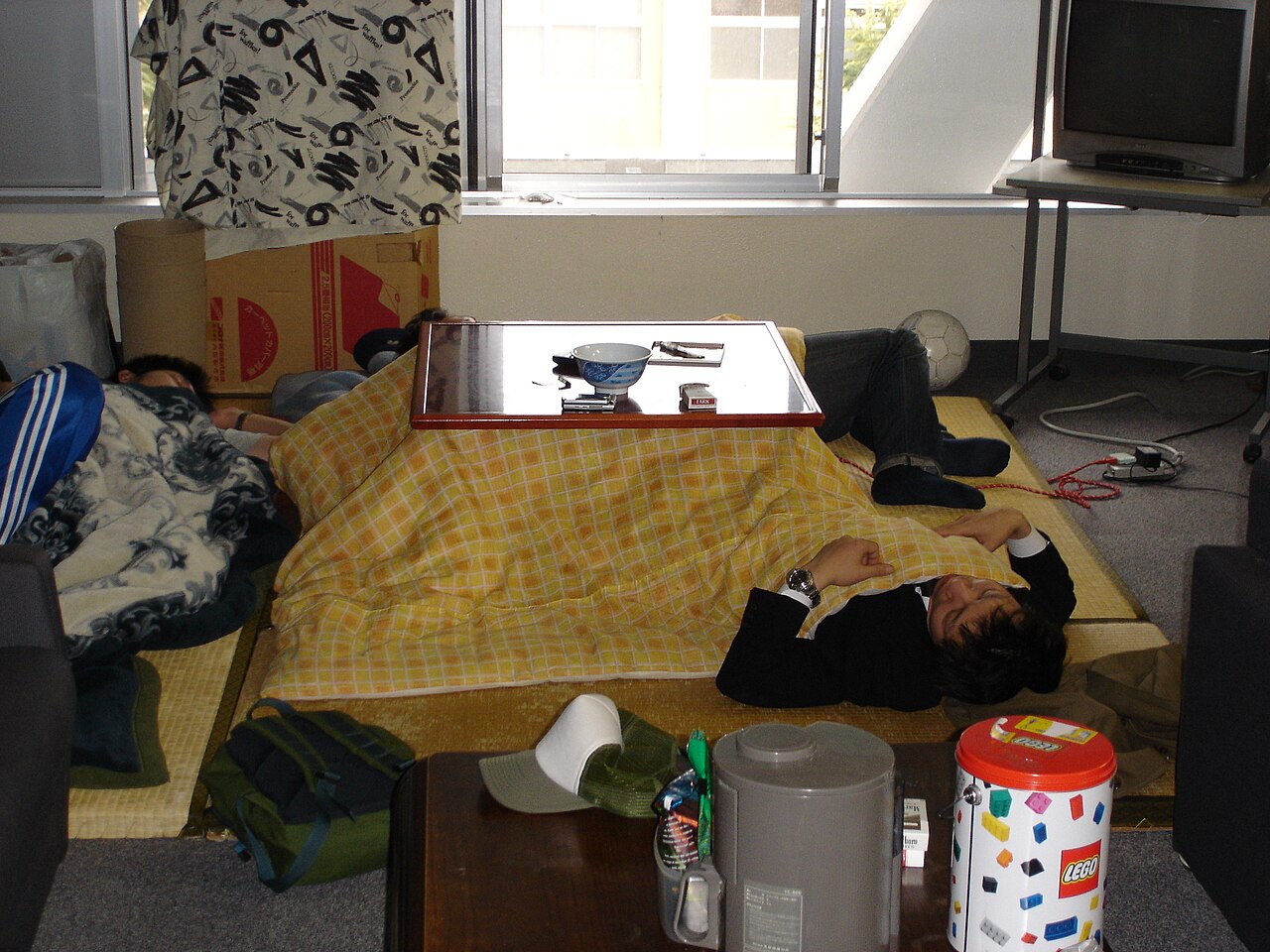
A contemporary kotatsu set up for winter use. Photo: hibino from Kanagawa, Japan, CC BY 2.0, via Wikimedia Commons.
History
The kotatsu evolved from the irori (囲炉裏) — the traditional sunken hearth at the center of Japanese homes that served as both cooking fire and heat source. During the Muromachi period (14th–16th century), people began placing a low frame over the irori and draping it with a blanket, creating the first hori-gotatsu (掘りごたつ), a recessed floor kotatsu.
The modern freestanding kotatsu (oki-gotatsu, 置きごたつ) using an electric heating element emerged in the 1950s during Japan's post-war economic recovery. Freed from the need for a fixed pit in the floor, these portable versions became standard in homes across the country and remain the most common type today.
Types
There are two main varieties:
| Type | Japanese | Description |
|---|---|---|
| Freestanding | 置きごたつ (oki-gotatsu) | A portable table with a detachable heater; the most common modern type |
| Recessed | 掘りごたつ (hori-gotatsu) | Built into a pit in the floor, allowing you to sit with legs dangling; common in traditional restaurants and older homes |
A full kotatsu set consists of three parts: the table frame (yagura, 矢倉), the inner blanket directly touching the heater, and the outer decorative kotatsu futon that drapes to the floor and traps the warmth.
Cultural Context
In 日本, where winters can be bitterly 寒い but homes are often poorly insulated — many traditional houses use single-pane windows and lack wall insulation — the kotatsu is a masterpiece of efficient, targeted heating. Rather than warming an entire 部屋, it creates a bubble of warmth exactly where the body needs it, using a fraction of the electricity that central heating would require.
The kotatsu is far more than a heating appliance; it is the gravitational center of Japanese home life in 冬. 家族 members 集まる around it to watch テレビ, share meals, do homework, and have conversations. The 居間 (living room) comes alive around the kotatsu in a way it rarely does in summer.
The classic kotatsu pairing is mikan (蜜柑 — Japanese mandarin oranges), piled in a bowl on top of the table. The combination is so iconic that it has become shorthand in art and advertising for the entire feeling of a Japanese winter: warm, lazy, content, and domestic. The 季節 of kotatsu is unmistakably winter.
The Kotatsu Trap
Japanese people joke about — and sincerely warn each other against — the kotatsu trap (こたつの罠). The phenomenon is simple: once you slide your legs under the 暖かい blanket, leaving feels almost physically impossible. The contrast between the pocket of heat around your legs and the cold air on your face and shoulders creates a kind of paralysis. Productivity evaporates. Hours pass.
This has inspired the affectionate term こたつむり (kotatsu-muri) — a portmanteau of こたつ and かたつむり (snail) — describing a person who has retreated into their kotatsu shell and refuses to come out. The image of a snail carrying its shell maps perfectly onto someone burrowed under the kotatsu futon, essentially carrying their warmth with them wherever they shuffle around the room.
こたつから出られない…もうこたつむりでいいや。 I can't get out of the kotatsu... I'll just be a kotatsu snail forever.
Social media sees a flood of こたつむり posts every winter, with people confessing their inability to 眠る anywhere other than half-under the kotatsu, or admitting they've cancelled plans because the table's gravity was simply too strong.
Kotatsu in Anime and Manga
The kotatsu is a near-universal visual shorthand in anime and manga for domestic comfort, winter, and family warmth. A character sitting alone at a kotatsu reads as lonely; a family crowded around one reads as cozy and connected. The image of a cat (neko, 猫) sleeping under a kotatsu is especially beloved — so much so that kotatsu-neko (こたつ猫) has become its own mini-genre of cute imagery.
Anime set during winter almost always include at least one kotatsu scene. The table serves as a meeting point for characters, a place where conversations happen naturally, and a visual cue that we are in the heart of the cold 季節.
Why Kotatsu Instead of Central Heating?
Japan's preference for kotatsu over central heating comes down to several factors:
- Architecture: Traditional Japanese homes use thin walls, sliding screens (shoji), and materials that prioritize air flow in humid summers over heat retention in winter. Heating an entire such home centrally is extremely expensive.
- Energy efficiency: A kotatsu uses roughly 50–100W of electricity — far less than air conditioning or floor heating for a whole room.
- Ritual and culture: The act of gathering around the kotatsu is itself valued. It keeps family members in the same space rather than retreating to individually heated rooms.
- Cost: Smaller, older Japanese homes and apartments often cannot easily retrofit central heating systems.
The kotatsu is thus both a practical solution and a cultural institution — an object that shapes how Japanese families spend their winters together.
Related Dictionary Words
kotatsu; table over an electric heater, with a hanging quilt to retain heat (orig. over a charcoal brazier in a floor well)
futon; Japanese bedding consisting of a mattress and a duvet
sunken hearth; sunken fireplace
(indoor) heating
mandarin (esp. the satsuma mandarin (Citrus unshiu)); mandarin orange; tangerine; clementine; satsuma
winter
family