琴
kotoA traditional 13-string Japanese zither plucked with fingerpicks, rooted in Heian-era court music and still central to Japan's classical and New Year's music traditions.
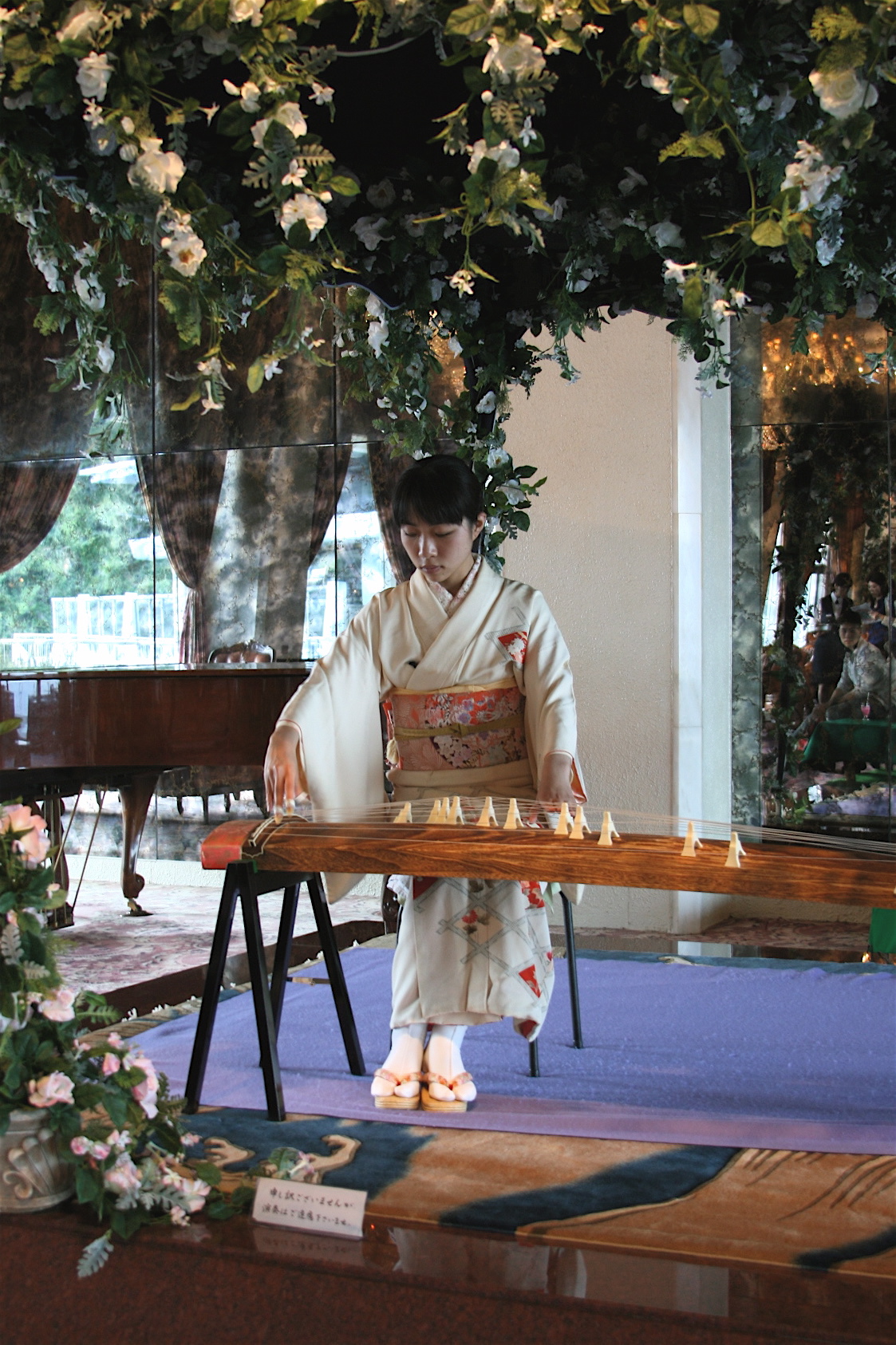
A koto player performing in formal kimono, showing the instrument's long soundboard, thirteen strings, and the ivory or plastic bridges (琴柱, kotoji) that set each string's pitch. Photo: Jim Epler, CC BY 2.0, via Wikimedia Commons.
Meaning
The 琴 (koto) is Japan's classical thirteen-string zither, and one of the most recognizable sounds in traditional Japanese music. It consists of a long, arched wooden body — traditionally paulownia (桐, kiri) — roughly 180 centimeters long, laid horizontally on the floor or on low stands. Thirteen silk or synthetic 弦 (strings) of equal thickness run its length, each supported by a small movable bridge called a 琴柱 (kotoji). Players tune the instrument by sliding these bridges, and pluck the strings with picks called 爪 (tsume) — ivory or plastic plectrums worn on the thumb, index, and middle fingers of the right hand, while the left hand presses or bends strings behind the bridges to alter pitch and add vibrato.
Because the koto has no frets and the bridges can be repositioned for each piece, a single instrument can be retuned into dozens of different scales, giving performers considerable expressive range within an otherwise fixed set of thirteen strings.
Usage
A koto player kneels in seiza beside the instrument, with the head (the wider, more ornately finished end) to their right. Pieces are read from cipher-style notation that marks which string to pluck and which picking technique to use, rather than staff notation. Common techniques include:
| Technique | Japanese | Description |
|---|---|---|
| Basic pluck | 弾く (hiku) | Standard right-hand pluck |
| Pitch bend | 押し手 (oshide) | Left hand presses a string to raise its pitch |
| Tremolo | 割り爪 (warizume) | Rapid alternating pluck for a shimmering effect |
| Glissando | 流し爪 (nagashizume) | Sweeping the picks across several strings |
琴を弾くのはとても難しいですが、美しい音色が魅力です。 Koto o hiku no wa totemo muzukashii desu ga, utsukushii neiro ga miryoku desu. "Playing the koto is very difficult, but its beautiful tone is captivating."
Solo koto music, along with pieces for koto in combination with 三味線 (shamisen) and 尺八 (shakuhachi) flute, is collectively known as 箏曲 (sōkyoku), "koto music" — the genre most people mean when they talk about "koto music" today, as distinct from the koto's older role inside court ensembles.
History
The koto's ancestry traces back to Chinese zithers — the guzheng (箏) and qin (琴) traditions — which entered Japan alongside other continental court instruments during the 7th and 8th centuries. It became a core voice of 雅楽 (gagaku), the ceremonial court music performed at the Heian-era (正月-era) imperial court, where it appears throughout The Tale of Genji as an accomplishment expected of refined aristocratic women.
For centuries the koto remained mostly a court and aristocratic instrument. That changed dramatically in the early Edo period, when the blind musician Yatsuhashi Kengyo (八橋検校, 1614–1685) developed a new tuning system and composition style that freed the koto from gagaku's formal constraints and established it as a solo and chamber instrument for a wider audience. His piece 六段の調 (Rokudan no Shirabe), "Music in Six Steps," remains one of the most performed works in the entire koto repertoire and is often considered the foundation of the modern 箏曲 tradition. Guild systems (like the iemoto system) organized koto teaching through the Edo period, and by the 20th century composer Miyagi Michio (宮城道雄, 1894–1956) — who also pioneered the 17-string bass koto — began blending koto music with Western harmony, most famously in his 1929 piece 春の海 (Haru no Umi), "The Sea in Spring," which is still broadcast across Japan every New Year's Day.
Cultural Context
The koto carries strong associations with refinement, femininity, and traditional elegance. Learning koto (along with 茶道, tea ceremony, and flower arranging) was long considered part of an accomplished young woman's education, and the instrument still appears as visual shorthand for cultivated, old-fashioned grace in film, television, and manga — a character seated at a koto signals refinement the same way a piano signals it in Western media.
Two pieces in particular carry outsized cultural weight:
- さくら さくら (Sakura Sakura) — a simple, pentatonic folk melody about cherry blossoms that is one of the first pieces koto students learn, and by far the most internationally recognizable koto tune. It's frequently used abroad (in film scores, anime, and games) as an instant musical signifier of "Japan," even though the melody itself is younger and simpler than most of the classical repertoire.
- 六段の調 (Rokudan no Shirabe) and 春の海 (Haru no Umi) — the two pieces most associated with formal and New Year's (正月) occasions; Haru no Umi in particular has become the unofficial sound of New Year's morning on Japanese radio and television.
The instrument also appears in 芸者 (geisha) performance contexts alongside shamisen and vocal music, and its stately, resonant tone made it a natural fit for 茶道-adjacent and other formal cultural settings where restraint and refinement (see wabi-sabi) are valued.
Contemporary Japan
Koto has not stayed frozen as a museum piece. Many Japanese middle and high schools run koto 部活 (bukatsu), after-school clubs where students learn the instrument as part of a broader push (backed by a 2002 education ministry curriculum requirement) to give students hands-on experience with a traditional Japanese instrument. Music schools and cultural centers across Japan continue to teach sōkyoku formally, and it remains a fixture at 初詣 (New Year's shrine visits) and other seasonal cultural events.
At the same time, a generation of contemporary players has pushed the koto into new territory. Groups like Rin' (koto, shakuhachi, and drums) and soloists mixing koto with electronic, jazz, and rock arrangements have built audiences well beyond traditional sōkyoku circles, and koto or koto-inspired timbres show up regularly in anime and video game soundtracks — used to signal a historical setting, a shrine or festival scene, or simply an unmistakably Japanese sonic palette. The instrument's distinctive plucked, bent-note sound has proven durable precisely because it can move between "ancient court music" and "modern film score" without losing its identity.
Related Instruments
| Instrument | Type | Relation to koto |
|---|---|---|
| 三味線 (shamisen) | 3-string plucked lute | Frequent duet partner in sōkyoku and geisha performance |
| 尺八 (shakuhachi) | Bamboo flute | Third voice in classic sankyoku (koto/shamisen/shakuhachi) trios |
| 太鼓 (taiko) | Drum | Shares roots in ensemble and festival music, though rarely played together |
| Guzheng (古筝) | Chinese zither | The koto's continental ancestor instrument |
Related Dictionary Words
koto (13-stringed Japanese zither)
bowstring
nail (e.g. fingernail, toenail); claw; talon; hoof
gagaku; ceremonial Japanese court music
koto music
shamisen; samisen; three-stringed Japanese lute
shakuhachi; end-blown fippleless bamboo flute
drum
New Year (esp. first three days)
tea ceremony; Way of Tea; sadō
geisha; professional female entertainer, usu. at traditional banquets