招き猫
maneki nekoThe iconic Japanese beckoning cat figurine believed to bring good luck, wealth, and customers to businesses — one of the most recognizable symbols of Japanese culture worldwide.
Meaning
招き猫 literally means "beckoning cat" — 招く (maneku, "to beckon" or "to invite") combined with 猫 (neko, "cat"). Despite being called a "waving" cat in many Western countries, the figurine is not actually waving goodbye. In Japanese custom, the gesture of holding a paw up with the palm facing outward and the fingers pointing downward is the traditional way to beckon someone toward you — so the cat is actively inviting good fortune in.
The maneki-neko is typically depicted as a sitting cat, often a Japanese Bobtail, with one paw raised. It frequently holds a gold coin called a koban (小判), an oval coin from the Edo period worth one ryō, adding to its association with 金運 (kin-un, financial luck).
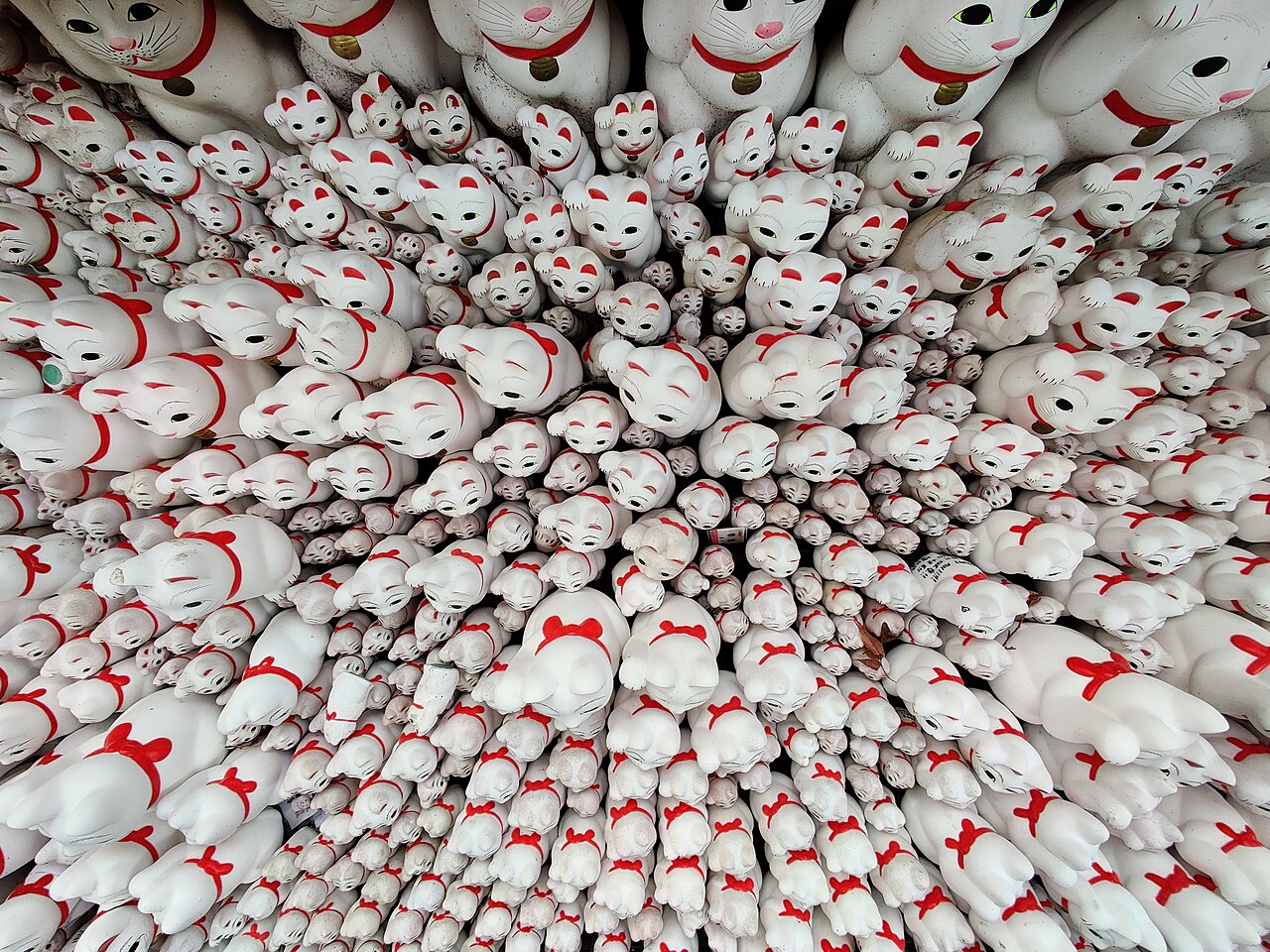
Maneki-neko votive offerings at Gotokuji Temple, Tokyo — one of the claimed birthplaces of the lucky cat tradition. Public domain, via Wikimedia Commons (Niwrat, CC0).
Cultural Context
The maneki-neko is believed to have originated during Japan's Edo period (1603–1868), though the exact origin remains debated. The earliest written records mentioning the figurine date to the late Edo period, around the 1850s, and they became mass-produced and widely popular during the Meiji era (1868–1912).
Several legends compete for the title of the maneki-neko's true origin. The most celebrated involves Gotokuji Temple (豪徳寺) in what is now Setagaya, Tokyo. According to the legend, a feudal lord named Ii Naotaka was caught in a sudden storm while returning from a falconry trip. He took shelter under a tree when he noticed a white cat at the temple gate, beckoning him inside. He followed, and moments later a bolt of lightning struck the very tree where he had been standing. Grateful to the cat for saving his life, Ii Naotaka became a great patron of the temple, and in honor of the cat, Gotokuji became famous for its maneki-neko. Today, visitors can leave small ceramic figurines as offerings — hundreds of them line the temple's ema (votive plaque) hall in a truly remarkable sight.
Another origin story centers on Imado Shrine (今戸神社) in Asakusa, Tokyo, which claims to be where the first maneki-neko figurines were crafted and sold in the early 19th century. The shrine is still associated with the lucky cat today.
Regardless of which legend is true, the figurine became a fixture of Japanese commercial life by the late 19th century, when it began to appear widely in shops and businesses.
Types and Symbolism
Modern maneki-neko come in a wide variety of colors, sizes, and styles, each carrying distinct meanings rooted in Japanese folk belief around 縁起 (engi, auspicious omens) and 幸運 (koun, good fortune):
Which paw is raised?
| Raised paw | Meaning |
|---|---|
| 右手 (right paw) | Invites wealth and financial luck (金運) |
| 左手 (left paw) | Invites customers and people |
| Both paws | Invites both — though some consider this unlucky (the cat cannot protect itself) |
The higher the raised paw, the greater the distance from which it is said to draw good fortune.
Color meanings
| Color | Japanese | Meaning |
|---|---|---|
| Calico (tricolor) | 三毛 (mike) | General good luck — the original and most traditional |
| White | 白 (shiro) | Purity, happiness, and positive energy |
| Gold | 金 (kin) | Wealth and prosperity |
| Black | 黒 (kuro) | Warding off evil spirits |
| Red | 赤 (aka) | Protection from illness and evil |
| Pink | 桃色 (momoiro) | Romance and love |
| Green | 緑 (midori) | Academic success and safety |
The calico pattern reflects Japan's traditional association between tricolor cats and good 福 (fuku, fortune). Calico cats — particularly the Japanese Bobtail breed — were historically considered very rare and lucky because calico males are extremely uncommon genetically.
Accessories and objects
Beyond color, maneki-neko may hold or wear various items:
- A koban coin (小判) — the most common accessory, symbolizing financial prosperity
- A red bib or collar (前掛け, maekake) — a tradition borrowed from Jizo statues, symbolizing protection
- A bell (鈴, suzu) — said to attract customers with its sound
- A fish, mallet, or jewel — additional symbols of abundance
Where to Find Them
Maneki-neko are ubiquitous across Japan and in Japanese communities worldwide. You'll spot them:
- At shop entrances — almost every restaurant, izakaya, convenience store, and small business in Japan keeps at least one near the register or entrance
- At Gotokuji Temple — the famous "cat temple" in Tokyo's Setagaya ward, where hundreds of white figurines are left as offerings
- At Imado Shrine in Asakusa, Tokyo — another major maneki-neko pilgrimage site
- In Tokoname, Aichi Prefecture — a ceramics town that has been a center of maneki-neko production since the Meiji era; the city even has a "Maneki-neko Street" (招き猫通り)
- At the Maneki Neko Museum in Tokoname, which houses over 2,000 figurines
Outside Japan, maneki-neko appear in Chinese restaurants, Asian grocery stores, and gift shops worldwide — often with a motorized arm that continuously waves. This electric version became widespread from the 1980s onward.
In Popular Culture
The maneki-neko has long transcended its role as a simple good luck charm and become a recognized symbol of Japan itself:
- Merchandise and fashion — maneki-neko imagery appears on everything from phone cases and tote bags to high-end ceramics and designer collaborations
- Anime and manga — the figurine makes cameo appearances in countless series, and characters like Meowth from Pokémon are directly inspired by the maneki-neko design
- Supercell's music — the song マニフィカ and various other pop works reference lucky cat imagery
- International recognition — the maneki-neko was featured in the 2020 Tokyo Olympics promotional materials as a symbol of Japanese hospitality and welcoming spirit
- The word itself in language — in Japanese internet culture, 招く (to beckon/invite) and the image of the raised paw are used as shorthand for welcoming or inviting someone
The figurine also plays a quiet role in Japanese 商売 (shōbai, business) culture: placing a maneki-neko in a shop is not merely superstition but a statement of intent — an outward expression of the desire for 繁盛 (hanjō, prosperity and thriving trade). The tradition reflects a broader Japanese tendency to embed meaning and aspiration into everyday objects, akin to values found in wabi-sabi and omamori culture.
お店の入り口には招き猫が置いてあります。 (Omise no iriguchi ni wa 招き猫 ga oite arimasu.) "There is a beckoning cat placed at the shop entrance."
右手を挙げた招き猫は金運を呼ぶと言われています。 (Migite wo ageta maneki-neko wa kin-un wo yobu to iwarete imasu.) "A beckoning cat with its right paw raised is said to invite financial luck."
Related Dictionary Words
beckoning cat; figure of a cat with one paw raised (usu. white porcelain)
cat (esp. the domestic cat, Felis catus); feline
to invite; to ask
omen; sign of luck
good luck; fortune
good fortune; happiness; blessing; good luck
economic fortune; luck with money
trade; business; commerce
prosperity; flourishing; thriving