漫才
manzaiA traditional Japanese stand-up comedy format performed by a duo — one playing the fool (boke) and the other the sharp-tongued straight man (tsukkomi) — rooted in Osaka's entertainment culture and supercharged by the annual M-1 Grand Prix.
Meaning
漫才 is Japan's most beloved form of comedy: a rapid-fire verbal performance by a two-person コンビ, one playing the role of the boke (ボケ, the fool or funny one) and the other the tsukkomi (ツッコミ, the straight man who reacts and corrects). The name itself — 漫 meaning "free" or "aimless," 才 meaning "wit" or "talent" — hints at its improvisational spirit.
A typical 漫才師 duo performs a ネタ (neta, a scripted routine) lasting four to five minutes, built entirely on the spoken word: puns, misunderstandings, wordplay, absurd logic, and the relentless clash between the boke's nonsense and the tsukkomi's exasperated correction. There are no props, no costumes, no elaborate staging — just two people and a microphone.
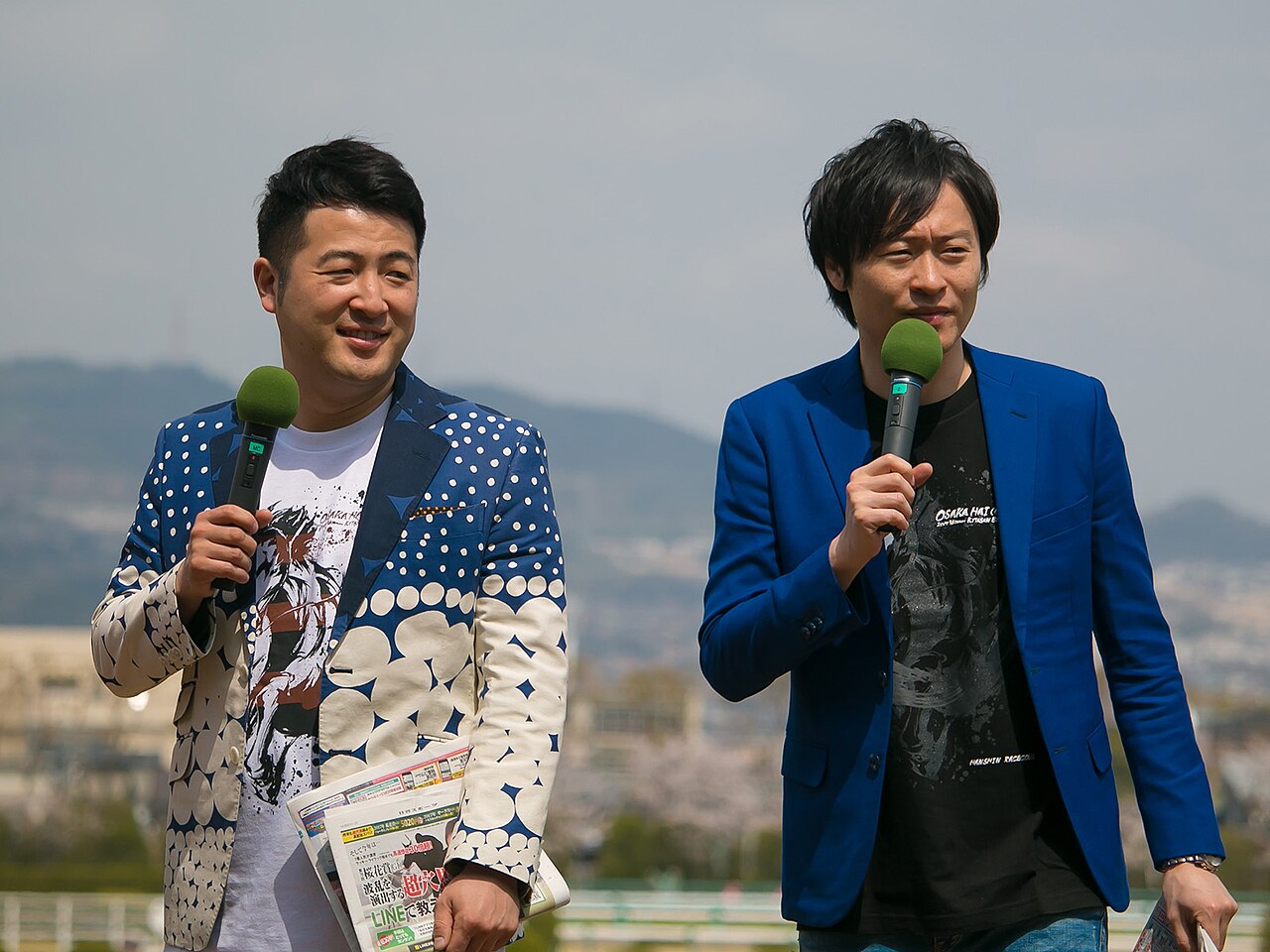
A manzai duo mid-routine on stage. Photo: Ogiyoshisan, CC BY-SA 4.0, via Wikimedia Commons.
The Boke and Tsukkomi Dynamic
The engine of every manzai act is the push-pull between two complementary roles:
| Role | Japanese | Meaning | Function |
|---|---|---|---|
| Boke | ボケ | fool, airhead | Says something wrong, absurd, or nonsensical |
| Tsukkomi | ツッコミ | 突っ込み | Calls it out, corrects, reacts with incredulity |
The word boke literally relates to mental fogginess (as in the age-related condition boke); the boke character is someone whose mind seems to operate on its own bizarre frequency. The tsukkomi is the audience's surrogate — the reasonable person trying to make sense of the chaos.
A simplified exchange:
ボケ:「昨日、ピアノを弾いたよ!」 ツッコミ:「え、ピアノ持ってないやろ?」 ボケ:「だから弾いて逃げた!」
Boke: "I played piano yesterday!" Tsukkomi: "You don't own a piano?" Boke: "That's why I played one and ran!"
The 笑い comes not just from the joke itself, but from the tsukkomi's reaction — the raised voice, the light slap to the boke's head (ハリセン, a paper fan slap, in older styles), the weary look of a person perpetually surrounded by idiots.
Good manzai is less about punchlines and more about rhythm. The call-and-response builds momentum, accelerating through the routine until the final twist lands. Experienced duos can read an audience and adjust tempo mid-performance.
Origins
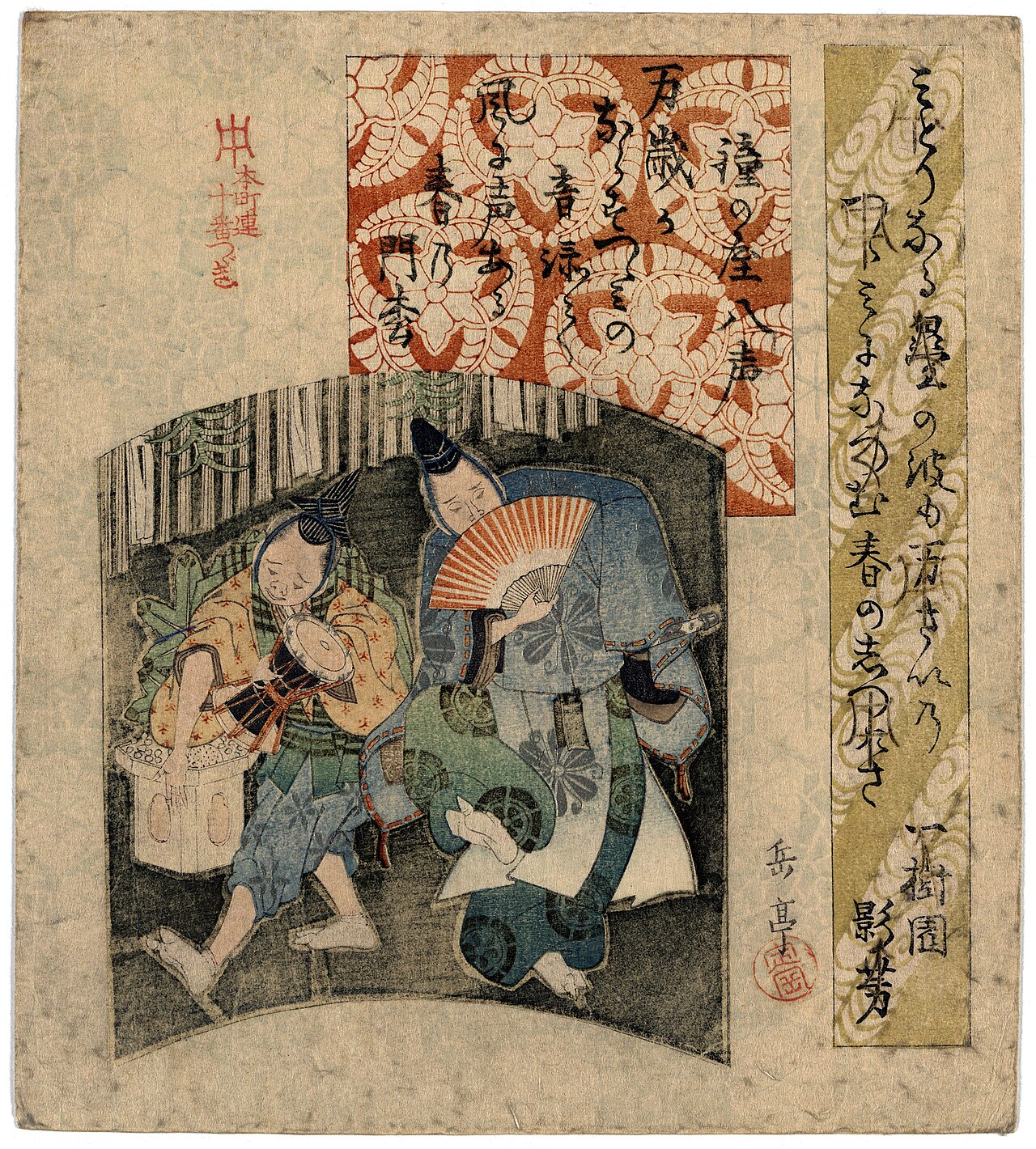
Manzai performers depicted in a woodblock print by Yashima Gakutei (early 19th century). Public domain, via Wikimedia Commons.
The roots of 漫才 reach back to the Heian period (794–1185), where itinerant performers called 萬歳 (manzai, written with different kanji meaning "ten thousand years") toured the country at New Year, performing blessings and comic routines in exchange for rice and coins. The name — invoking long life and prosperity — was an auspicious gift for the new year.
Through the Edo period, these performers evolved and regionalized. The Osaka style, which became the dominant modern form, shifted away from the blessing-ritual origins and toward pure comedy. By the Meiji and Taisho eras, manzai had absorbed influences from 落語 (rakugo, solo comic storytelling) and Western vaudeville, and was performed in yose theaters (寄席) alongside other variety acts.
The pivotal modern transformation came in 1933. Yoshimoto Kogyo (吉本興業), an Osaka entertainment conglomerate founded in 1912, officially coined the term 漫才 with its current kanji — 漫 and 才 — and introduced the Osaka style to Tokyo audiences. This standardized the form and gave it a new written identity distinct from its ceremonial ancestor.
Osaka: The Comedy Capital
Ask any Japanese person where the funniest people come from, and you'll hear one word: 大阪 (Osaka). This is not mere regional pride — it is institutional.
Osaka's 方言 — Kansai-ben (関西弁, 関西弁), the regional dialect of the Kansai area — is itself considered inherently funnier to Japanese ears than standard Tokyo Japanese. The dialect's rising intonation, distinctive vocabulary, and blunt directness lend themselves to comedy. Many manzai jokes land specifically because they use Kansai-ben; the same words in standard Japanese simply would not work.
The cultural value placed on being funny in Osaka is genuine and pervasive. In Tokyo, standing out is politely avoided; in Osaka, being boring is the embarrassment. Children are expected to be able to make people 笑い — laughter is a social currency. This environment produces comedians the way Okinawa produces musicians or Hokkaido produces dairy farmers.
At the center of it all is Yoshimoto Kogyo, the agency that manages the vast majority of Japan's biggest comedy acts. The company operates training schools (NSC, Namba Sento College), runs its own theaters (the Namba Grand Kagetsu in Osaka, the Lumine the Yoshimoto in Tokyo), and controls the careers of hundreds of 芸人 (entertainers). Signing with Yoshimoto is the conventional path for any aspiring 漫才師.
The M-1 Grand Prix
If Yoshimoto Kogyo is the house of manzai, the M-1 グランプリ is the Olympics.
Launched in 2001 by comedian Shinsuke Shimada, the M-1 Grand Prix is an annual national manzai competition open to duos who have been together for fewer than a set number of years (originally ten years; later expanded). The competition runs regional qualifying rounds that attract thousands of entries — over 6,000 duos in recent years — before culminating in a nationally televised final broadcast live from Osaka.
The format is brutal: four to five minutes, live, in front of a panel of judges and millions of viewers. Scores are tallied; the top performers advance to a final vote. Winning changes careers instantly — an unknown duo that takes the M-1 trophy becomes a household name by morning.
The show draws some of the highest ratings of any comedy broadcast in Japan. For the 芸能人 world (entertainment world, 芸能), the M-1 represents both peak achievement and enormous risk — duos have dissolved under the pressure of not performing to expectation on that stage.
The competition was suspended from 2010 to 2014 after its creator became embroiled in scandal, but returned in 2015 and has grown even larger since. It is now also streamed internationally via Netflix, introducing manzai to audiences outside Japan for the first time at scale.
Famous Duos
Some コンビ that shaped the form:
ダウンタウン (Downtown) — Hitoshi Matsumoto and Masatoshi Hamada, formed 1982 in Amagasaki. The most influential comedy duo of the modern era. Their style was deliberately un-manzai: slow, conversational, unsettling. Matsumoto's comedy veers into surrealism and cruelty; Hamada's tsukkomi is more irritable older brother than textbook straight man. They transcended the format and became synonymous with Japanese comedy itself, hosting the legendary prank show Gaki no Tsukai for decades.
ナインティナイン (Ninety-Nine) — Hiroyuki Yabe and Takashi Okamura, formed 1990. Osaka-born, Yoshimoto-trained, reliably entertaining. They represent the professional mainstream of manzai — technically precise, audience-friendly, long-running TV hosts.
サンドウィッチマン (Sandwichman) — Tomoya Ito and Fumiya Tomizawa, from Sendai (not Osaka — a notable exception). They won the M-1 in 2007 after a wildcard entry and became one of the most beloved duos in Japan, known for their warm, clean comedy and consistent appearances on variety television.
雨上がり決死隊 (Ameagari Kesshitai) — Miyasako Hiroyuki and Ryo (Tsuchida Teruyuki), formed 1989. Long-running veterans known for energetic, physical-adjacent manzai before transitioning to variety TV stardom.
Manzai vs. Related Forms
漫才 sits within a broader landscape of Japanese comedy (お笑い) that includes:
| Form | Description | Key Feature |
|---|---|---|
| 漫才 (manzai) | Two-person stand-up | Boke/tsukkomi verbal interplay |
| 落語 (rakugo) | Solo storytelling | One performer plays all characters |
| コント (conte) | Character-based sketch | Costumes, props, plays characters |
| 大喜利 (ogiri) | Panel improv game | Quick-fire creative responses to prompts |
The distinction between manzai and conte (コント, from the French conte) is important: in manzai, the performers appear as themselves — two people having a conversation. In conte, they become characters in a scenario (a doctor and patient, a teacher and student). Many duos perform both formats.
Rakugo is the elder sibling — solo, seated, austere, requiring a single performer to voice an entire cast using only posture and a folding fan. Manzai is rakugo's louder, more chaotic younger cousin.
Manzai in Anime and Pop Culture
Because the boke/tsukkomi structure is essentially a universal template for comedic character pairs, it has saturated anime and manga to the point of invisibility. Two characters who constantly argue, where one says foolish things and the other corrects them? That's manzai DNA.
Gintama is the clearest example — the show is explicitly structured around manzai routines, with characters breaking the fourth wall to complain that their scene partner is "doing manzai wrong." The whole series functions as a love letter to Osaka-style comedy.
Osomatsu-san, the sextuplet comedy anime, features characters explicitly assigned boke and tsukkomi roles within the sibling dynamic.
Beyond anime, the vocabulary has entered everyday Japanese. If someone says something idiotic in a group chat, a friend responding "そこ突っ込むところやろ!" ("That's exactly the part you're supposed to call out!") is applying tsukkomi logic to real life. The structure has become a cognitive frame for understanding comedy itself in Japan.
Why Manzai Doesn't Export Well
Manzai is one of the hardest Japanese art forms to translate — arguably harder than 落語, which at least has a strong analogous tradition (stand-up storytelling) in Western cultures.
The barriers:
Kansai-ben dependence: Many jokes hinge on Osaka dialect vocabulary or intonation patterns that vanish in translation. Even a Japanese speaker from Tokyo misses some of it.
Wordplay density: Manzai is saturated with 言葉遊び (kotoba asobi, wordplay) — puns, homophones, double meanings. Japanese's rich phonetic structure creates collision points that simply don't exist in most other languages.
Cultural knowledge: References to specific foods, TV shows, regional stereotypes, and social situations require an insider's fluency. A joke about a Tokyoite in Osaka lands because everyone knows the stereotype.
Rhythm over content: A skilled tsukkomi's timing — the fraction of a second between the boke's absurd statement and the exasperated correction — is where the laugh actually lives. That rhythm doesn't survive a subtitle delay.
Foreign audiences who encounter manzai through subtitled footage often remark that it "doesn't seem that funny." This is not a failure of the comedy — it is a demonstration of how deeply embedded it is in its own cultural and linguistic soil.
Legacy and Influence
漫才 has been the proving ground for generations of Japanese entertainers. Many major film directors, actors, and television hosts began as 漫才師 — Takeshi Kitano (Beat Takeshi) is the most internationally famous example, starting his career as one half of the manzai duo Two Beat.
The 才能 required for the form — quick thinking, precise timing, physical charisma, the ability to read thousands of people in real time — forges performers who tend to thrive in any medium they enter afterward.
For Japanese audiences, M-1 night in December has the energy of a sporting championship. People pick favorites, argue online, replay clips, and cite memorable routines years later. In a media landscape increasingly fragmented by streaming and social media, manzai remains one of the few things that can stop the country and make it laugh together.
Related Dictionary Words
manzai; comic dialogue; two-person comedy act, usu. presented as a fast-paced dialogue, occ. presented as a skit
rakugo; traditional Japanese comic storytelling; comic story (told by a professional storyteller)
thrust; charge; penetration
combination; pair; duo
Kansai dialect
comical (story, song); comic
(TV) comedian
word game; wordplay; playing with words
banzai; hurray; hurrah; hooray