たこ焼き
takoyakiOsaka's iconic street food — golden, crispy balls of dashi-flavored batter filled with octopus, topped with savory sauce, mayonnaise, dancing bonito flakes, and green aonori.
Meaning
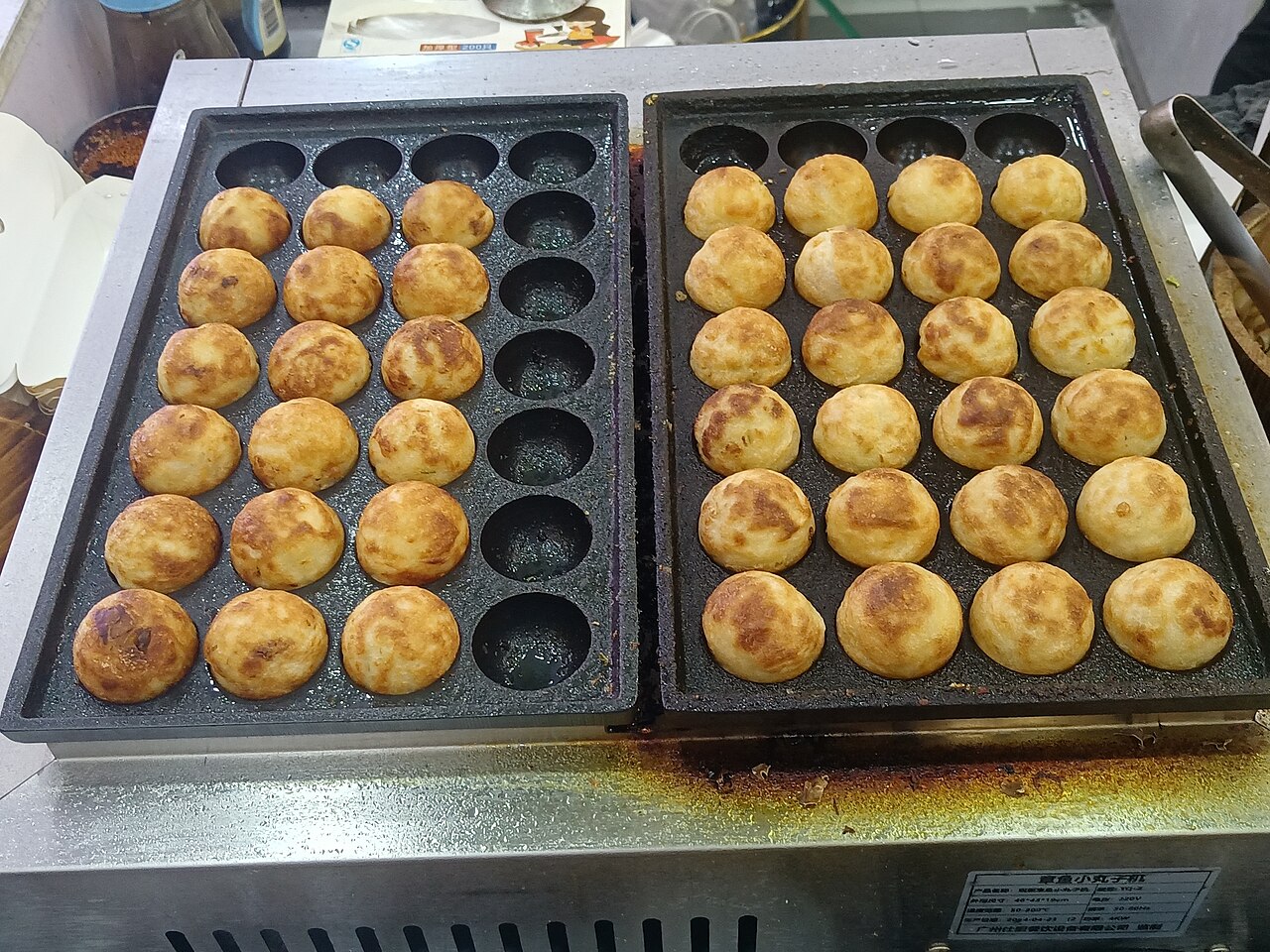
たこ焼き (takoyaki) literally means "grilled octopus" — tako (タコ, octopus) combined with yaki (焼き, grilled or cooked over heat). The dish consists of roughly golf-ball-sized spheres of 生地 (wheat-flour batter) enriched with 醤油, dashi (kombu-and-bonito stock), and grated mountain yam (yama-imo), enclosing a cube of octopus, tenkasu (天かす, crunchy tempura scraps), pickled red ginger (beni shoga), and green onion. They are cooked in a special hemispherical cast-iron pan, rotated expertly with metal picks until perfectly round and golden — crisp on the outside, molten and creamy within.
What Goes Into a Takoyaki
The batter is the heart of the dish. A good takoyaki 生地 uses a light wheat flour base dissolved in dashi stock — not water — giving every ball a deep, savory flavor before a single topping is added. 醤油 and eggs are whisked in for color and richness. Each mold receives a generous pour of batter, a chunk of boiled octopus, a pinch of 天かす, slivers of beni shoga, and sliced green onion, then another pour of batter to fill it to the brim.
Once cooked and plated, the finishing toppings are applied in layers:
| Topping | Japanese | Role |
|---|---|---|
| Takoyaki sauce | たこ焼きソース | Sweet, thick Worcestershire-style glaze |
| Kewpie マヨネーズ | マヨ | Creamy, tangy zigzag drizzle |
| 鰹節 | 鰹節 | Paper-thin bonito flakes that "dance" in the heat |
| Aonori | 青のり | Dried green seaweed powder |
The dramatic motion of 鰹節 waving in the steam rising from freshly sauced balls is one of the defining visual spectacles of Japanese street food.
Freshly made takoyaki topped with sauce, mayo, katsuobushi, and aonori. Public domain, via Wikimedia Commons.
Cultural Context
Birth in Osaka, 1933
たこ焼き was born in the Nishinari district of 大阪 in 1933. Tomekichi Endo, the founder of the street stall Aizuya, was inspired by an Akashi-style snack called akashiyaki — an earlier egg-heavy ball made with octopus — and by radioyaki, a precursor ball made with beef and konnyaku that was already popular on the streets. Endo combined the octopus filling with a dashi-forward batter and cooked them in the hemispherical iron pan that became the standard tool. The dish spread rapidly through the labyrinthine street-stall networks of 大阪.
By the post-war 1950s, American-influenced Worcestershire ソース arrived in Japan, and 大阪 vendors began drizzling it over their balls alongside bonito flakes and aonori. This completed the flavor profile that defines takoyaki today. The dish then expanded nationwide, carried by Osaka migrants and replicated by food entrepreneurs in every city.
The Craft of the Cast-Iron Pan
A takoyaki pan (takoyaki-ki, たこ焼き器) is a heavy 鉄板 (iron griddle) pocked with hemispherical molds, typically arranged in a grid of 16 to 32 cups. Cast iron is prized for its heat retention: the intense, even heat is what creates the thin, crackled crust while keeping the interior silky. Electric tabletop versions are now ubiquitous for home use.
The technique of rotating the balls (kaesu, 返す) is considered an art form. Vendors use two slender metal or bamboo picks to slide under each half-formed ball, flip it 90 degrees to tuck the raw batter inward, and continue rotating until a perfectly round sphere emerges. Skilled vendors at busy stalls — managing 32 balls simultaneously on a blazing griddle — rotate them with practiced, rhythmic speed, drawing crowds of spectators.
Konamon Culture and Osaka Identity
Takoyaki is the undisputed flagship of 粉もの (konamon bunka, lit. "flour things culture") — the uniquely Osakan love of wheat-flour dishes like お好み焼き (savory pancakes) and udon. 関西 residents take fierce pride in their konamon heritage, and takoyaki is its most recognizable symbol worldwide.
The statistic most often cited by Osaka food historians is that approximately 90% of Osaka households own a takoyaki pan — a figure that reflects just how deeply the dish is embedded in domestic life, not only street culture. Making takoyaki at home with family and friends is a distinct social tradition sometimes called a takoyaki party (takoyaki pati, たこ焼きパーティー), in which everyone gathers around a hot griddle, fills and rotates their own balls, and eats them straight from the pan.
Usage
Takoyaki appear in virtually every eating context in Japan:
道端で熱々のたこ焼きを食べた。 Michibata de atsuatsu no takoyaki o tabeta. "I ate piping-hot takoyaki on the side of the road."
お祭りの屋台にはいつもたこ焼きがある。 O-matsuri no yatai ni wa itsumo takoyaki ga aru. "There are always takoyaki stalls at festival food stalls."
たこ焼きパーティーしようよ! Takoyaki pati shiyou yo! "Let's have a takoyaki party!"
Where to Eat Takoyaki
Dotonbori, Osaka is the spiritual home of competitive takoyaki shops. The cramped canal-side street hosts legendary vendors including Wanaka, Kukuru, and Aizuya (the original 1933 shop, now a museum-restaurant). Long queues form daily; locals and tourists alike eat their order standing on the stone embankment.
縁日 (ennichi, festival market days) and summer matsuri (祭り) are where most Japanese children encounter takoyaki for the first time — bought from a 屋台 (yatai, food stall) and eaten from a small paper boat with a toothpick.
Konbini versions (convenience store takoyaki, sold refrigerated or freshly heated) are a nationwide constant. Major chains like 7-Eleven and Lawson sell millions of packs annually, though connoisseurs debate whether they can substitute for fresh-off-the-griddle versions.
Regional Variations
While the Osaka style is the national standard, regional variants exist:
- Akashi-yaki (明石焼き) — The Hyogo Prefecture predecessor that inspired Endo. Much softer, egg-rich balls with almost no crust, dipped in warm dashi broth rather than sauced. Considered more delicate in flavor.
- Ebiyaki (えびやき) — A Kyoto variant substituting shrimp (ebi) for octopus, sometimes found at temples and tourist markets.
- Cheesetako — A modern chain-restaurant adaptation with melted cheese layered inside, popularized in the 2000s.
- International variations — Outside Japan, takoyaki is popular across Southeast Asia (especially the Philippines, Thailand, and South Korea), where local adaptations swap octopus for squid, fish cake, or shrimp.
The Takoyaki Pan at Home
The tabletop electric takoyaki pan democratized the dish for domestic cooking from the 1980s onward. Today, affordable electric models are available everywhere from 100-yen shops to department stores. Making takoyaki at home is a true participatory food experience — the pan sits at the table, everyone takes a skewer, and the conversation flows as naturally as the batter.
Recipe essentials:
- 200g soft wheat flour (hakurikiko)
- 600ml dashi stock (kombu + 鰹節)
- 2 eggs
- 醤油 and a pinch of salt
- Fillings: boiled octopus, 天かす, beni shoga, green onion
- Toppings: takoyaki ソース, マヨネーズ, 鰹節, aonori
Legacy
Takoyaki has transcended its street-food origins to become one of the most globally recognizable symbols of Japanese cuisine and Osaka culture. It anchors the city's self-image as Japan's kuidaore no machi (食い倒れの街, "town of eating yourself bankrupt"), a place where food is identity, not just sustenance. The Dotonbori Kukuru Konamon Museum in Osaka dedicated an entire exhibit to the dish's history. International takoyaki chains have opened in Los Angeles, Sydney, Bangkok, and London.
For anyone visiting 大阪, eating fresh takoyaki — standing at a counter, burning your tongue on the molten interior, watching bonito flakes ripple in the steam — is considered not optional but obligatory.
Related Dictionary Words
takoyaki; octopus dumplings
okonomiyaki; savoury pancake fried on an iron griddle with vegetables, meat and/or seafood and topped with various sauces and condiments
food made from flour (esp. dishes like okonomiyaki and takoyaki)
cart (esp. a food cart); stall; stand
festival; feast; matsuri
katsuobushi; pieces of sliced dried bonito
Osaka (city, prefecture)
Kansai (region comprising Kyoto, Osaka, Kobe and surrounding prefectures)
tenkasu; crunchy bits of fried batter left after cooking tempura
temple festival; fair; fete day; day related to a particular deity and thought to bring divine blessing to those who celebrate it