お盆
obonA Buddhist festival held in mid-summer to honor deceased ancestors, when their spirits are believed to return home and families reunite for graveside visits, lantern rituals, and bon odori dancing.
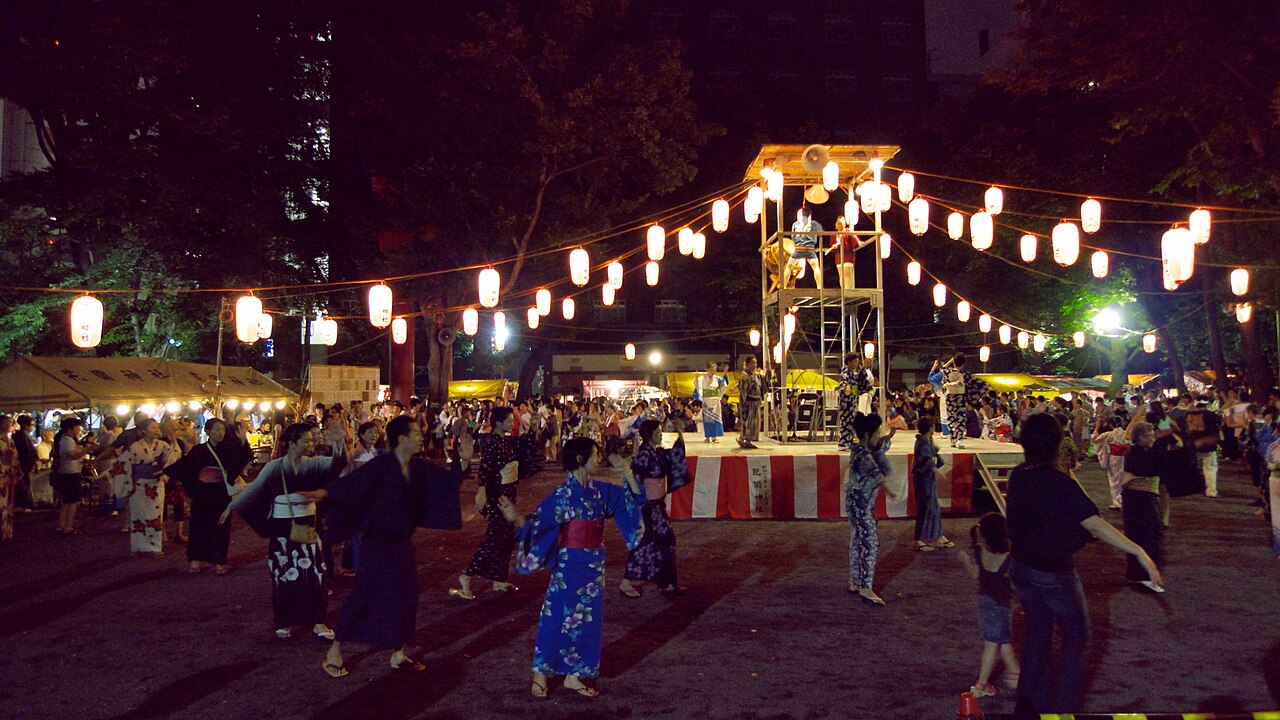
Yukata-clad dancers circle the yagura at a bon odori festival, Hanazono Shrine, Shinjuku, Tokyo. Public domain, via Wikimedia Commons.
Meaning
お盆 (obon), often just called 盆 (bon), is a Buddhist observance held in mid-summer during which the spirits of deceased ancestors are believed to return to the family home for a few days. It sits at the intersection of imported Buddhist doctrine and much older, native ancestor-worship practices, which is why it feels less like a solemn funeral rite and more like a warm, slightly bittersweet family reunion — equal parts remembrance, hometown visit, and neighborhood block party.
The word itself is a shortened form of Urabon'e (盂蘭盆会), the Japanese transliteration of the Sanskrit/Pali term Ullambana, roughly "hanging upside down," referring to the suffering of souls in the afterlife that the ritual is meant to relieve. The Ullambana Sutra tells of the monk Mokuren (Maudgalyayana), who used his supernatural powers to see that his deceased mother had been reborn into a realm of hungry ghosts. On the Buddha's instruction, he made offerings to the monastic community at the end of their summer retreat, which freed her from suffering — an act of filial piety that became the model for obon's family offerings and merit-making today.
Usage
Obon is a set of household rituals carried out over several days, built around the idea of welcoming ancestral spirits in and seeing them back off again.
- Mukaebi (迎え火) — a small "welcoming fire," traditionally made by burning hemp stalks (麻幹, ogara) in a dish at the entrance of the house, lit on the first evening of obon to guide ancestors' spirits home.
- Chochin (提灯) lanterns, often hung outside the house or placed at the household butsudan (Buddhist altar), serve the same guiding purpose and are especially associated with a family's first obon after a death (新盆, niibon).
- Ohaka mairi (お墓参り), visiting and cleaning the family grave, is the centerpiece of the holiday for most households — families travel, sometimes long distances, to tend graves together.
- Bon odori (盆踊り), community dancing performed around a raised wooden tower called a yagura, welcomes and entertains the visiting spirits. What began as a solemn dance has become a lively public festival, with taiko drumming, food stalls, and dancers in 浴衣 circling the yagura late into the night.
- Okuribi (送り火), the "sending-off fire," is lit on the final evening to guide spirits back to the afterworld. Kyoto's famous Gozan no Okuribi (the giant bonfires spelling out characters like 大 on the mountainsides surrounding the city) is the best-known example.
- Toro nagashi (灯籠流し), floating paper lanterns down a river or out to sea, is practiced in some regions as an alternative or companion to okuribi — a visually striking way of sending ancestors' spirits back on the water.
今年のお盆はいつ実家に帰る? When are you heading back to your hometown for obon this year?
お墓参りに行ってから、夜は盆踊りを見に行こう。 Let's visit the grave, then go watch the bon odori dancing tonight.
Regional Timing
Obon's date is the single most confusing thing about it for outsiders, because Japan actually observes it on two different sets of dates depending on region — a side effect of the country switching from the lunar to the Gregorian calendar in 1873.
| Name | Dates | Where observed |
|---|---|---|
| 七月盆 (Shichigatsu Bon) | July 13–16 | Tokyo, Yokohama, parts of Tohoku — areas that adopted the new Gregorian calendar's obon date directly |
| 八月盆 (Hachigatsu Bon) | August 13–16 | Most of Japan, including rural areas nationwide — the more common observance |
| 旧盆 (Kyu Bon) | Follows the old lunar calendar, varies year to year | Okinawa and parts of the Amami islands |
Hachigatsu Bon in mid-August is by far the most widely practiced version, since it approximates the original lunar-calendar date more closely than a literal July 15. Most people simply refer to "obon" as an August holiday, and it's Hachigatsu Bon that anchors Japan's national summer travel calendar.
Cultural Context
Obon has no fixed legal status as a national holiday — unlike New Year's, it isn't written into the law establishing public holidays — but in practice it functions as one of the country's three great travel seasons, alongside New Year's and Golden Week. Many companies close for a few days around mid-August (お盆休み, obon-yasumi), and the mid-August period sees some of the heaviest domestic travel congestion of the year, as tens of millions of people head back to their 実家 (jikka, parental home) or ancestral hometown — a phenomenon commonly called 帰省ラッシュ (kisei rasshu, the "homecoming rush"), mirrored by expressways and shinkansen stations packed well beyond capacity.
That travel pressure reflects what obon actually is at a social level: it's the one time of year when extended families reliably reassemble in one place. Grandparents, parents, and children gather at the family home or hometown; graves are cleaned as a group activity; and the neighborhood bon odori becomes a rare occasion where three generations dance the same steps together. In this sense obon functions much like a Japanese equivalent of Thanksgiving or a family reunion holiday — nominally religious in origin, but experienced by most modern households as a cultural occasion for reconnecting with family and place of origin as much as a Buddhist rite for the dead.
The festival also leaves a visible mark on summer culture more broadly: the bon odori's call-and-response folk songs (ondo), the sight of chochin-lit shrine grounds, and yukata-clad crowds are stock imagery of Japanese summer in film, anime, and photography, appearing well beyond households that actively practice the religious side of the holiday.
Related Observances
Obon shares its late-summer season with several related customs, some Buddhist and some purely secular:
- Kyoto's Gozan no Okuribi, the mountainside bonfires marking obon's end, draws large crowds every August 16th and is one of the most photographed okuribi rituals in the country.
- Hiroshima's toro nagashi, held on August 6th to coincide with the atomic bombing memorial rather than obon proper, shows how the lantern-floating custom has been adapted for civic remembrance beyond strictly ancestral contexts.
- Awa Odori in Tokushima, one of Japan's largest bon odori festivals, draws over a million visitors each August and has grown into a major tourism event distinct from its household-ritual origins.
Related Dictionary Words
Obon; Bon Festival; Buddhist festival for honouring the spirits of one's ancestors, held in mid-August or in some regions, mid-July
Bon Festival dance; Lantern Festival dance
paper lantern; Chinese lantern; Japanese lantern
floating lanterns or offerings for the spirits of the deceased
welcoming fire for returning spirits (on the first night of the Bon festival)
ceremonial bonfire (seeing off the spirits on the final night of Obon)
ancestor; forefather; foremother
Buddhism
Bon holidays (in mid-August); Bon holiday period
yukata; light cotton kimono worn in the summer or used as a bathrobe